

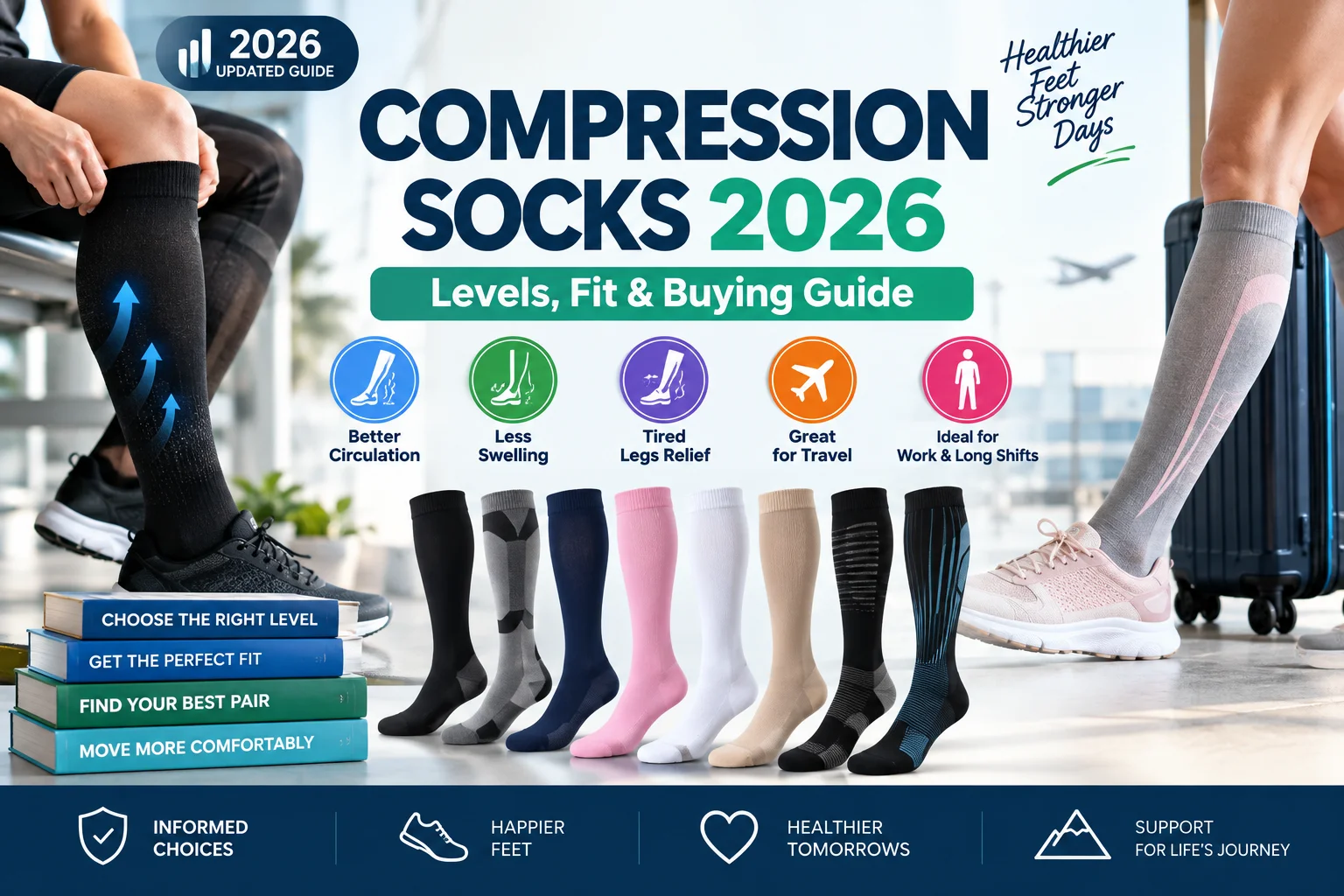
A good pair of compression socks should feel supportive, not punishing. Shopping gets confusing quickly: 15–20 mmHg or 20–30 mmHg? Knee-high or thigh-high? Open toe or closed toe? And does a traveler need the same sock as a nurse, runner, senior, or someone with swollen ankles?
The right choice depends on why you want compression, how your legs are shaped, and whether a medical condition changes the safety decision. This guide explains how graduated compression works, what common pressure levels mean, how to measure, which features matter, and when medical advice should come before buying.
Quick Answer: What Are Compression Socks Good For?
Compression socks are elastic garments that apply controlled pressure to the legs. Most everyday and medical styles use graduated compression, with the greatest pressure near the ankle and gradually less pressure higher up.
They may be useful for people who spend long periods sitting or standing, travelers, some pregnant people, and people with certain venous conditions or lower-leg swelling. Medical compression is also used for selected vascular and lymphatic problems.
They are not a cure-all. Compression does not automatically fix the cause of swelling, “poor circulation,” leg pain, or fatigue, and stronger compression is not always better.
How Do Compression Socks Work?

Veins in the legs return blood upward against gravity. Walking helps because the calf muscles act like a pump around the veins. During prolonged sitting or standing, that calf-muscle pump is less active and blood and fluid can accumulate in the lower legs.
Graduated compression applies external pressure to the tissues and veins. The pressure gradient can support venous return and help limit fluid buildup in appropriate users.
That is why compression stockings are commonly used for swollen ankles, tired or heavy legs, venous insufficiency, varicose veins, travel, and prolonged standing. But leg swelling has many possible causes. New or significant symptoms should not be treated as a simple sock-selection problem.
What does mmHg mean?
Compression strength is usually expressed in mmHg, or millimeters of mercury. It is a unit of pressure. A label showing 15–20 mmHg describes the intended pressure range, not the sock size.
Compression level and sizing are separate decisions. A 20–30 mmHg sock can still be wrong if the ankle, calf, foot, or leg length does not fit.
Compression Levels: 8–15, 15–20, 20–30 and 30–40 mmHg
Pressure categories vary slightly by brand and medical system, so check the product chart and follow clinical instructions when compression is used for a diagnosed condition. Cleveland Clinic describes common ranges as mild 8–15 mmHg, moderate 15–20 mmHg, firm 20–30 mmHg and extra-firm 30–40 mmHg.
| Compression level | General description | Common context |
|---|---|---|
| 8–15 mmHg | Mild | Light everyday support |
| 15–20 mmHg | Moderate | Travel, prolonged sitting or standing, mild support |
| 20–30 mmHg | Firm | More substantial compression; often used for swelling or venous problems when appropriate |
| 30–40 mmHg | Extra-firm / medical-strength | Usually selected with professional medical guidance |
Is 15–20 mmHg enough?
For many healthy adults seeking everyday support during travel, desk work, or long periods on their feet, 15–20 mmHg is a common over-the-counter range. It is not automatically right for everyone.
Persistent edema, a diagnosed venous condition, a history of blood clots, or post-procedure swelling should be managed according to professional guidance rather than by simply choosing a stronger sock.
Who should consider 20–30 mmHg?
A 20–30 mmHg garment provides firmer pressure and is common in medical or symptom-management settings. Suitability depends on arterial circulation, sensation, skin condition, diagnosis, and fit.
Do not choose it just because 15–20 mmHg sounds weak. Firmer compression is harder to put on and less forgiving of poor sizing.
Is 30–40 mmHg too strong?
For casual self-selection, it often is. Extra-firm compression is generally used for specific medical needs and should be chosen with professional guidance and accurate measurement.
Best Compression Socks by Use Case

There is no universal “best compression sock.” Start with what you actually need it to do.
| Product | Compression | Best For | Key Features | Main Limitation | Amazon |
|---|---|---|---|---|---|
| Comrad CloudCotton Compression Socks | 15–20 mmHg | Everyday wear, travel & long sitting/standing | Graduated compression, soft cotton/Tencel-style blend, wide-size options, knee-high fit | Premium price; not firm enough if someone specifically needs 20–30 mmHg | Check Price on Amazon |
| Physix Gear Compression Socks | 20–30 mmHg | Firmer compression, standing, travel & wide calves | Knee-high graduated compression, nylon/spandex, breathable construction, wider-calf friendly fit | Firmer pressure can be harder to put on and is not automatically better | Check Price on Amazon |
| VIM & VIGR Cotton Graduated Compression Socks | 15–20 mmHg | Wide calves & everyday support | Graduated compression, cotton blend, wide-calf sizes available | Limited cushioning | Check Price on Amazon |
| Sockwell Winterland Moderate Compression Socks | 15–20 mmHg | Walking, cooler weather & merino comfort | Merino blend, moisture management, knee-high graduated compression, lightweight feel | May feel warmer/thicker than lightweight synthetics | Check Price on Amazon |
| Wellow Wide Calf Compression Socks | 18–25 mmHg | Plus-size/wide-calf users | Wide-calf sizing, soft bamboo-derived blend, seamless heel/toe, moderate-to-firm support | 18–25 mmHg is less standard than the usual 15–20 or 20–30 ranges | Check Price on Amazon |
Standing all day or working long shifts
Nurses, teachers, retail workers, hospitality staff, and others who spend hours upright often prioritize knee-high graduated compression, breathability, a secure top band, and enough toe room for work shoes.
For work, comfort matters as much as pressure. A sock that rolls, overheats, digs behind the knee, or crowds the toes is unlikely to be worn consistently.
Sitting at a desk
Office workers may prefer moderate compression that fits under normal clothing and stays smooth at the ankle. Compression should not replace movement; short walking breaks and ankle movement still activate the calf-muscle pump.
Travel and long flights
Long-distance travel means prolonged sitting and limited leg movement. The CDC recommends moving the legs frequently and walking periodically; travelers with additional blood-clot risk factors should ask a healthcare professional whether graduated compression stockings are appropriate.
Choose travel socks you can put on before swelling develops and wear comfortably with your shoes. Do not buy an aggressively tight pair immediately before a long flight without checking the fit.
Swelling, edema and swollen ankles
Compression can help manage some forms of lower-leg edema, but swelling is a symptom, not a diagnosis. New, severe, painful, rapidly worsening, or one-sided swelling needs medical evaluation.
If compression has been recommended for recurring swelling, ankle and calf measurements matter. Simply sizing up for more room can change how the intended pressure is delivered.
Varicose veins and venous insufficiency
Compression can reduce symptoms for some people with venous disease, but it does not repair faulty vein valves. Current vascular guidelines use compression as a conservative option in selected patients while recommending venous intervention over long-term stockings for some people who are suitable for procedures.
Pregnancy
Foot and ankle swelling is common during pregnancy, and a healthcare professional may suggest supportive or compression stockings. Sudden painful swelling, especially on one side, should be evaluated promptly rather than treated with socks.
Walking and running
Athletic compression socks may feel supportive, but they should not be sold as guaranteed performance enhancers. Recent systematic reviews have not found convincing evidence that compression socks improve running time or endurance versus regular socks.
For walking or running, prioritize fit, moisture management, shoe compatibility, and blister prevention. Thick cushioning can require more shoe volume than a thin synthetic blend.
Knee-High, Thigh-High or Ankle Compression?

Knee-high compression socks are practical for many work, travel, and lower-leg uses. They cover the ankle and calf while being easier to manage than longer garments.
Thigh-high compression stockings may be used when compression is needed above the knee. They require careful sizing because a poor top-band fit can slip, roll, or irritate skin.
Ankle compression socks or sleeves may feel supportive around the foot and ankle but are not equivalent to full graduated knee-high stockings when controlled pressure through the calf is the goal.
Choose length for the intended purpose, not just appearance.
Open Toe vs. Closed Toe
Closed-toe socks resemble conventional socks and suit many work, travel, and everyday shoes.
Open-toe stockings leave the toes exposed. Some users prefer them for toe sensitivity, warmer weather, easier toe inspection, or certain footwear. Open toe does not automatically mean less compression.
With either style, the forefoot should not crowd the toes or cause rubbing, tingling, or numbness.
How to Measure for Compression Socks
A reliable size chart may ask for more than shoe size. For knee-high garments, ankle circumference and calf circumference can matter more than shoe size because they determine how the sock fits the main compression zones.
Measure when swelling is minimal, often earlier in the day if your legs tend to swell. Medical guidance similarly recommends accurate measurement and fitting rather than choosing compression stockings by appearance or shoe size alone.
- Measure around the narrowest part of the ankle, above the ankle bone.
- Measure the widest part of the calf.
- Measure lower-leg length if the brand requests it.
- Check shoe size or foot length when included.
- Match every measurement to the same manufacturer’s chart.
Do not automatically size up because compression feels snug. A larger size may become loose at the ankle while remaining too long. Wide-calf, petite, tall, or plus-size ranges are better when standard proportions do not match your leg.
Why length matters
A knee-high sock that is too long can bunch behind the knee or be folded over, creating concentrated pressure. The top should generally finish below the knee crease. If you repeatedly need to fold the cuff, the length or size is likely wrong.
How Tight Should Compression Socks Be?
They should feel snug and supportive, with the greatest pressure usually near the ankle. They should not feel like a tourniquet.
A good fit lies smooth against the skin without deep folds, painful pressure points, or a rolled top band. Rolling and bunching can focus pressure into a narrow area.
Remove the garment and seek medical advice if you develop concerning pain, new numbness or tingling, marked color changes, skin damage, a cold foot, or worsening swelling. Those findings can signal poor fit or a problem that needs assessment.
Wide Calves, Petite Legs and Plus-Size Fit
Wide-calf users often make one mistake: buying a larger shoe-size sock instead of a garment designed for a larger calf circumference. That may leave the foot loose while the cuff still feels restrictive.
Look for size charts that separate ankle and calf measurements. A true wide-calf range should add calf room without making the ankle excessively loose.
Petite users can have the opposite problem: the circumference fits, but the garment is too long and bunches below the knee. A short-length option works better than folding a standard sock.
Labels such as “women’s,” “men’s,” or “plus size” are less useful than actual measurements. Women and men should buy by the chart rather than assume a gender label guarantees fit. Seniors should also consider hand strength and mobility; a correctly sized lower-compression option or donning aid may be easier to manage when appropriate.
What Material Is Best?
Most compression socks use elastic synthetics such as nylon, polyester, spandex or elastane because the garment must stretch and recover repeatedly.
Nylon or polyester blends can be thin, durable, and moisture-managing. Merino wool blends add warmth and softness but may take more shoe space. Cotton blends feel familiar but can retain more moisture than some technical fabrics. Bamboo-derived viscose or rayon blends can feel soft; treat broad antimicrobial or medical-benefit claims cautiously.
Also check seams, reinforced heels and toes, moisture handling, and cushioning. For all-day wear, construction can matter as much as fiber type.
Compression Socks Buying Checklist
Before buying, check:
- Purpose: work, travel, sport, pregnancy, swelling, or clinician-directed use.
- Compression: choose for the need, not the highest number.
- Sizing: prefer ankle and calf measurements over shoe size alone.
- Length: avoid excess fabric behind the knee.
- Calf range: use wide-calf or petite sizing when measurements require it.
- Material: balance breathability, warmth, moisture control, and shoe space.
- Toe style: choose open or closed toe for comfort and footwear.
- Ease of use: firmer socks may require more hand strength or a donning aid.
- Seams and cushioning: check areas likely to rub.
- Care: the garment must retain its elasticity.
Comfort does not mean “loose.” It comes from an appropriate compression level, correct size, and shape that matches your leg.
How to Put Compression Socks On
Compression garments are often easiest to apply before the legs have accumulated much swelling.
- Start with dry skin.
- Reach inside and hold the heel.
- Turn the sock inside out to the heel.
- Insert the foot and position the heel correctly.
- Ease the material over the ankle.
- Smooth it gradually up the calf.
- Remove wrinkles rather than pulling hard from the top.
Do not twist the fabric or fold the top band. Rubber gloves can improve grip, while stocking donners can help people with limited hand strength, mobility, or firmer compression.
When and How Long Should You Wear Them?
For many daytime uses, compression socks are put on in the morning and removed later in the day. The correct schedule depends on why they are being worn.
If compression was prescribed after surgery or for venous disease, lymphedema, or another condition, follow the clinical schedule. Do not replace it with generic internet advice.
For self-selected work or travel use, the sock should remain comfortable and properly positioned. Pain, numbness, color changes, skin injury, or worsening symptoms are reasons to stop and reassess.
Can you sleep in compression socks?
Routine overnight wear is not needed for most people using standard daytime compression. Medical guidance commonly advises removing stockings at night unless a clinician has given different instructions.
Hospital anti-embolism stockings are a separate category and may follow a different schedule.
Who Should Not Self-Select Compression?
Compression needs extra caution when arterial blood flow is reduced or when a person cannot reliably feel excessive pressure.
Ask a healthcare professional before using compression if you have known or suspected peripheral artery disease (PAD), significant circulation problems, severe peripheral neuropathy or reduced sensation, active wounds, fragile or infected skin, major unexplained swelling, or certain forms of heart failure. An international consensus statement identifies severe peripheral arterial disease as a contraindication to sustained medical compression stockings and recommends arterial assessment when circulation is in question.
Diabetes alone does not mean every person must avoid compression. However, diabetes can coexist with neuropathy, PAD, wounds, and reduced sensation, which can change the decision and require closer skin and fit monitoring.
Seek prompt medical care for sudden one-sided leg swelling, warmth, redness, tenderness, chest pain, shortness of breath, or other symptoms that could indicate a blood clot or another urgent problem. Do not use compression to delay evaluation.
Compression Socks vs. Diabetic Socks
These products have different purposes.
Compression socks intentionally apply pressure to the leg. Diabetic socks are generally designed around non-binding cuffs, reduced friction, moisture management, cushioning, and protection of sensitive feet rather than measured graduated pressure.
A person with diabetes may sometimes be advised to use medical compression, but diabetic socks and compression stockings are not automatic substitutes. With neuropathy, PAD, ulcers, wounds, or reduced sensation, professional guidance is particularly important.
Washing and Replacement
Follow the manufacturer’s label because fabrics vary. Medical guidance commonly recommends gentle washing and air drying away from direct heat, which can damage elastic fibers.
Two pairs make rotation easier. Regular washing also helps frequently worn garments return toward their intended shape.
Medical compression stockings are often replaced every three to six months, depending on the product, wear, care, and clinical instructions. Replace them earlier if they are damaged, permanently stretched, repeatedly slide down, or no longer feel evenly supportive.
Common Fit Problems
Rolling down: The calf may be too wide, the sock too long, or the top band a poor match. Do not fold it into a tighter band.
Bunching at the ankle: The sock may be too long, poorly applied, or loose in part of the leg. Smooth wrinkles immediately.
Cramped toes: Check foot length, toe design, and shoe space. Thick compression socks can make fitted shoes too tight.
Very difficult to put on: Firm compression is harder to apply, but the size may also be wrong. A donning aid can help.
Pain or deep marks: Stop and reassess. Persistent pain, numbness, color change, skin injury, or worsening swelling needs medical advice.
Frequently Asked Questions
1. What are the best compression socks?
The best pair matches your purpose, appropriate pressure, ankle and calf measurements, leg length, footwear, and comfort needs. No single sock is best for everyone.
2. Do compression socks really work?
Graduated compression has established uses for supporting venous circulation and managing certain forms of swelling. Results depend on the condition, pressure, fit, and how consistently the garment is used.
3. Are compression socks good for circulation?
They can support venous return. But “circulation” also includes arteries, and people with impaired arterial blood flow may need assessment before compression.
4. Can I wear compression socks every day?
Many people do, especially when they have been prescribed. Daily use is reasonable only when the pressure is appropriate, fit remains comfortable, and the skin is healthy.
5. Are compression socks good for standing all day?
They may help some people with lower-leg heaviness or swelling during long standing shifts. Supportive shoes, movement, and proper sizing still matter.
6. Do compression socks help swollen feet and ankles?
They can help some types of swelling. New, severe, painful, rapidly worsening, or one-sided swelling should be evaluated rather than self-treated.
7. Knee-high or thigh-high: which is better?
Neither is automatically better. Knee-highs suit many lower-leg uses; thigh-highs are appropriate when compression is needed above the knee or specifically recommended.
8. Can people with neuropathy wear compression socks?
Reduced sensation changes the safety decision because excessive pressure or skin injury may be harder to feel. Significant neuropathy warrants professional guidance.
9. How often should compression socks be washed?
Follow the label. Many medical-care resources recommend frequent or daily washing for regularly worn garments, using gentle methods and air drying away from direct heat.
10. How often should compression socks be replaced?
For regularly used medical stockings, three to six months is a common interval, though product instructions and wear vary. Replace them sooner if elasticity or fit deteriorates.
Final Takeaway
Choosing compression socks is a two-part decision: select an appropriate compression level for the reason you want them, then choose a size and shape that fit your leg. Do not rely on shoe size alone when ankle, calf, and leg-length measurements are available.
For healthy adults shopping for work or travel support, comfort, accurate sizing, and practical features may matter more than chasing the strongest mmHg number. For persistent swelling, venous disease, diabetes with neuropathy, PAD, wounds, major circulation problems, or higher medical-grade compression, professional guidance should come first.
Medical information notice: This article provides general educational information and is not a substitute for individualized medical advice. If you have a diagnosed circulation condition, significant or unexplained swelling, reduced sensation, wounds, or another medical concern, ask a qualified healthcare professional what type of compression, if any, is appropriate for you.
Sources & Medical References
- Cleveland Clinic — What You Need To Know About Compression Socks, updated July 2026.
- MedlinePlus — Compression Stockings and Pressure Stockings, reviewed/updated through 2026.
- Centers for Disease Control and Prevention — guidance on travel-associated blood clots and graduated compression stockings.
- Society for Vascular Surgery, American Venous Forum and American Vein and Lymphatic Society — clinical practice guidelines for varicose veins.
- Rabe et al. — international consensus statement on risks and contraindications of medical compression treatment.
- Mayo Clinic — guidance on pregnancy-related ankle swelling and edema.
- Telles et al. — systematic review and meta-analysis of compression socks during running.
- Guy’s and St Thomas’ NHS Foundation Trust and NHS Inform — compression-stocking application, care and replacement guidance.

1 thought on “Compression Socks 2026: Levels, Fit & Buying Guide”