

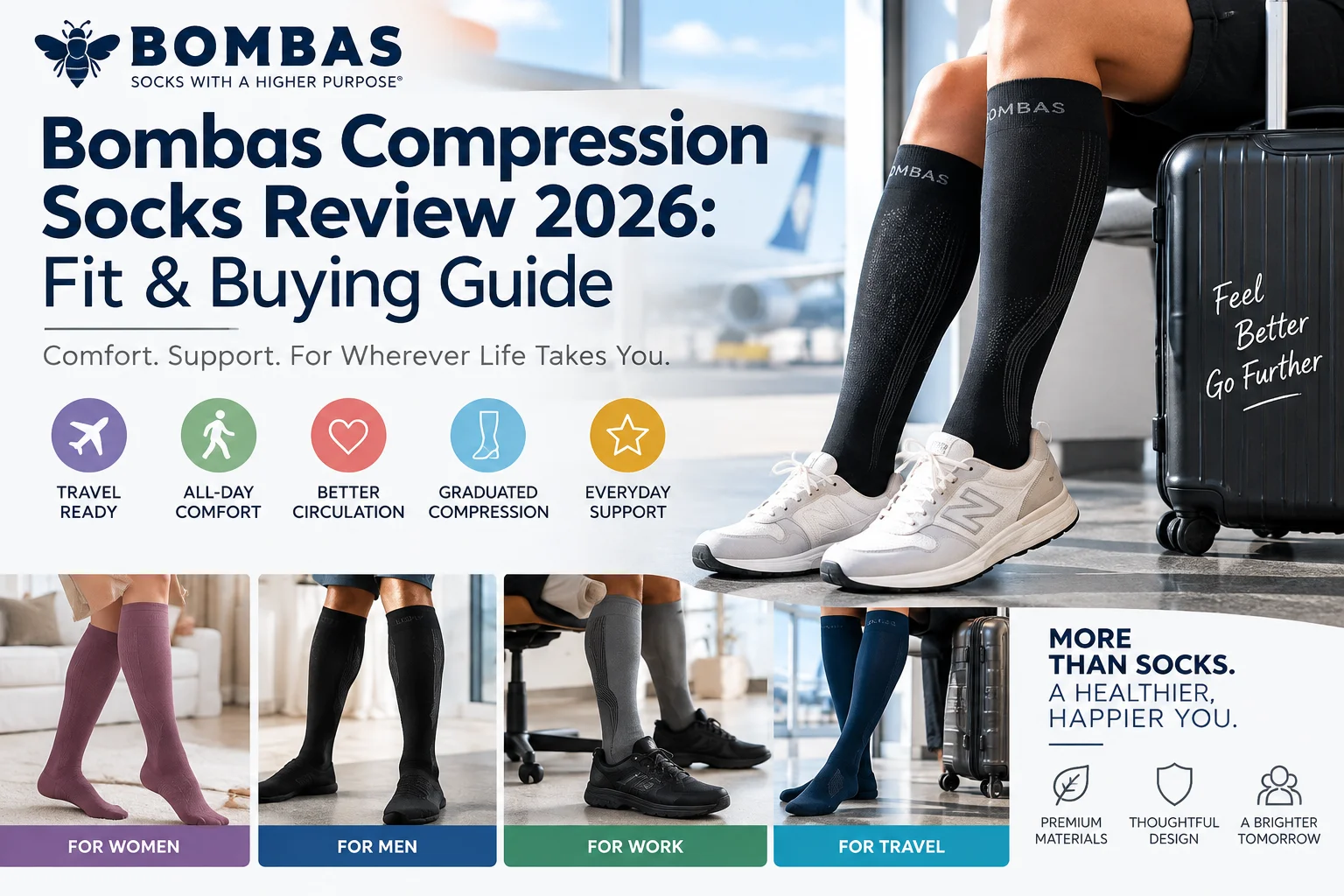
Bombas compression socks appeal to people who want support for travel or long workdays and to buyers looking for firmer compression for swelling, recovery, or a medical reason. Those groups should not automatically choose the same pair.
The main decision is the compression level, length, fabric, and fit for your actual use. Bombas currently sells 15–20 mmHg options for everyday wear and travel, plus firmer 20–30 mmHg Sport and Medical Grade styles. This guide explains the differences, sizing issues, useful use cases, limitations, and safety points that matter before buying.
Editorial note: This is an evidence-based product analysis, not a claim of hands-on testing. Product details were checked against current manufacturer information in September 2026.
Quick Answer: Are Bombas Compression Socks Good?
Bombas is a strong option for buyers who want cushioned, everyday-looking compression socks rather than thin clinical-style hosiery. The Everyday Compression Knee High uses 15–20 mmHg compression and a midweight cotton blend. The Travel Knee High is also 15–20 mmHg but is lighter and uses merino-wool and cotton yarns. Bombas also sells 20–30 mmHg Sport and Medical Grade knee-high styles.
Stronger compression is not automatically better. Cleveland Clinic describes 15–20 mmHg as moderate and 20–30 mmHg as firm; medical use should be guided by the condition being treated and an appropriate healthcare professional when needed.
| Bombas style | Compression | Best starting use case | Main trade-off |
|---|---|---|---|
| Everyday Compression Knee High | 15–20 mmHg | Work, standing, desk days | Midweight feel can be bulky in tight shoes |
| Travel Compression Knee High | 15–20 mmHg | Flights and long travel | Costs more than Everyday |
| Medical Grade Knee High | 20–30 mmHg | Firmer support when appropriate | More difficult to put on |
| Sport Compression Knee High | 20–30 mmHg | Training or recovery | May be more compression than casual users need |
| Sport Compression Calf Sleeve | 20–30 mmHg | Calf-focused athletic support | Does not compress the foot |
Bombas Compression Socks: What Is Available in 2026?
Bombas now separates compression by activity and pressure level rather than selling only one general compression sock. Its current collection includes Everyday, Travel, Sport, and firmer wellness-oriented options.
Everyday Compression Socks: 15–20 mmHg
The Everyday Compression Knee High is the broadest general-use model. Bombas lists it as 15–20 mmHg, midweight, and made with a soft cotton blend plus heel-to-toe cushioning. A single pair was listed at $30 when checked in September 2026.
This model is relevant to nurses, teachers, office workers, retail staff, and people who spend long periods sitting or standing. Its sock-like cushioning is a comfort advantage, but it also takes up more room inside shoes. If footwear already fits tightly, the combination can crowd the toes.
Travel Compression Socks: 15–20 mmHg
Bombas Travel Compression Knee High Socks also provide 15–20 mmHg compression, but use a lightweight construction with merino-wool and cotton yarns. Bombas markets the knit as easier to put on, and the pair was listed at $35 when checked.
That lighter design may be useful on long trips, but compression socks should not replace movement. The CDC recommends walking periodically and moving the calf muscles during long-distance travel; travelers with additional blood-clot risk factors should ask a healthcare professional whether compression stockings are appropriate.
Strong, Sport and Medical Grade Compression: 20–30 mmHg
People searching for “Bombas strong compression socks” are generally looking for the firmer 20–30 mmHg range. Bombas currently sells Sport Compression Knee High Socks and Medical Grade Compression Knee High Socks at that pressure. Both were listed at $40 per pair when checked.
“Medical Grade” is Bombas’s product label, not a personal prescription. If you have significant swelling, vascular disease, neuropathy, wounds, or another circulation-related condition, the correct pressure and garment should be chosen according to your medical situation.
Bombas 15–20 vs 20–30 mmHg: Which Level Makes Sense?
Compression is measured in millimeters of mercury. Graduated compression is strongest near the ankle and decreases up the leg, helping support venous return rather than applying identical pressure everywhere.
For general wellness, work, travel, or long periods of sitting or standing, 15–20 mmHg is the more approachable Bombas category when compression is otherwise appropriate. It is still real compression and should feel noticeably snug.
The 20–30 mmHg range is firmer. It can be harder to put on and remove and is used in more specialized situations. A person who simply wants comfortable work socks should not move to 20–30 mmHg just because stronger sounds more effective.
Keep four rules in mind:
- Choose compression based on why you need it, not how much pressure you can tolerate.
- Treat fit and mmHg as separate decisions. The right pressure in the wrong size is still a poor fit.
- For a diagnosed medical condition, follow professional guidance on pressure and garment style.
- Remove the sock and reassess if you develop pain, numbness, tingling, skin discoloration, skin injury, or worsening swelling.
Bombas Compression Socks for Work, Travel, Swelling and Exercise
Standing All Day: Nurses, Teachers and Other Workers
The 15–20 mmHg Everyday Knee High is the most logical Bombas option for general work use. Bombas specifically positions its Everyday compression range for long shifts and days spent on the feet. Its cushioned midweight construction may appeal to nurses, teachers, hospitality workers, warehouse staff, and others who spend hours on their feet.
Profession alone does not determine compression strength. A healthy teacher looking for general leg support may have different needs from a nurse with diagnosed venous disease. Also check shoe volume: even a correctly sized sock can become uncomfortable if extra cushioning makes the shoe too tight.
Flying and Long Travel
The Travel Knee High is the most travel-specific Bombas choice. The CDC notes that trips longer than four hours can increase blood-clot risk, though absolute risk is small for most people. Walking, stretching, and calf movement remain important.
Travelers with a previous clot, recent surgery, pregnancy, active cancer, limited mobility, or other major risk factors should discuss prevention with a clinician rather than relying only on over-the-counter socks.
Swollen Feet, Ankles and Tired Legs
Graduated compression can help reduce fluid pooling and swelling in some situations. Cleveland Clinic explains that compression can help improve blood return and limit fluid buildup in the lower legs. It should not, however, be used to self-diagnose unexplained swelling.
Persistent or severe swelling deserves evaluation, and sudden one-sided swelling with pain, warmth, or redness can be a warning sign of a blood clot. For ordinary end-of-day heaviness related to prolonged standing or sitting, a properly fitted compression sock may be useful when there are no contraindications.
Pregnancy
Pregnancy can be associated with swelling and is also a blood-clot risk factor. ACOG says below-knee compression stockings may help some pregnant travelers, but recommends discussing them with a healthcare professional because they are not right for everyone.
Pregnancy alone therefore does not tell you whether 15–20 or 20–30 mmHg is appropriate.
Walking, Running and Recovery
For walking and routine activity, the 15–20 mmHg Everyday style may provide enough support for people who do not need firmer compression. Bombas Sport knee-highs and calf sleeves use 20–30 mmHg with lighter, sweat-wicking nylon-blend construction.
A calf sleeve is not equivalent to a full knee-high sock. It leaves the foot uncovered, so it may suit certain athletic uses but is a different choice for someone concerned about ankle or foot swelling.
Bombas Compression Socks Sizing: Shoe Size Is Only Part of the Fit
Current Bombas compression product pages prominently organize sizing by shoe size. Women’s Everyday Knee High sizes are S for U.S. women’s 4–7½, M for 8–10½, and L for 11–13. Men’s sizes are M for U.S. 6–9, L for 9½–13, and XL for 13½–16.
For knee-high compression, however, leg shape matters too. Calf circumference, ankle circumference, and lower-leg length affect how the sock distributes pressure. Medical guidance also emphasizes correct measurement and fit when compression is being used therapeutically.
Someone can have the correct foot size but still find the calf too tight or the sock too long.
What a Good Fit Should Feel Like
A well-fitted compression sock should feel snug and supportive without sharp pressure, numbness, or pinching. The heel should sit in the heel pocket, the toe box should not crush the toes, and the top band should lie flat.
Common fit problems include:
- Rolling at the top: the sock may be too long, too tight at the calf, or folded over.
- Bunching behind the knee: often points to excess length or poor positioning.
- Painful deep marks: may indicate too much localized pressure.
- Slipping: may indicate the size or leg shape is mismatched.
- Toe crowding: may come from sock thickness, the shoe, or both.
- Numbness, tingling or color change: remove the sock and seek guidance if symptoms persist.
Are Bombas Compression Socks Good for Wide Calves?
Buyers should be careful here. Bombas does sell products labeled Wide Calf Socks, but the current wide-calf products surfaced on its U.S. site are regular socks, not clearly labeled graduated-compression socks with an mmHg rating.
Do not assume a Bombas wide-calf casual sock provides the same pressure as its 15–20 or 20–30 mmHg compression line.
If you have a larger calf circumference and standard Bombas compression sizing feels restrictive, a brand that publishes calf measurements or offers dedicated wide-calf compression sizes may be easier to fit. Comrad, for example, currently publishes calf-circumference ranges and wide sizes for several knee-high styles.
Materials, Thickness and Comfort
Bombas changes fabrics by use case. Everyday socks use a midweight cotton blend. Travel socks combine merino-wool and cotton yarns. Bombas describes its Wellness/Medical Grade range as a sweat-wicking cotton-poly blend, while Sport compression uses a lighter nylon blend.
Each choice has a trade-off. Cotton blends feel familiar and cushioned but can occupy more shoe space. Merino-containing socks may be appealing for temperature changes during travel. Nylon-heavy performance socks generally emphasize stretch, durability, and moisture management.
Independent testing provides useful context without implying that USAShocks performed its own test. In a 2026 review, NBC Select described Bombas Everyday Compression Socks as soft, cushioned, easy to put on, and thicker than some alternatives. That is appealing for comfort-focused buyers but less ideal for someone who wants the thinnest possible compression sock.
How to Put On Bombas Compression Socks
Compression socks are usually easiest to apply before the legs become swollen. MedlinePlus recommends putting compression stockings on early in the morning and keeping the fabric smooth rather than bunched.
- Start with dry skin.
- Turn the sock partly inside out to the heel.
- Place the toes and heel correctly first.
- Ease the fabric upward gradually instead of pulling hard on the top band.
- Smooth wrinkles from the ankle upward.
- Never fold the top band over to shorten a knee-high sock.
20–30 mmHg styles generally require more hand strength and technique. If dexterity or mobility is limited, a stocking donner or a different garment design may be more practical. MedlinePlus specifically notes that donning aids can help people who struggle to pull compression stockings on.
For washing, follow the care label for the exact Bombas style. Replace compression socks when they become stretched, damaged, or no longer provide consistent support.
Bombas Compression Socks Pros and Cons
Strengths
- Clear 15–20 and 20–30 mmHg options.
- Separate Everyday, Travel, Sport, and Medical Grade lines.
- Cotton-blend, merino-containing, and nylon-blend choices.
- Cushioned, conventional sock feel in the Everyday line.
- Bombas currently offers 30-day refunds, with exchanges, replacements, or store credit available afterward under its Happiness Guarantee terms.
- Each purchase supports Bombas’s donation program.
Limitations
- Core knee-high styles currently cost about $30–$40 per pair.
- Shoe-size-led sizing gives less calf information than brands that publish circumference ranges.
- Bombas wide-calf casual socks should not be confused with rated compression socks.
- Midweight cushioning can make close-fitting shoes tighter.
- 20–30 mmHg options can be harder to put on and are not automatically appropriate for everyday use.
Bombas vs Comrad vs Sockwell
Bombas is a good fit for buyers who prioritize cushioning and distinct Everyday and Travel choices.
Comrad may be easier to size for larger calves because it publishes calf-circumference ranges and dedicated wide sizes. Its current knee-high sizing includes multiple standard and wide-calf options.
Sockwell is worth comparing if you prefer merino-wool/bamboo-rayon blends and want both 15–20 and 20–30 mmHg graduated-compression choices.
Do not choose solely by brand reputation. Compare the mmHg rating, calf fit, sock length, material, thickness, and intended use. For a diagnosed vascular or swelling problem, clinical fit and pressure guidance should come before brand preference.
Who Should Use Extra Caution With Compression Socks?
Compression socks are safe for many people, but some situations need professional guidance. Cleveland Clinic advises against compression stockings over open wounds or skin infections and recommends medical input for severe or unexplained swelling, peripheral artery disease, or severely reduced sensation from conditions such as peripheral neuropathy.
People with diabetes should not assume diabetic socks and compression socks are interchangeable. Diabetic socks are generally designed to minimize restrictive pressure, friction, and irritation; compression socks intentionally apply pressure. If diabetes is accompanied by neuropathy, reduced circulation, wounds, or major swelling, ask a qualified healthcare professional what type of sock is appropriate.
Seek urgent medical care for symptoms that could indicate a blood clot or pulmonary embolism, including sudden unexplained leg swelling with pain or warmth, chest pain, sudden shortness of breath, coughing up blood, or fainting.
Are Bombas Compression Socks Worth It?
Bombas makes the most sense for buyers who value comfort-focused construction and want an everyday sock feel with a stated graduated-compression level. Everyday 15–20 mmHg is the broadest general-use model, while Travel offers a lighter merino-containing design. The 20–30 mmHg Sport and Medical Grade lines are firmer and more specialized.
Fit is the deciding factor. If Bombas sizing works for your foot and calf shape, its cushioning, multiple compression levels, and return policy can support the premium price. If you need explicit wide-calf measurements, a very thin sock, a different fiber blend, or a clinically fitted garment, another option may suit you better.
Frequently Asked Questions
Are Bombas compression socks 15–20 mmHg?
Many are. Everyday Compression Knee High and Travel Compression Knee High socks are currently 15–20 mmHg. Bombas also sells 20–30 mmHg Sport and Medical Grade styles.
Does Bombas make 20–30 mmHg compression socks?
Yes. Current listings include 20–30 mmHg Sport Compression Knee High Socks, calf sleeves, and Medical Grade Compression Knee High Socks.
Can you wear Bombas compression socks all day?
Many people wear properly fitted compression socks during daytime hours. How long you should wear them depends on your reason for using them and your health status. Cleveland Clinic generally recommends putting them on in the morning and removing them before bed unless your clinician instructs otherwise.
Are Bombas compression socks good for flying?
Bombas makes a 15–20 mmHg Travel Knee High specifically for travel. Compression should complement movement, not replace it. Higher-risk travelers should ask a clinician whether compression is appropriate.
Are Bombas compression socks good for nurses and teachers?
The Everyday 15–20 mmHg style is designed for long shifts and days on the feet, so it may suit workers seeking general support. A job title alone does not determine the right pressure.
Are Bombas compression socks good for swollen ankles?
They may help with some types of swelling, but the cause matters. Persistent, severe, sudden, or one-sided swelling should be evaluated rather than treated only by changing socks.
Do Bombas compression socks run small?
They are supposed to fit more closely than regular socks. Use the current size chart and judge the heel position, calf pressure, length, toe room, and any painful constriction rather than deciding by tightness alone.
Are Bombas compression socks hard to put on?
They can be, especially 20–30 mmHg styles. Applying them in the morning, setting the heel first, and smoothing fabric upward usually helps. A donning aid may help people with limited hand strength.
Are Bombas compression socks worth the price?
They may be worth it if you value cushioning, use-specific designs, Bombas’s return policy, and its donation model. If you need dedicated wide-calf compression sizing, very thin fabric, or a lower price, compare alternatives.
Medical information notice: This article provides general educational and product-selection information and is not a substitute for individualized medical advice. If you have significant swelling, peripheral artery disease, diabetes with reduced sensation, wounds, a history of blood clots, or another circulation-related condition, ask a qualified healthcare professional what type and strength of compression, if any, is appropriate for you.
Sources & Medical References
Bombas — Compression Socks collection and current product specifications. Bombas Compression Socks
Bombas — Happiness Guarantee and Return Policy. Bombas Refund Policy
Cleveland Clinic — current guidance on compression levels, fit, safety and contraindications. Cleveland Clinic: Compression Socks
CDC — long-distance travel, DVT risk and graduated compression stockings. CDC: Blood Clots and Travel
MedlinePlus — compression stocking fit, donning and care guidance. MedlinePlus: Compression Stockings
American College of Obstetricians and Gynecologists — DVT prevention and pregnancy/travel considerations. ACOG: Preventing Deep Vein Thrombosis

1 thought on “Bombas Compression Socks Review 2026: Fit & Buying Guide”