

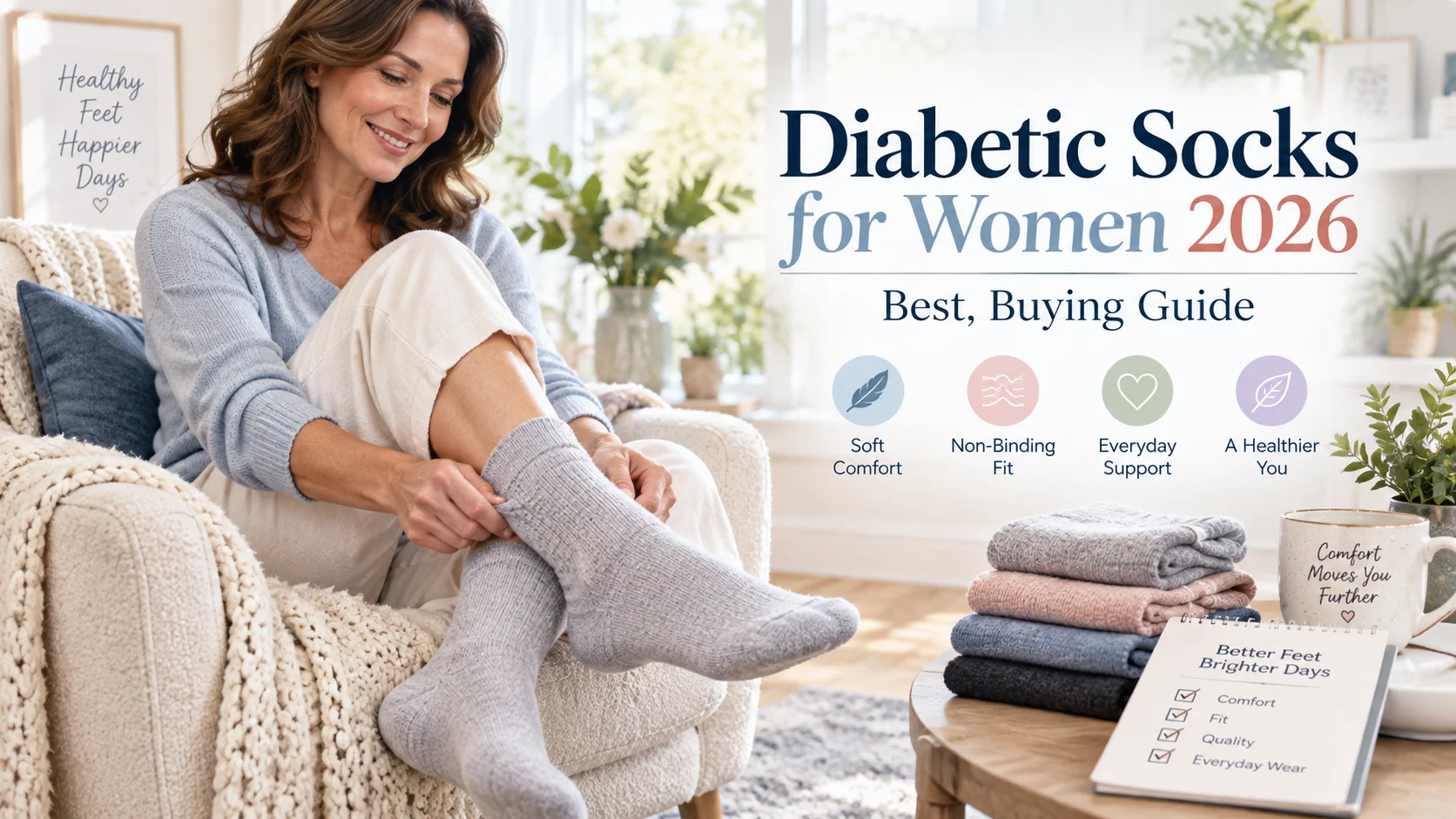
A sock that looks soft on the package can still create problems if the cuff digs into the ankle, the toe seam rubs, or extra fabric bunches inside a shoe. For women with diabetes—especially those with neuropathy, swelling, sensitive skin, or changes in foot shape—those small fit details can matter.
The best diabetic socks for women are not simply the loosest or thickest pair available. A good choice should fit securely without constricting the leg, feel smooth against the toes, manage moisture, work with the shoes you actually wear, and provide cushioning appropriate for your activity.
This guide explains how to compare non-binding, seamless, cushioned, wide-fit, warm, breathable, and compression options without treating socks as a substitute for medical foot care.
Quick Answer: What Should Women Look for in Diabetic Socks?
For most everyday situations, look for five things:
- A non-binding cuff that stays up without leaving a deep pressure line.
- A smooth or seamless toe to reduce rubbing around sensitive toes.
- Light-to-moderate cushioning where it improves comfort without making shoes tight.
- Breathable, moisture-managing fabric that helps keep the skin reasonably dry.
- Correct sizing, including enough toe room and, for crew or knee-high socks, enough stretch for the ankle and calf.
NIDDK guidance for diabetes foot care recommends clean, lightly padded socks that fit well and notes that socks without seams are best. It also advises against tight socks or elastic stockings.
No sock can guarantee better circulation, prevent neuropathy, or prevent a diabetic foot ulcer. A 2026 systematic review found that evidence on the clinical effectiveness of diabetic-sock designs is still limited, even though features such as cushioning, low-friction construction, breathability, and seamless toes are commonly used.
What Makes Women’s Diabetic Socks Different From Regular Socks?
“Diabetic sock” is a design category, not a guarantee of medical benefit. Compared with many ordinary socks, diabetic-oriented styles typically place more emphasis on minimizing pressure, rubbing, moisture buildup, and tight elastic.
That usually means a wider or more stretchable cuff, a smoother toe closure, softer interior construction, and some level of sole cushioning. Many are also made in ankle, crew, knee-high, extra-wide, and dress-friendly versions.
For women, the most useful distinction is not the word “women’s” on the label. It is whether the sock actually matches your foot length, foot width, ankle circumference, calf circumference, shoe volume, and activity.
A women’s shoe-size range is only a starting point. If a knee-high sock fits the foot but cuts into a wide calf, it is the wrong size or design.
Features Worth Prioritizing
| Feature | Why it may matter | What to watch for |
|---|---|---|
| Non-binding cuff | Reduces concentrated pressure at the top | “Loose” should not mean slipping or bunching |
| Seamless or flat toe | Reduces a common rubbing point | Check the inside; some “seamless” socks still have a noticeable ridge |
| Cushioned sole | Adds comfort and may reduce localized pressure | Too much thickness can crowd a shoe |
| Moisture management | Helps reduce prolonged dampness | Fabric blend and knit structure matter, not just marketing terms |
| Extra-wide stretch | Can accommodate larger ankles, feet, or calves | Do not simply size up if the foot section becomes too long |
| Smooth interior | Helps limit friction against sensitive skin | Inspect for rough threads, labels, or raised stitching |
Best Diabetic Socks for Women by Need

There is no single “best” pair for every woman. The right design changes with foot sensation, swelling, footwear, weather, and daily activity.
| Product | Key Features | Best Use Case | Style / Material | Amazon |
|---|---|---|---|---|
| Dr. Segal’s Women’s Diabetic Socks | Non-binding top, seamless construction, extra cushioning, moisture-wicking design | Everyday wear, sensitive feet, wide ankles/calves | Women’s diabetic crew styles | Check Price on Amazon |
| Doctor’s Choice Women’s Diabetic Quarter Socks | Easy-stretch non-binding top, hand-tied seamless toe, full cushioning, moisture-wicking synthetic blend | Walking, casual shoes, everyday comfort | Quarter / ankle style | Check Price on Amazon |
| Sockwell Extra Easy Women Diabetic Socks | Seamless construction, flexible cuff, no therapeutic compression, light cushioning | Sensitive feet, winter/cooler weather, women wanting merino blend | 40% merino wool + 40% bamboo blend | Check Price on Amazon |
| Sockwell Easy Does It Women Diabetic Socks | Seamless toe, non-elastic/flexible top, light cushioning | Everyday wear and sensitive skin | Merino wool + bamboo + nylon blend | Check Price on Amazon |
| Dr. Johnny’s Diabetic Socks | Non-binding cuff, near-seamless toe, cushioned footbed, moisture-wicking cotton blend | Women wanting a simple everyday non-binding sock | Unisex crew styles | Check Price on Amazon |
For Neuropathy, Numb Feet, or Sensitive Skin
Prioritize a smooth interior, minimal toe seam, secure fit without wrinkles, and enough cushioning for the shoes being worn.
Neuropathy can reduce the ability to feel pressure, heat, rubbing, or a developing blister, so visual foot checks become especially important. CDC and NIDDK both advise daily foot inspection for people with diabetes.
A very loose sock is not automatically safer. If it slides, twists, or folds under the forefoot, the fabric itself can become a friction or pressure point.
For Swollen Feet, Wide Feet, or Wide Calves
Look for a high-stretch, non-restrictive cuff and a size chart that includes ankle or calf measurements when possible.
Extra-wide diabetic socks can be more practical than buying a longer foot size just to gain leg room. Sizing up too far may leave excess material around the heel or toes, creating wrinkles inside the shoe.
New, one-sided, severe, or unexplained swelling should not be solved by guessing at socks. The American Diabetes Association’s 2026 Standards of Care say people with open ulceration or unexplained swelling, redness, or increased skin temperature should be referred promptly for specialist evaluation.
For Everyday Wear, Walking, and Work
A crew or ankle sock with a smooth toe, moderate stretch, moisture management, and light cushioning is often the most versatile combination.
Nurses, retail workers, office workers, and others who spend long hours standing or sitting may care more about breathability and cuff comfort than maximum padding.
For walking shoes and sneakers, check that cushioning does not make the toe box tight. NIDDK emphasizes well-fitting footwear with enough toe room and recommends checking the feet for soreness when breaking in new shoes.
For Dress Shoes
Thin diabetic dress socks can work better than thick cushioned socks because many dress shoes have less internal volume.
Prioritize a flat toe seam, smooth fabric, and a cuff that stays up gently. If a “protective” sock makes the shoe noticeably tighter, the combination is working against the goal.
For Boots and Cold Feet
Warm diabetic socks may use wool blends, merino wool, or thicker synthetic constructions.
Warmth is useful, but the boot still needs enough room for the toes. NIDDK recommends protecting feet from cold and says socks may be worn in bed if the feet get cold.
For Summer or Hot Workplaces
Choose a thinner sock with breathable knit zones and effective moisture handling.
“Bamboo” alone does not guarantee superior performance. Construction, blend, thickness, and how quickly the sock dries all matter.
Which Material Is Best for Women’s Diabetic Socks

There is no proven universal winner.
The 2026 systematic review of diabetic socks found that fiber blends and knit structure affect performance, but the overall clinical evidence remains limited. That makes fit, construction, moisture behavior, and shoe compatibility more useful buying criteria than choosing a sock solely because it contains cotton, bamboo-derived rayon, wool, or a synthetic fiber.
| Material | Practical strengths | Possible trade-offs |
|---|---|---|
| Cotton blend | Familiar feel, soft, widely available | High-cotton socks may stay damp longer after heavy sweating |
| Bamboo-derived rayon/viscose | Often feels smooth and soft | “Bamboo” is not a medical-performance guarantee; durability and drying vary by blend |
| Merino wool/wool blend | Warm and useful for cold-weather socks | Thickness may reduce shoe room; some users dislike the feel |
| Polyester/nylon blends | Often durable and useful for moisture transport | Feel varies; poorly designed synthetics can still be hot or rough |
| Spandex/elastane | Helps socks retain shape and stay up | Too much tension in the wrong size can create a restrictive cuff |
A useful rule is to judge the whole sock, not one ingredient.
A soft fiber with a bulky toe seam can still rub. A moisture-wicking fabric that is too tight around the calf is still a poor fit.
How Should Diabetic Socks for Women Fit?

The ideal fit is snug enough to stay smooth, loose enough not to constrict, and correctly shaped so the heel and toe sit where they should.
Start with the manufacturer’s women’s shoe-size chart, then check width and leg measurements if the style is crew or knee-high.
For swollen feet or wide calves, a calf measurement can be more informative than shoe size alone.
Signs a Sock May Be Too Tight
- A deep cuff groove that persists after removal
- Pain, pinching, or increasing discomfort
- Toes feeling crowded
- The top band rolling into a narrow cord
- New color change or skin irritation where the sock presses
Signs a Sock May Be Too Loose
- Heel pocket sliding above or below the heel
- Wrinkles under the arch or forefoot
- Fabric bunching at the toes
- Sock repeatedly slipping down
- Excess length folded inside the shoe
If sensation is reduced, do not rely only on how the sock “feels.” Remove it and look at the skin.
Daily checks should include redness, blisters, cuts, swelling, sores, and other changes.
Shoe fit is part of sock fit. A thicker sock can turn an otherwise comfortable sneaker, work shoe, or winter boot into a tight shoe. This is one reason more cushioning is not always better.
Diabetic Socks vs. Compression Socks for Women
Diabetic socks and compression socks are not interchangeable.
| Diabetic socks | Compression socks |
|---|---|
| Usually designed to minimize constriction, seams, rubbing, and pressure points | Designed to apply measured pressure to the leg |
| Often have minimal or no therapeutic compression | Often use graduated compression labeled in mmHg |
| Main purpose is comfort and foot protection | Used for specific venous, swelling, travel, or medical indications |
| Fit should be non-binding | Fit is intentionally compressive and must be correctly sized |
Compression can be appropriate for some people with diabetes, but diabetes alone is not a reason to start it.
Peripheral artery disease (PAD), loss of protective sensation, skin wounds, significant swelling, and other vascular or neurological issues can change what is appropriate.
The ADA recommends vascular and neurological assessment as part of diabetic foot care, and MedlinePlus advises people with ischemic ulcers not to use compression stockings or wraps unless instructed by a healthcare provider.
If compression has been recommended, follow the prescribed or professionally advised compression level rather than assuming stronger compression is better.
Mild and moderate compression ranges such as 15–20 mmHg or 20–30 mmHg are not automatically appropriate for every woman with diabetes.
Also be careful with products marketed as “diabetic compression socks.” That phrase combines two different product concepts. Check whether the sock simply has a comfortable stretch top or actually provides measured graduated compression.
How to Wear and Care for Diabetic Socks
Put on a clean pair and smooth out wrinkles before putting on shoes. Check that the heel is aligned, the toe area is not folded, and the cuff is not rolled.
Change socks at least daily and sooner if they become wet, sweaty, or dirty. When you remove them, inspect the feet rather than treating sock changes as an automatic routine.
Follow the care label. High heat and aggressive drying can affect elasticity and fit in some fabrics, while socks that have permanently stretched, developed rough areas, or formed holes should be replaced.
For bedtime, ordinary loose-fitting socks may be used for warmth if they are comfortable. NIDDK specifically notes that people with diabetes can wear socks in bed if their feet are cold.
Compression socks are different. They are generally removed for sleep unless a healthcare professional has instructed otherwise.
What Socks Should Women With Diabetes Avoid?
Avoid any sock that repeatedly creates pressure, rubbing, or bunching, even if it is marketed as “diabetic.”
Be cautious with:
- Tight elastic bands that dig into the leg
- Thick toe seams that rub sensitive toes
- Socks that slide and wrinkle inside shoes
- Very bulky cushioning in already-snug footwear
- Socks with holes, rough repairs, or damaged interiors
- Compression socks chosen without appropriate guidance when circulation or sensation is impaired
A diabetic sock also should not be used to hide or simply “pad over” an existing foot problem.
Contact a healthcare professional promptly for a foot wound, worsening redness, warmth, persistent swelling, drainage, or a blister or cut that is not beginning to heal.
NIDDK advises prompt medical attention for several of these changes, and the ADA recommends more frequent professional foot surveillance for people with loss of protective sensation, PAD, previous ulcers, or amputation.
Women’s Diabetic Socks Buying Checklist
Before buying, ask:
- Does the cuff stay up without digging in?
- Is the toe seam truly smooth?
- Is the sock the right foot length and width?
- Does the calf opening match my leg rather than forcing me to size up?
- Is the cushioning compatible with my shoes?
- Will the fabric and thickness suit the season and activity?
- Can I inspect the inside for rough stitching?
- If I need compression, has the compression level been chosen appropriately for my health situation?
The best women’s diabetic socks are the pair that meets these practical checks consistently—not the pair with the longest list of marketing claims.
Frequently Asked Questions
Do Women With Diabetes Need Special Diabetic Socks?
Not everyone with diabetes needs a sock labeled “diabetic.”
The useful features are what matter: proper fit, a non-restrictive cuff, a smooth toe area, suitable cushioning, and clean, dry-feeling fabric. People with neuropathy, foot deformity, swelling, previous ulcers, or circulation problems may need more individualized guidance.
Do Diabetic Socks Help Neuropathy?
Diabetic socks do not treat or reverse diabetic neuropathy.
They may provide a smoother, more cushioned environment around a sensitive or numb foot, which can make footwear more comfortable and reduce avoidable rubbing. Daily foot inspection and appropriate diabetes and medical care remain essential.
Do Diabetic Socks Help Swollen Feet?
A roomy, non-binding sock may be more comfortable when mild swelling is present, but it does not diagnose or treat the cause of swelling.
If swelling is new, significant, unexplained, one-sided, or accompanied by redness, warmth, pain, or a wound, seek medical assessment rather than simply moving to a looser sock.
Are Seamless Socks Better for Diabetic Women?
A smooth or seamless toe can remove a common source of rubbing, particularly around sensitive toes. NIDDK states that socks with no seams are best as part of diabetes foot care.
Still, the entire sock must fit properly. A seamless sock that bunches, slips, or constricts is not a good choice.
Are Cotton, Bamboo, or Merino Wool Socks Best?
No material has been proven best for every diabetic foot.
Cotton blends can feel familiar and soft, bamboo-derived rayon or viscose often feels smooth, merino wool can be useful for warmth, and synthetics can add durability and moisture transport.
Compare the complete fabric blend, knit, thickness, seam construction, and fit rather than relying on a single fiber claim.
Should Diabetic Socks Be Tight or Loose?
They should be non-restrictive but not baggy.
The sock should stay in place without a tight pressure band and should lie smooth without folds. If the cuff digs in, the sock may be too restrictive. If it slides or bunches, it may be too large or too loose.
Can Women With Diabetes Wear Compression Socks?
Some can, but compression should be treated as a separate decision from choosing diabetic socks.
The appropriate level depends on why compression is being considered and on factors such as arterial circulation, sensation, skin condition, swelling, and medical history.
If PAD, neuropathy with reduced sensation, wounds, or unexplained swelling are concerns, obtain professional advice before using compression.
Can Diabetic Women Wear Socks All Day or Sleep in Them?
A well-fitting, non-binding everyday sock can generally be worn during normal daytime activities and changed if it becomes damp or dirty.
For cold feet, NIDDK notes that socks may be worn in bed. Compression socks are usually removed at bedtime unless a healthcare professional has advised nighttime use.
What Are the Best Diabetic Socks for Elderly or Senior Women?
Look for easy-to-pull-on socks with a wide stretchable cuff, smooth toe, stable heel fit, and cushioning that does not crowd the shoe.
If bending, vision, hand strength, or reduced sensation makes foot checks difficult, assistance from a caregiver or healthcare professional may be useful. The ADA emphasizes more frequent surveillance for higher-risk feet.
Where Can Women Buy Diabetic Socks?
Diabetic socks are widely sold through pharmacies, medical-supply stores, footwear retailers, department stores, and online shops.
Instead of choosing by star rating alone, compare the size chart, return policy, cuff construction, toe seam, material blend, thickness, and whether the product is a true non-binding sock or a measured compression garment.
Final Summary
The best diabetic socks for women should protect comfort without creating new pressure points.
Start with fit: a non-binding cuff, smooth toe, correct heel placement, enough room for the toes, and no wrinkles. Then choose cushioning, material, length, and warmth according to your shoes, activity, season, and foot sensitivity.
If neuropathy, loss of sensation, PAD, a previous ulcer, significant swelling, or a current wound is part of the picture, sock choice should sit inside a broader diabetic foot-care plan rather than replacing professional evaluation.
Medical information notice: This article provides general educational information and is not a substitute for individualized medical advice. If you have loss of protective sensation, circulation disease, a wound, unexplained swelling, major skin-color or temperature changes, or another foot-health concern, ask a qualified healthcare professional or podiatrist what type of sock or compression, if any, is appropriate.
Sources & Medical References
- American Diabetes Association — Standards of Care in Diabetes—2026: Retinopathy, Neuropathy, and Foot Care. Current recommendations covering diabetic foot evaluation, neuropathy, loss of protective sensation, PAD, ulcer risk, footwear, and referral.
- National Institute of Diabetes and Digestive and Kidney Diseases (NIDDK) — Diabetes & Foot Problems. Guidance on daily foot care, sock and footwear fit, seamless/lightly padded socks, cold protection, and warning signs.
- Centers for Disease Control and Prevention — Your Feet and Diabetes. Guidance on neuropathy, daily inspection, footwear, and early recognition of foot problems.
- Venkatraman PD et al. — Diabetic Socks: A Systematic Review of the Literature and Commercially Available Products. Diabetes/Metabolism Research and Reviews, 2026. Review of diabetic-sock materials, structures, cushioning, seams, commercial designs, and limitations of current clinical evidence.
- MedlinePlus — Ischemic Ulcers: Self-Care. Guidance relevant to arterial circulation concerns and the need for clinician direction before compression where ischemia is present.
- Guy’s and St Thomas’ NHS Foundation Trust — Compression Stockings. Guidance on correct compression-stocking use and nighttime removal unless otherwise directed by a clinician.
