

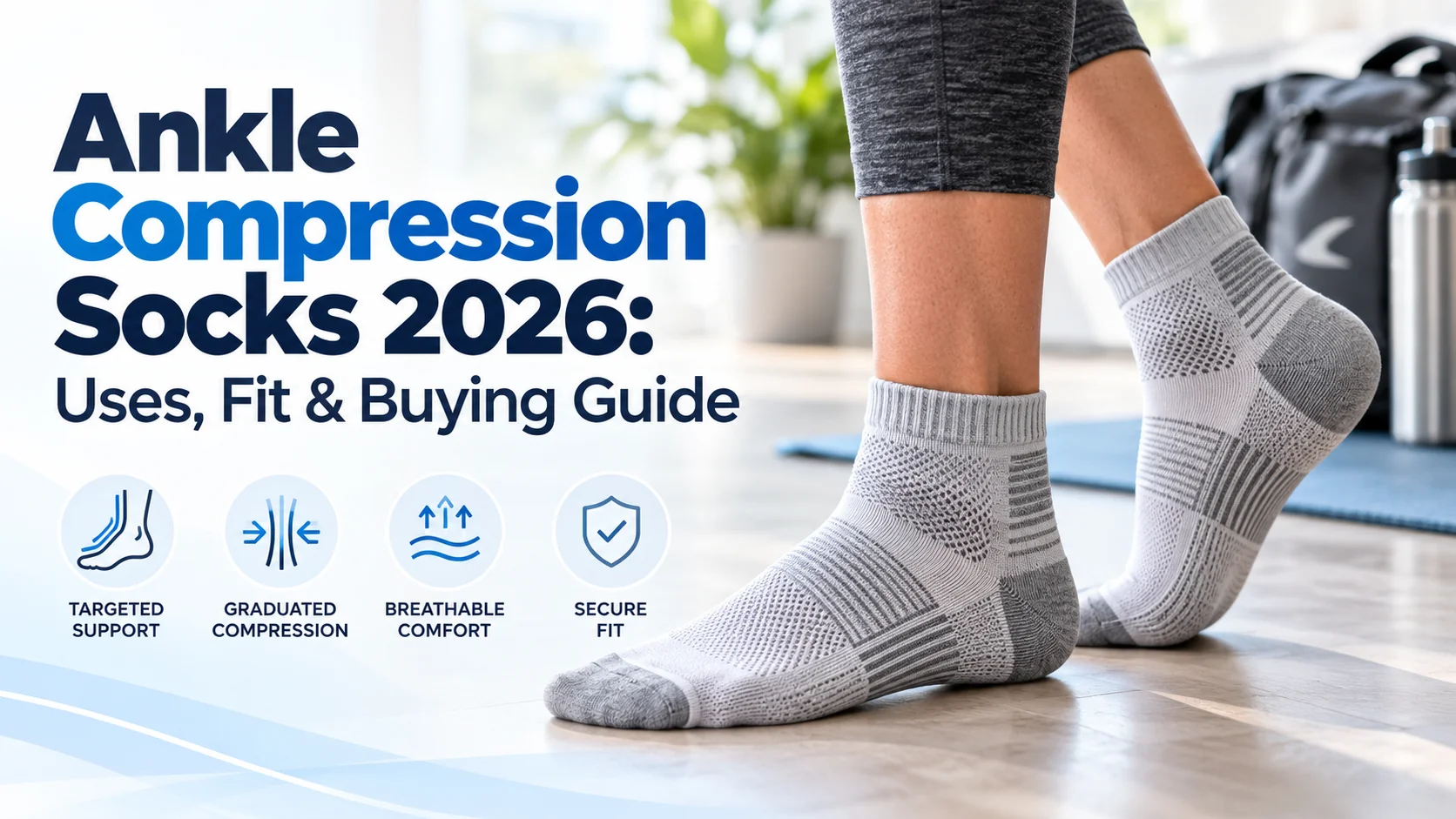
Ankle compression socks can look like a simpler alternative when knee-high compression feels too tall or warm. They are popular for walking, running, work shoes, tired feet, and localized foot-and-ankle support.
The confusing part is the word “compression.” A short ankle sock, an ankle sleeve, and a medical graduated compression stocking are not automatically the same product. This guide explains what ankle compression socks can realistically do, how 15–20 and 20–30 mmHg differ, how to size them, and when knee-high compression or medical advice may make more sense.
Quick Answer: What Are Ankle Compression Socks?
Ankle compression socks are short socks that apply snug pressure around the foot, arch, heel, and ankle. Some are designed mainly for athletic comfort or localized support; others state a measured compression range in mmHg.
They can suit foot-and-ankle support, close-fitting shoes, or light everyday compression. However, a low-cut sock cannot reproduce the full lower-leg pressure gradient of a typical knee-high graduated stocking. For persistent swelling or a diagnosed venous or lymphatic condition, do not assume ankle length is an equal substitute for medically selected compression. Cleveland Clinic describes graduated compression as being strongest around the ankle and decreasing farther up the leg, while standard medical stockings are commonly knee-high or thigh-high.
How Ankle Compression Socks Work — and Where the Effect Stops
Compression garments create external pressure around soft tissue. In a properly engineered graduated medical stocking, pressure is highest near the ankle and decreases as the garment moves up the leg. This gradient is intended to support venous return and reduce pooling in the lower leg.
An ankle-height sock covers a much smaller area. Depending on its construction, it may provide compression around the arch, heel, ankle joint, and lower ankle area, but it cannot continue a pressure gradient up the calf if the fabric ends near the ankle.
That difference matters because buyers often see phrases such as “graduated ankle compression socks” or “compression ankle stockings” and assume they work exactly like knee-high medical hosiery. Check the actual product specification. A sock may have targeted compression zones without being a clinically graduated stocking.
Localized Compression vs Graduated Leg Compression
Think of the choice by coverage:
| Product type | Main coverage | Typical reason people choose it | Key limitation |
|---|---|---|---|
| Low-cut ankle compression sock | Foot and ankle | Shoe-friendly support, exercise, tired feet | Limited lower-leg coverage |
| Ankle compression sleeve | Ankle; often leaves toes/heel partly exposed | Localized support, sport, brace-like feel | May not provide sock cushioning or true graduated pressure |
| Quarter/crew compression sock | Ankle to lower calf | More coverage without knee-high length | Still shorter than standard graduated hosiery |
| Knee-high graduated compression sock | Foot to below knee | Lower-leg swelling, travel, prolonged sitting/standing, venous support | Warmer and usually harder to put on |
| Thigh-high/pantyhose compression | Above knee/full leg | Selected medical situations requiring greater coverage | More difficult to fit and wear |
The practical takeaway: choose the length based on where you need compression, not simply on which style is easiest to wear.
Do Ankle Compression Socks Help Swollen Ankles or Feet?

They may help some people feel more supported around the foot and ankle, and measured compression can help limit fluid accumulation in the area it actually covers. Compression stockings are used clinically to help manage leg swelling by applying external pressure, but garment length and the reason for swelling matter.
For mild end-of-day puffiness, a properly fitted short sock may feel comfortable. If swelling extends into the lower leg, frequently returns, or is substantial, ankle length may provide too little coverage. A tight cuff can also become uncomfortable if swelling builds above it.
Persistent or unexplained swelling should not be treated as a simple sock-shopping problem. New swelling in one leg, especially with pain, tenderness, warmth, or skin color change, can occur with deep vein thrombosis and needs prompt medical assessment. Difficulty breathing or chest pain can be signs of pulmonary embolism and require urgent medical attention.
What About Circulation?
“Improves circulation” is used loosely in compression marketing. Medical compression is mainly used to support venous blood return from the legs; it does not open arteries narrowed by peripheral artery disease.
For people with PAD or suspected poor arterial blood flow, compression without clinical guidance can be inappropriate. PAD can reduce blood flow to the legs and feet, and compression guidance emphasizes assessment of arterial circulation when significant disease is suspected.
Cold feet, major color changes, unusual numbness, or exertional calf pain deserve evaluation rather than stronger socks.
Ankle Compression Socks vs Knee-High Compression Socks
Ankle and knee-high styles solve different problems. An ankle-length style suits low-profile footwear, localized foot-and-ankle support, breathability, or sport use when full lower-leg compression is not needed.
Knee-high compression is more logical when the goal involves lower-leg venous support or swelling that extends beyond the ankle. Medical references commonly describe graduated stockings as knee-high or thigh-high, with greatest pressure at the ankle and progressively less pressure farther up the leg.
An ankle sock therefore is not an automatic replacement simply because both products carry an mmHg number.
Ankle Compression Sock vs Ankle Sleeve vs Ankle Brace

These products overlap, but they are not interchangeable.
An ankle compression sock covers the foot and ankle and can add moisture management, cushioning, and a barrier between skin and shoe. An ankle sleeve focuses more on the ankle or midfoot; if it has no mmHg rating, do not assume a specific medical compression level.
An ankle brace may use straps or structured components to limit movement, so compression alone does not provide the same mechanical restraint.
For a significant sprain, suspected tendon injury, or ongoing instability, a compression sock is not a substitute for assessment or rehabilitation guidance. It may provide a supportive sensation, but it does not diagnose the injury or establish when returning to activity is safe.
15–20 vs 20–30 mmHg Ankle Compression Socks

mmHg means millimeters of mercury, a unit of pressure. Higher numbers mean firmer compression, but stronger is not automatically better.
Cleveland Clinic lists commonly encountered compression ranges including 8–15 mmHg, 15–20 mmHg, 20–30 mmHg and firmer 30–40 mmHg compression. It also advises matching pressure to the user’s needs rather than choosing a level without appropriate guidance for medical concerns.
15–20 mmHg
This range is commonly sold as moderate everyday compression. In a properly fitted product, it may suit healthy adults looking for more noticeable support during long periods of sitting or standing, travel, or routine daily wear.
For ankle-length products, verify where and how the pressure was measured. A printed “15–20 mmHg” range is more meaningful than vague terms such as “firm support,” but product construction still matters.
20–30 mmHg
This is firmer compression and is commonly encountered in medical compression garments for selected venous or swelling-related needs. Firmer stockings can also be more difficult to put on correctly.
If you are considering 20–30 mmHg because of persistent edema, varicose veins, venous insufficiency, surgery, injury, pregnancy-related swelling, or another medical reason, it is sensible to confirm both the pressure level and garment length with a qualified healthcare professional.
What About 8–15 or 30–40 mmHg?
Light 8–15 mmHg products may be used for mild support. At the other end, 30–40 mmHg is substantially firmer medical compression and should not be treated as an “upgrade.” Cleveland Clinic recommends clinician supervision for extra-firm 30–40 mmHg products.
Choose pressure, length, and design to match the reason for compression—not simply the strongest pair you can tolerate.
Best Ankle Compression Socks by Use Case: What to Look For
There is no single best ankle compression sock for runners, nurses, travelers, older adults, and people with swelling. The features that matter change with the job.
For Standing All Day, Nurses, Teachers, and Work
Prioritize a cuff that stays flat without digging in, enough toe room, moisture-wicking fabric, and cushioning that still fits inside your work shoes.
If your discomfort or swelling extends into the calf, compare a knee-high option rather than choosing ankle length only because it is cooler. Coverage should match where support is actually needed.
For Running, Walking, Basketball, Hiking, and the Gym
Look for a secure heel pocket, arch support if you like that sensation, low-friction seams, breathable synthetic or wool blends, and enough stretch to prevent bunching.
Compression may provide a snug supportive feel, but buyers should be cautious with claims that it automatically improves athletic performance. A 2025 systematic review and meta-analysis found no clear advantage of compression socks over regular socks for running performance, physiological measures, or perceptual outcomes, although certainty varied across outcomes.
Treat recovery compression as an optional comfort tool rather than guaranteed performance technology; research on post-exercise recovery has produced mixed results across studies and outcomes.
For Travel and Flying
A low-cut sock can be comfortable, but travelers seeking lower-leg venous support should know knee-high graduated stockings cover more of the leg.
Movement still matters. The American Heart Association advises getting up periodically on long flights and moving the ankles and calf muscles while seated. Travelers with blood-clot risk factors should discuss appropriate prevention with a healthcare professional rather than relying on ankle socks alone.
For Plantar Fasciitis, Heel Pain, Achilles Discomfort, or Ankle Pain
Ankle compression socks and sleeves may feel supportive around the arch, heel, or ankle, but they do not establish the cause of pain and should not be presented as a cure for plantar fasciitis, Achilles problems, heel pain, or an ankle injury.
Choose based on comfort, shoe fit, and whether the garment aggravates the painful area. Persistent pain, weakness, swelling after injury, or difficulty bearing weight deserves proper evaluation.
For Wide Feet, Wide Ankles, and Plus-Size Users
Do not simply size up by shoe size. Look for ankle circumference and foot measurements rather than S/M/L alone.
Stretchy cuffs, width options, and a roomy toe box can matter more than the gender label on the package. A larger shoe-size sock that is loose around the ankle may not produce the intended compression, while an undersized cuff can concentrate pressure.
How to Measure for Ankle Compression Socks
Sizing systems vary, so always use the manufacturer’s chart. For many ankle products, useful measurements include shoe size plus ankle circumference; some designs also use arch or foot circumference.
Measure the ankle at the narrowest area above the ankle bones unless the product chart gives a different location. Keep the tape level and snug without pulling it into the skin. If foot circumference is requested, measure exactly where the brand’s chart specifies.
For swelling-prone feet, timing can affect measurements. Medical guidance commonly recommends putting compression stockings on earlier in the day, when leg swelling may be lower.
If ankle size changes substantially during the day or one side is much larger than the other, get fitting or clinical guidance rather than forcing yourself into a standard size.
How Should Ankle Compression Socks Fit?

A correct fit should feel snug, not painful. The heel should sit in its pocket, the toe area should not crush the toes, the cuff should lie flat, and the fabric should not bunch or roll into a narrow band.
Remove the sock and reassess the size if you develop persistent numbness, tingling, increasing pain, cold toes, unusual color change, or pronounced pressure areas.
Mild temporary impressions can occur with close-fitting garments, but deep painful grooves or symptoms below the cuff suggest the fit or product may be wrong.
A common mistake is treating discomfort as proof that “the compression is working.” Medical compression should be appropriately snug; it should not be something you have to endure despite neurologic or circulation warning signs.
Materials, Breathability, and Shoe Compatibility
Nylon, polyester, spandex, and elastane are common because they provide stretch and shape retention. Merino wool blends can suit walking or hiking; cotton may retain more moisture than many performance fabrics.
“Bamboo” usually means bamboo-derived viscose or rayon blended with elastic fibers, so check the actual fiber label rather than assuming the word itself guarantees breathability or other performance characteristics.
For warm weather, prioritize ventilation and moisture management. Cushioning can improve comfort but may reduce toe-box space in tight shoes. A seamless or low-profile toe may help if rubbing is a concern.
Can You Wear Ankle Compression Socks All Day or Sleep in Them?
Many people wear appropriately fitted compression socks during daytime activity, but wear time depends on the product and reason for use. MedlinePlus notes that prescribed compression stockings may be worn throughout the day depending on the user’s clinical instructions.
Do not assume nighttime use is beneficial. Medically directed overnight compression is a separate decision and may depend on the condition being treated.
For over-the-counter use, remove the socks if they cause pain, numbness, skin irritation, cold toes, or worsening discomfort. If compression was prescribed, follow the schedule given by your clinician.
Diabetes, Neuropathy, PAD, Pregnancy, and Other Safety Considerations
Compression deserves extra caution when a person may not feel pressure normally or may have reduced arterial blood flow.
People with diabetes are not one uniform group. Some have normal sensation and circulation; others have neuropathy, PAD, wounds, foot deformity, or previous ulcers. NIDDK explains that diabetic peripheral neuropathy can reduce sensation in the feet, making pressure, blisters, sores, or injuries harder to notice. Diabetes may also be associated with reduced blood flow to the feet.
Therefore, do not assume a product marketed as an “ankle compression sock for diabetes” is automatically appropriate. A non-binding diabetic sock designed to minimize friction and constriction is also not automatically the same as a compression sock.
People with known or suspected PAD should get professional guidance before meaningful compression, particularly firmer levels. NHS guidance on compression therapy emphasizes assessment of arterial circulation before stronger compression is used when arterial disease may be present.
Pregnancy-related swelling also varies. For persistent or substantial swelling during pregnancy, discuss pressure and garment length with a maternity care professional rather than assuming a particular mmHg level is universally appropriate.
Open wounds, active skin infection, major unexplained swelling, or marked changes in foot color or temperature are reasons to seek advice before using tighter garments.
Pros and Cons of Ankle Compression Socks
Their main advantage is convenience: ankle-height designs are discreet, cooler, shoe-friendly, and can combine arch, foot, and ankle support.
Their main limitation is length. They cannot compress the calf like a knee-high stocking, and a short cuff can become a pressure point if sizing is wrong or swelling accumulates above it.
They make the most sense when the goal is genuinely local rather than full lower-leg treatment.
Ankle Compression Socks Buying Checklist
Before buying, check these factors:
- Purpose: Is your goal everyday comfort, sport, work, travel, swelling management, or a medically diagnosed condition?
- Coverage: Is the problem really limited to the foot and ankle, or do you need calf coverage?
- Compression rating: Does the product state an actual mmHg range, or only vague marketing terms?
- Compression profile: Is it truly graduated, targeted, or simply uniformly snug?
- Sizing: Does the chart use ankle circumference and relevant foot measurements?
- Cuff design: Will it stay flat without rolling or creating a narrow pressure band?
- Toe and heel fit: Is there enough room without slipping or bunching?
- Material: Does the fabric suit your climate, activity, and moisture needs?
- Shoe space: Will cushioning or fabric thickness make your footwear too tight?
- Safety: Do you have PAD, neuropathy, diabetes-related foot problems, wounds, significant swelling, or another condition that changes whether compression is appropriate?
Common Problems and How to Troubleshoot Them
The sock leaves a deep line at the cuff: Recheck ankle measurement and cuff placement. A rolled or undersized cuff concentrates pressure in a narrow area.
My toes feel numb or cold: Remove the sock and do not simply “break it in.” Numbness, coldness, or color change can mean the fit or compression is unsuitable and may warrant medical advice.
My ankle still swells above the sock: The garment may not cover enough of the swollen area. The solution may be a different garment length or medical evaluation, not automatically stronger ankle compression.
The sock bunches or slides: Recheck heel placement, foot length, and ankle sizing. Bunching can create friction and pressure inside shoes.
Frequently Asked Questions
Are Ankle Compression Socks Worth It?
They can be worthwhile when you want low-profile foot-and-ankle support, a snug athletic sock, or mild compression that fits easily inside shoes.
They are less suitable when your main need is full lower-leg graduated compression.
Do Ankle Compression Socks Improve Circulation?
A short compression sock applies external pressure where it covers the foot and ankle. However, it does not provide the same lower-leg gradient as a knee-high graduated stocking.
“Circulation” is also a broad term. People with arterial circulation problems should not self-treat by adding stronger compression.
Are Short Compression Socks Effective for Swollen Ankles?
They may help with mild localized puffiness in some users, but usefulness depends on the cause and extent of swelling.
Recurrent, substantial, one-sided, or medically unexplained swelling needs assessment rather than simply trying a stronger sock.
How Tight Should Ankle Compression Socks Be?
Snug, smooth, and secure without pain, numbness, cold toes, significant color change, or deep cuff pressure.
Use the product’s measurement chart rather than choosing tightness by feel.
Can I Wear Ankle Compression Socks for Running?
Yes, if they fit comfortably and do not cause pressure or rubbing. Choose breathable, moisture-managing fabric and good heel and toe fit.
Do not expect compression alone to improve running performance; current research does not show a consistent performance advantage over regular running socks.
Can Ankle Compression Socks Help Plantar Fasciitis?
Some people may like the feeling of arch or foot compression, but compression socks are not a cure for plantar fasciitis.
Persistent heel pain should be managed according to its actual cause rather than relying on compression alone.
Are Ankle Compression Socks Safe for Diabetes?
Not automatically. Diabetes may be accompanied by neuropathy, reduced circulation, skin problems, or previous ulcers. Those factors can change whether compression is appropriate and how closely the feet should be monitored.
Can I Sleep in Ankle Compression Socks?
Do not assume you need them overnight. Nighttime compression depends on the reason for use and, for medical conditions, should follow professional guidance.
Final Takeaway
Ankle compression socks are most useful when you actually want short, localized compression: a supportive fit around the foot and ankle, an athletic or work sock that stays low inside footwear, or light everyday compression without covering the calf.
They are not simply miniature knee-high medical stockings. If your goal is managing persistent swelling, venous insufficiency, varicose veins, lymphatic swelling, post-surgical needs, or another diagnosed condition, the right pressure and the right length matter as much as the word “compression.”
Choose by purpose first, then verify mmHg, measurements, cuff fit, materials, and shoe compatibility. If compression causes numbness, coldness, pain, unusual color change, or worsening swelling, stop using the garment and get appropriate medical advice.
Medical Information Notice: This article provides general educational information and is not a substitute for individualized medical advice. If you have diagnosed circulation disease, diabetes-related foot problems, neuropathy, significant or unexplained swelling, wounds, or another medical concern, ask a qualified healthcare professional what type of compression, if any, is appropriate for you.
Sources & Medical References
- Cleveland Clinic — What You Need To Know About Compression Socks: graduated compression, compression levels, sizing, and medical-use context.
- MedlinePlus — Compression Stockings: how compression stockings work, common lengths, fit, wear, and swelling guidance.
- National Institute of Diabetes and Digestive and Kidney Diseases — Diabetes & Foot Problems / Peripheral Neuropathy: diabetes-related loss of sensation, foot injury risk, circulation, and foot-care considerations.
- CDC — About Venous Thromboembolism: signs and symptoms of DVT and pulmonary embolism.
- American Heart Association — Compression Socks on Long Flights: travel movement and compression context.
- Oxford Health NHS Foundation Trust — Compression Therapy: arterial assessment and safety considerations before stronger compression.
- PubMed — 2025 Systematic Review and Meta-Analysis of Compression Socks During Running: current evidence on running performance and perceptual outcomes.

1 thought on “Ankle Compression Socks 2026: Uses, Fit & Buying Guide”