

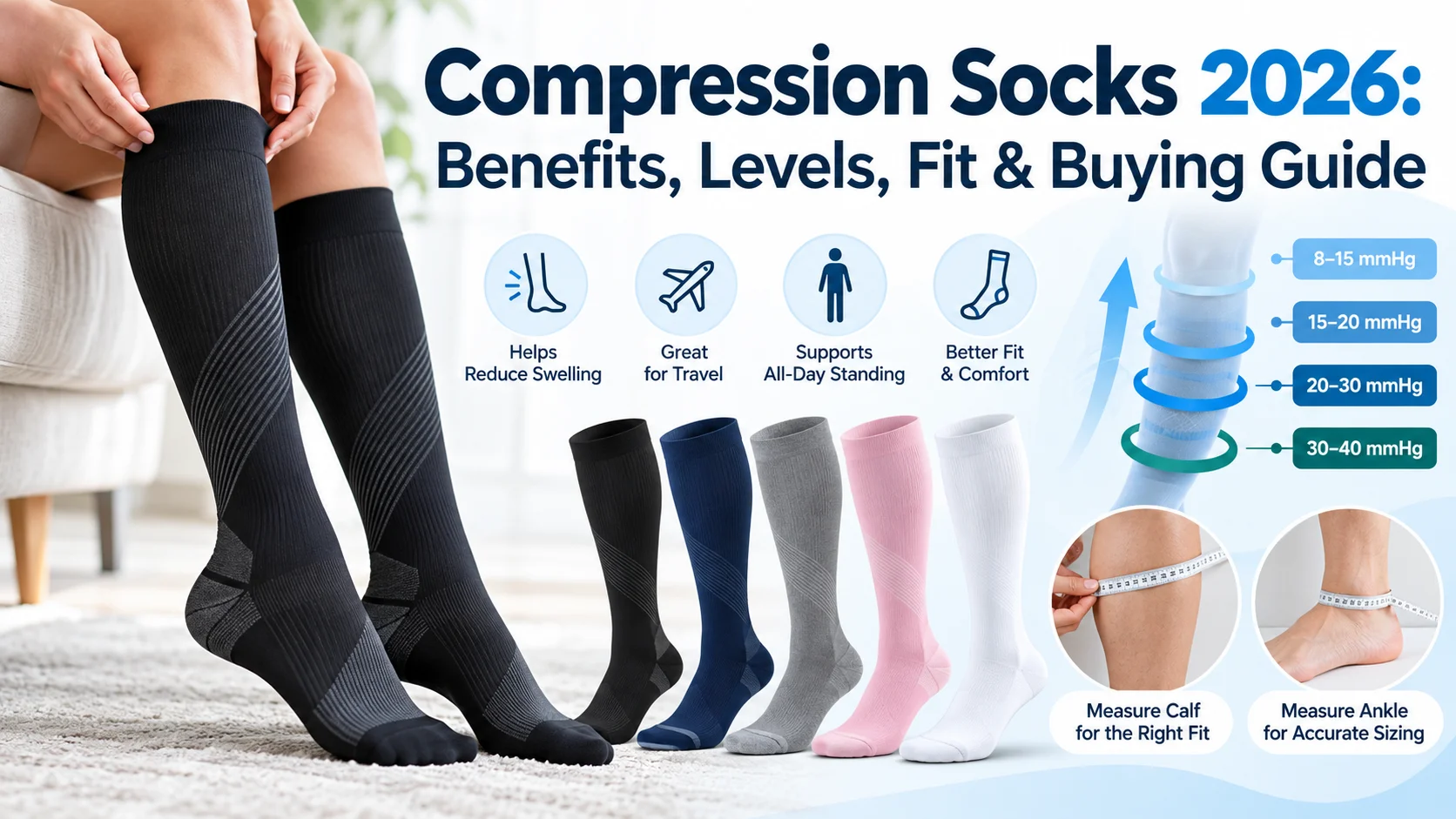
If your ankles look puffier after a long shift, your legs feel heavy after hours at a desk, or you are choosing between 15–20 and 20–30 mmHg socks, the hardest part is rarely finding compression socks. It is figuring out which pair actually matches your reason for wearing them.
Compression socks can be useful for everyday comfort, certain types of leg swelling, venous problems, travel, pregnancy-related symptoms and some medical situations. But they are not interchangeable with ordinary tight socks, diabetic socks or hospital anti-embolism stockings. The right choice depends on compression level, length, leg measurements, comfort, health history and how long you can realistically wear the garment.
This guide focuses on choosing the right pressure, length, fit and features while using compression safely.
Quick Answer: What Do Compression Socks Do?
Compression socks apply controlled external pressure to the legs. In graduated compression socks, pressure is greatest near the ankle and gradually decreases higher up the leg. This can help limit venous pooling and fluid accumulation and support the return of blood through the leg veins.
They are commonly used for swollen ankles or lower legs, tired or heavy legs, prolonged sitting or standing, chronic venous insufficiency and selected travel or postoperative situations. They may also be used as part of lymphedema care or after DVT, but those situations need professional guidance.
For most buyers, the decision comes down to purpose, pressure, size and whether a health condition makes self-selection unsafe.
How Compression Socks Work
Your leg veins have to move blood upward against gravity. Venous valves and the calf-muscle pump help with that job. When you walk, calf muscles contract and assist venous return. When you stand or sit for a long time, blood and fluid can collect in the lower legs more easily.
Graduated compression creates a pressure gradient: more pressure around the ankle, then progressively less toward the calf or thigh. The goal is mainly to support venous and lymphatic fluid movement and reduce pooling in the lower extremities.
That distinction matters. “Poor circulation” is a vague phrase. Compression can be helpful for some venous problems, but arterial disease is different. If arteries are not delivering enough blood to the feet, external pressure can require careful medical assessment.
Compression does not fix every cause of swelling. New, one-sided, severe or unexplained swelling needs evaluation.
Who May Benefit From Compression Socks?

Venous Swelling, Heaviness and Varicose-Vein Symptoms
Chronic venous insufficiency occurs when leg veins do not return blood efficiently, allowing blood to pool. Symptoms can include swelling, aching, heaviness, skin changes and varicose veins. Compression stockings are one option clinicians use to help manage venous symptoms and swelling.
People with established venous disease may need a specific pressure, length or medical-grade garment. A “stronger is better” approach is not appropriate.
Nurses, Teachers and People Who Stand for Long Shifts
Nurses, healthcare workers, teachers, retail workers and others who stand for much of the day often shop for compression socks because their legs feel tired or swollen by the end of a shift.
Comfort and adherence matter as much as the printed mmHg number. A sock that pinches behind the knee, traps heat or rolls down will probably stay in a drawer. Breathability, correct calf sizing and a cuff that stays flat may matter more than extra-thick cushioning.
Office Workers and People Who Sit Most of the Day
Long periods of sitting reduce calf-muscle activity. Compression socks may help some people who develop minor dependent swelling or heavy-leg symptoms while sitting, but movement still matters. Regular walking and ankle movement help activate the calf-muscle pump.
Travelers and People Taking Long Flights
Travel lasting more than four hours can increase venous thromboembolism risk, although the absolute risk is small for many travelers and rises when additional risk factors are present. The CDC recommends moving the legs and walking periodically; people at increased clot risk should discuss whether graduated compression stockings or other preventive measures are appropriate.
Do not treat “flight compression socks” as a guarantee against DVT. Previous blood clots, recent surgery, pregnancy, active cancer and limited mobility change the decision.
Pregnancy
Pregnancy can contribute to ankle swelling and varicose-vein symptoms. Support or compression stockings may help some pregnant people with swelling or venous discomfort, and clinicians sometimes recommend them during the day.
Sudden, painful or one-sided swelling is different from ordinary pregnancy-related puffiness and needs medical assessment.
Runners and Athletes
Sports compression socks are popular for running, walking and recovery. Research is mixed: some reviews report possible improvements in perceived soreness or selected recovery outcomes, while other analyses find little or no meaningful improvement in strength recovery.
Treat athletic compression as a preference tool, not a guaranteed performance enhancer.
Seniors and Older Adults
Older adults may use compression for venous swelling or medical indications, but age alone does not mean someone needs it. Arthritis, limited flexibility, fragile skin, neuropathy or arterial disease can make compression harder or less appropriate to self-manage. A stocking donner can help when hand strength or mobility is limited.
Compression Levels: 8–15 vs 15–20 vs 20–30 vs 30–40 mmHg
Compression pressure is measured in millimeters of mercury, abbreviated mmHg. The higher the range, the stronger the pressure—but the best level is the one that matches the goal and the person, not simply the highest number.
| Compression level | General description | Common context |
|---|---|---|
| 8–15 mmHg | Mild | Light everyday support, minor tired-leg comfort |
| 15–20 mmHg | Moderate | Everyday support, travel, prolonged sitting or standing, mild swelling in appropriate users |
| 20–30 mmHg | Firm | Often used for more significant venous symptoms or medical needs; professional guidance is sensible |
| 30–40 mmHg | Extra firm | Medical-grade compression commonly used under clinician supervision |
These commonly used compression ranges are also described by Cleveland Clinic, which advises professional guidance for stronger medical compression.
These ranges are useful shopping categories, not universal prescriptions. The same 20–30 mmHg stocking may be suitable for one person and inappropriate for another.
If you are choosing compression for diagnosed venous insufficiency, lymphedema, after DVT, after surgery, venous ulcers or substantial edema, base the decision on your clinical situation rather than an internet chart.
Knee-High, Thigh-High or Ankle Compression?

Knee-High Compression Socks
Knee-high socks are the most common everyday style. They cover the foot, ankle and calf and are often practical for work, travel and lower-leg swelling. For many people, they are easier to put on and tolerate than thigh-high garments.
If a knee-high sock is too long, fabric may bunch or dig into the crease behind the knee. That is a fit problem, not something that needs to be “broken in.”
Thigh-High Stockings and Compression Tights
Thigh-high garments provide compression above the knee. They may be selected when symptoms or a medical indication extend higher on the leg. They can be warmer, harder to put on and more prone to slipping if sizing is wrong.
Ankle Compression Socks
Ankle compression socks provide local pressure around the foot and ankle but do not give the same calf coverage as knee-high graduated stockings. They may suit sport, localized comfort or footwear needs, but should not be assumed equivalent for lower-leg venous pooling or swelling.
Open-Toe vs Closed-Toe
Open-toe compression can help when toe space, bunions, toe sensitivity or footwear fit makes a closed toe uncomfortable. Closed-toe designs feel more like standard socks and provide full-foot coverage. Neither is automatically better for every user.
How to Measure for Compression Socks

Do not choose knee-high compression socks by shoe size alone. Shoe size tells you about the foot; it does not tell you the width or length of the lower leg.
For many knee-high brands, the key measurements are:
- Ankle circumference at the narrowest point above the ankle bone
- Calf circumference at the widest part
- Lower-leg length, depending on the brand
- Shoe size, when included in the sizing system
Measure earlier in the day if your legs become progressively more swollen. Follow the exact brand chart because a “large” in one line may not match a “large” in another.
Wide Calf, Plus Size and Extra-Wide Compression Socks
Wide-calf users should compare actual calf circumference ranges, not simply order a larger foot size. Sizing up indiscriminately can create a foot that is too loose while the calf is still wrong.
Someone with a 20-inch or 22-inch calf should look for a brand whose chart specifically accommodates that measurement. “Wide calf,” “full calf,” “plus size” and “extra wide” are not standardized terms.
Petite Sizing
Petite users can have the opposite problem: the circumference fits, but the sock is too long. Extra length can bunch behind the knee or make the top band sit too high. Look for short or petite-length options when available.
How Should Compression Socks Fit?
A good compression sock should feel snug and supportive, with even pressure and no sharp pinching. The fabric should lie smooth against the skin.
Signs of a better fit include:
- Heel sits in the correct place
- No major wrinkles or folded areas
- Top band lies flat
- Toes are not cramped
- Sock does not slide down repeatedly
- No painful pressure points
Compression socks can leave temporary impressions on the skin, but deep painful grooves, persistent numbness, tingling, cold toes, color changes or worsening swelling are not “normal tightness.” Cleveland Clinic recommends removing compression garments and seeking advice if symptoms such as pain, numbness, tingling, discoloration, skin damage or worsening swelling develop.
Why Compression Socks Roll Down
Rolling usually points to the sock being too long, the calf size being wrong, a cuff that does not suit the leg shape, or elastic that has worn out.
Do not fold the top over to make it shorter; folding creates a narrow band of extra pressure. Wrinkles, bunching and folded cuffs can concentrate pressure instead of distributing it evenly.
Why They Slip or Bunch
Slipping can happen when the garment is too large, the calf fit is too loose or the elastic is worn out. Bunching near the ankle may mean poor sizing, incorrect donning or too much length.
Fit and compression strength are separate. Increasing from 15–20 to 20–30 mmHg will not fix a wrong size.
Compression Socks Buying Guide: What Actually Matters
The best compression socks are not one universal brand or pressure level. They are the pair you can wear safely, comfortably and consistently for your intended use.
1. Start With the Use Case
Work socks should prioritize all-day comfort and moisture handling. Travel socks should be easy enough to put on before a trip and comfortable in shoes. Running socks need secure foot fit and heat management. Medical compression may require measured fitting and a clinician-recommended pressure.
2. Check Sizing Before Fabric
A premium fabric cannot compensate for the wrong calf circumference. Sizing should come before color, pattern or cushioning.
3. Choose Materials for Climate and Shoes
Most compression hosiery uses nylon or polyester blended with spandex/elastane. Some products add merino wool, cotton or bamboo-derived viscose.
For hot weather, look for lighter weight, ventilation and moisture management. Merino blends may suit cooler conditions. Thick cushioning can feel comfortable but may make shoes tighter.
“Bamboo” does not automatically mean cooler, medical or more breathable; construction matters as much as the fiber label.
4. Check Seams and Toe Construction
A bulky toe seam can rub inside a tight shoe. People with sensitive feet may prefer smoother seams, but even “seamless” socks still need correct sizing.
5. Think About Donning
Firm compression is harder to put on. If you cannot get the sock on correctly, the theoretical compression level is irrelevant. Zippered styles and donning aids may help some users.
How to Put On Compression Socks
Putting them on in the morning is often easier because many people have less lower-leg swelling then. Cleveland Clinic similarly recommends putting compression stockings on before swelling builds during the day.
- Make sure the skin is dry.
- Turn the sock inside out to the heel.
- Place the foot in and seat the heel correctly.
- Gradually work the sock up the leg.
- Smooth wrinkles without pulling only from the top band.
- Check the heel, ankle and cuff position.
Rubber donning gloves can improve grip. A stocking donner can help people with limited flexibility or hand strength.
How Long Can You Wear Compression Socks?
For many daytime users, compression socks are worn while upright, working, traveling or active, then removed before bed. How many hours is appropriate depends on the reason for wearing them, pressure level, skin tolerance and any medical instructions.
Many people can wear correctly fitted daytime compression for much of the day. The sock should remain comfortable and the skin should be checked when it is removed.
Can You Sleep in Compression Socks?
Do not assume daytime compression should be worn 24/7. When you lie down, gravity affects venous pooling differently, and routine sleeping in compression is unnecessary for many users. Some medical situations use compression overnight, but that should follow a specific treatment plan.
How to Wash Compression Socks
Follow the manufacturer’s care label because heat and harsh treatment can damage elastic fibers.
In general:
- Wash regularly to remove sweat and skin oils.
- Use mild detergent.
- Avoid high heat unless the label permits it.
- Do not aggressively wring or stretch the garment.
- Replace socks that stay loose, distorted or stretched out.
Risks, Side Effects and Who Should Use Caution
Compression socks are safe for many people when correctly selected and fitted, but they are not risk-free.
Possible problems include skin irritation, pressure discomfort, bunching, localized swelling, numbness, tingling or skin injury. Incorrect fit and folded or wrinkled fabric can concentrate pressure.
Get professional advice before self-selecting compression if you have:
- Peripheral artery disease or suspected arterial insufficiency
- Diabetes with reduced sensation or neuropathy
- Open wounds, skin infection or very fragile skin
- Severe or unexplained swelling
- Significant heart, kidney or vascular disease
- A recent or suspected DVT
- A postoperative condition where a specific protocol was prescribed
- Lymphedema requiring a fitted compression plan
Peripheral arterial disease is particularly important because compression intended for venous problems may not be safe when arterial blood flow is significantly reduced. Clinical assessment may be necessary before compression is used.
If a sock causes pain, new numbness, tingling, cold toes, marked color change, skin damage or worsening swelling, remove it and seek appropriate advice.
New one-sided leg swelling, warmth, redness or unexplained pain can be symptoms of DVT and should not be self-treated with compression. Shortness of breath, chest pain, coughing blood or fainting can indicate pulmonary embolism and require urgent medical care.
Compression Socks vs Anti-Embolism Stockings
These terms are often confused.
Graduated compression socks are commonly used by mobile people for venous support, symptom management or everyday use. Anti-embolism stockings, sometimes called TED stockings, are typically used in specific clinical settings for people with limited mobility, often around hospitalization or surgery.
Do not substitute one for the other simply because both feel tight. If you were prescribed a hospital stocking, follow the instructions for that garment.
Pros and Cons of Compression Socks
Potential advantages: noninvasive, reusable, available in many lengths and pressure levels, and potentially useful for venous swelling, heaviness and selected medical or travel needs.
Limitations: they can be hot, difficult to put on, uncomfortable when sized incorrectly and inappropriate for some vascular or skin conditions. They also do not diagnose or cure the cause of leg swelling.
Frequently Asked Questions
Do Compression Socks Really Improve Circulation?
They can support venous return and reduce venous pooling in appropriate users. That is different from saying they improve every type of circulation. Arterial circulation problems require separate assessment.
Do Compression Socks Reduce Swollen Ankles?
They may help some forms of lower-leg or ankle swelling, especially venous or dependent edema. Compression garments are used in selected edema-management plans, but swelling can have many causes.
Swelling can also come from heart, kidney, medication, lymphatic, injury or clot-related causes, so unexplained or significant swelling should be evaluated.
Do Compression Socks Prevent Blood Clots?
Graduated compression stockings can be part of clot-prevention strategies in selected travelers or medical patients, but they are not a universal guarantee. Travel guidance also emphasizes movement, and higher-risk people should discuss prevention with a clinician.
Are Compression Socks Safe for Diabetes?
Diabetes alone does not answer the question. Reduced sensation, neuropathy, arterial disease, wounds and skin health can change whether compression is safe and what level is appropriate.
A clinician should guide use when those concerns are present.
What Are the Best Compression Socks for Wide Calves?
Look for a sizing chart that includes your actual ankle and calf circumference, enough length options, a cuff that stays flat and a foot size that still matches.
Do not simply buy a larger shoe size to gain calf room.
What Are the Best Compression Socks for Nurses or Standing All Day?
Prioritize correct calf sizing, breathable fabric, a smooth cuff, moisture handling and a pressure level appropriate for your health and goal.
Comfort across a full shift is more useful than choosing the strongest sock available.
Are Knee-High Compression Socks Better Than Ankle Socks?
For lower-leg venous support, knee-high graduated socks cover more of the calf and are not equivalent to ankle-only compression. Ankle styles can still be useful for sport or localized needs.
When Should I Replace Compression Socks?
Replace them when they lose their original snugness, stretch out, develop damaged elastic or no longer stay in position. The exact schedule depends on the product, wear frequency and care.
Final Takeaway
Compression socks work best when pressure, size, length and purpose all match. For everyday work, travel or minor tired-leg comfort, a properly fitted lower-pressure garment may be enough for an appropriate user. Medical conditions, stronger compression, substantial swelling, neuropathy, arterial disease, wounds, DVT history or lymphedema deserve individualized guidance.
Do not judge a pair only by the mmHg number. Measure your leg, check the brand’s chart, choose a length you can comfortably wear, and pay attention to what your skin and feet are telling you.
Medical information notice: This article provides general educational information and is not a substitute for individualized medical advice. If you have a diagnosed vascular condition, significant or unexplained swelling, reduced sensation, wounds, skin infection or a history of blood clots, ask a qualified healthcare professional what type of compression, if any, is appropriate for you.
Sources & Medical References
- Cleveland Clinic — What You Need To Know About Compression Socks, updated July 16, 2026.
- Cleveland Clinic — Compression Therapy: Types and Benefits.
- Johns Hopkins Medicine — Chronic Venous Insufficiency.
- CDC — Understanding Your Risk for Blood Clots with Travel.
- CDC Yellow Book 2026 — Deep Vein Thrombosis and Pulmonary Embolism.
- Mayo Clinic — Ankle Swelling During Pregnancy: What Helps?
- American College of Obstetricians and Gynecologists — Travel During Pregnancy.
- National Cancer Institute — definition and medical use of compression garments for lymphedema.
- PubMed — systematic-review evidence on compression stockings, exercise and recovery.

2 thoughts on “Compression Socks 2026: Benefits, Levels, Fit & Buying Guide”