

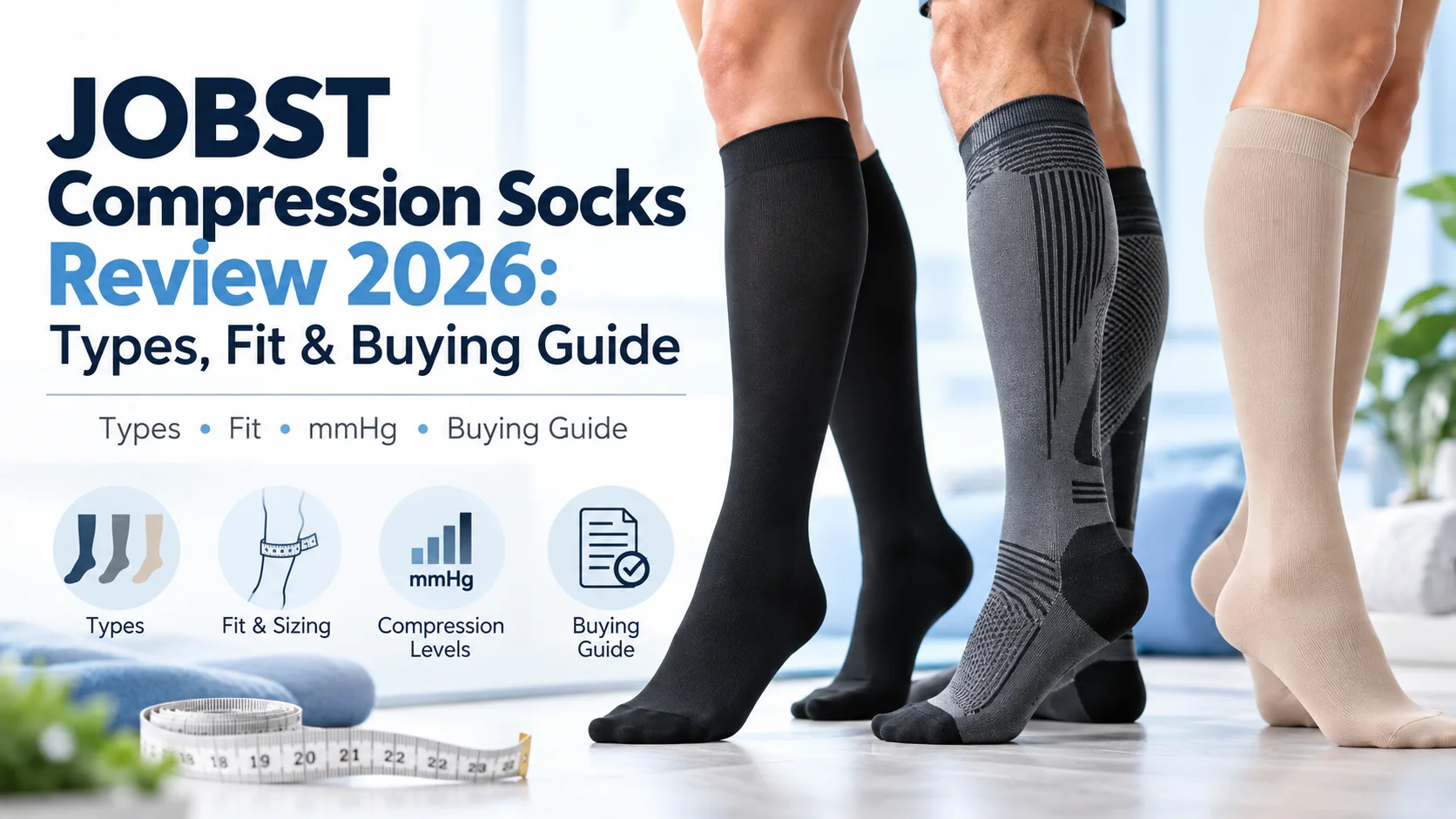
mHg, or millimeters of mercury. A higher number means stronger compression, not automatically a better sock. If compression is being used for a diagnosed condition, after surgery, or for significant swelling, the pressure level should come from the treating clinician rather than a “stronger is better” rule.
JOBST Compression Socks and Stockings Compared
JOBST’s range makes more sense when you compare each line by its practical purpose.
| JOBST Line | Current Compression Options | Practical Fit/Use Focus |
|---|---|---|
| JOBST Relief | 15–20, 20–30, 30–40 mmHg | Durable everyday medical compression; knee-high, thigh-high, chap and waist-high styles; open or closed toe; full-calf sizes on selected styles |
| JOBST Opaque | 15–20, 20–30, 30–40 mmHg | Soft, concealing fabric for people who prefer an opaque everyday or dress look |
| JOBST UltraSheer | Multiple medical compression levels, including 15–20, 20–30 and 30–40 mmHg | Sheer, lighter-looking hosiery; knee-high, thigh-high and waist-high configurations |
| JOBST Sport | 15–20, 20–30 mmHg | Athletic knee-high with breathable knit, cushioning, moisture management and odor-control features |
| JOBST ACTIVA Athletic | 8–15, 15–20, 20–30 mmHg | Thicker athletic-style sock for activity, travel and prolonged sitting or standing |
| JOBST ACTIVA Sheer | 8–15, 15–20, 20–30 mmHg | Lightweight, transparent everyday option |
| JOBST forMen | 15–20, 20–30, 30–40 mmHg | Men’s knee-high/thigh-high medical compression with open- and closed-toe choices on selected styles |
| JOBST Style | 15–20, 20–30, 30–40 mmHg | Patterned knee-highs with regular, petite and long lengths and full-calf sizes |
These specifications come from current JOBST U.S. product pages; exact colors, sizes, toe options and pressure levels can differ by configuration.
JOBST Relief: The Practical Medical-Style Option
JOBST Relief is the line many shoppers encounter when they search for traditional medical compression stockings. It is unisex, uses reinforced foot areas, and is offered in several garment lengths. The current U.S. range includes knee-high, thigh-high, chap and waist-high options, plus open- and closed-toe versions and full-calf sizes in selected configurations.
Its advantage is flexibility across compression, length and toe style. A traditional medical-style stocking, however, may not be the coolest or most discreet daily-wear choice.
JOBST Opaque vs UltraSheer
Choose between these primarily by fabric feel, appearance and coverage, not because one name sounds more medical.
JOBST Opaque uses soft yarns, moisture-management features and a concealing knit. It can make more sense if you want coverage for visible veins or prefer a more substantial fabric.
UltraSheer uses fine, breathable, satin-touch yarn and a transparent appearance, making it more suitable when discretion or dress wear matters. Both are available in multiple garment lengths and medical compression levels.
“Sheer” does not mean “weak.” Always check the mmHg for the exact product.
JOBST Sport and ACTIVA Athletic
JOBST Sport is the more purpose-built athletic option. JOBST lists breathable knit, moisture management, heel and sole cushioning, odor-control technology and a seamless toe section. It is currently offered as a knee-high in 15–20 and 20–30 mmHg.
ACTIVA Athletic is another active-lifestyle knee-high, but it uses thicker material and is available in 8–15, 15–20 and 20–30 mmHg. It may appeal to people who want a more conventional athletic-sock feel for walking, travel or long periods on their feet.
For runners and walkers, shoe fit also matters: thicker compression socks take up more room and may create pressure in snug footwear.
Which JOBST Compression Level Should You Choose?

The most common mistake is choosing the pressure before defining the purpose.
8–15 mmHg
This is mild compression found in selected ACTIVA products. It is generally the least intense of the ranges discussed here and may be marketed for everyday comfort or prolonged sitting and standing. It is not interchangeable with higher medical compression.
15–20 mmHg
This moderate range appears across many JOBST lines and may suit some everyday, work or travel uses. “Moderate” does not mean universally appropriate for every medical condition.
20–30 mmHg
This firmer range is widely available in JOBST’s medical and active lines. If you are treating persistent edema, post-procedure swelling or another diagnosed condition, use the level your clinician recommends.
30–40 mmHg
This is strong medical compression offered in lines such as Relief, Opaque, UltraSheer, forMen and Style. It should not be chosen merely because 20–30 mmHg “doesn’t sound strong enough.”
Higher pressure can also make a garment harder to apply and may be inappropriate when arterial circulation or sensation is impaired.
How to Size JOBST Compression Socks Correctly
For knee-high medical compression, ankle and calf circumference often matter more than shoe size. Length also matters because a sock that is too long may bunch behind the knee, while one that is too short may pull downward.
A practical measuring routine is:
- Measure the ankle at its narrowest point, just above the ankle bone.
- Measure the widest part of the calf.
- For knee-high length, measure from the floor to just below the bend of the knee while following the instructions for the specific JOBST chart.
- Compare all measurements with the chart for the exact product, compression level and style you plan to buy.
Do not assume that a larger shoe size means a larger compression size.
Regular vs Full Calf
“Full calf” is not simply a looser version of the same sock. It is intended for a different circumference range. JOBST currently lists full-calf sizes in products such as Relief, Opaque, UltraSheer, forMen, Style and ActiveWear.
If the ankle fits one size but the calf falls outside that size range, do not automatically size up. That can reduce the intended fit at the ankle. A full-calf option or professional fitting may solve the mismatch more appropriately.
Petite vs Regular vs Long
Petite sizing addresses leg length, not just body size. JOBST offers petite lengths in several lines, while some products also offer regular or long versions.
If standard knee-highs bunch behind your knee or thigh-highs sit in the wrong place, check the length measurement before blaming the compression level.
Knee-High, Thigh-High or Waist-High?

For many everyday users, knee-highs are easier to put on and integrate with normal clothing. They also cover the area where many people experience ankle and lower-leg swelling.
Thigh-high or waist-high stockings extend compression farther up the leg and may be chosen for specific medical or anatomical reasons. They are not automatically more effective for every person simply because they cover more area.
If a thigh-high repeatedly slides or rolls, the problem may be size, length, band position, skin products under the silicone band or the garment design. JOBST notes that rolling or sliding can happen when stockings are too tight or too large and recommends rechecking the size chart or fit.
Open Toe vs Closed Toe
Closed toe gives full foot coverage and feels more like a conventional sock. Open toe leaves the toes exposed and may be preferable when toe pressure, forefoot fit, ventilation or footwear makes a closed toe uncomfortable.
Open toe does not mean weaker leg compression.
Check the specific product before buying because not every JOBST line offers both options.
Who May Find JOBST Compression Socks Useful?
Depending on the product and pressure level, JOBST garments may be relevant to people who stand or sit for long periods, travelers, nurses, teachers, office workers, active adults, pregnant people advised to use compression, and people treated for venous conditions.
A travel sock and a prescribed garment for chronic venous insufficiency, lymphedema or recent surgery are not interchangeable. JOBST also makes specialized lymphedema garments and wraps, so an ordinary everyday knee-high should not be assumed to replace a prescribed lymphedema garment.
JOBST Compression Socks Safety: Who Should Ask a Healthcare Professional First?
Compression socks are safe for many people, but they are not appropriate in every situation.
Ask a qualified healthcare professional before self-selecting compression if you have peripheral artery disease (PAD), severely reduced sensation, peripheral neuropathy, significant or unexplained swelling, or a condition that affects arterial circulation.
Open wounds, skin infection or very fragile skin also require extra caution. Cleveland Clinic advises stopping and seeking guidance if compression causes pain, numbness, tingling, skin discoloration or worsening swelling.
For people with diabetes, the diagnosis alone does not automatically mean “use compression” or “avoid compression.” What matters includes circulation, sensation, skin condition, edema and the reason compression is being considered.
Reduced sensation can make pressure injury harder to notice, so neuropathy deserves particular care.
After surgery, use the garment type and pressure recommended by the surgical team. Anti-embolism stockings for immobilized surgical patients are a different category from ordinary everyday compression socks.
How Should JOBST Compression Socks Feel?
A properly fitted garment should feel snug and supportive, not painfully constricting.
Recheck the fit if you notice:
- Persistent numbness or tingling
- Increasing pain
- Unusual color change
- A deep, painful cuff line
- Fabric bunching at the ankle or behind the knee
- Repeated rolling or slipping
- Worsening swelling below or above the garment
Painful marks, neurologic symptoms or skin damage are not something to “push through.”
How to Put On JOBST Compression Stockings
Firmer compression is easiest to manage before the legs become more swollen. JOBST’s instructions generally recommend turning the stocking inside out to the heel, positioning the foot and heel first, then gradually working the fabric upward rather than pulling hard from the top.
Smooth the garment so it lies flat without creases. Rubber donning gloves can improve grip.
If hand strength, arthritis, mobility or 30–40 mmHg compression makes application difficult, a stocking aid may be more practical than repeatedly overstretching the garment.
Can You Wear JOBST Compression Socks All Day or Sleep in Them?
Many daytime compression garments are designed to be put on in the morning and removed later in the day.
Cleveland Clinic advises putting compression stockings on before swelling builds and generally taking them off before bed unless a clinician has given different instructions.
Do not assume that a daytime JOBST stocking should be worn overnight. Nighttime lymphedema garments and hospital anti-embolism stockings are different products with different instructions.
How to Wash JOBST Compression Socks
JOBST recommends washing compression garments daily or at least every other day with mild detergent and avoiding fabric softener, bleach and harsh laundry additives.
The company advises pressing out moisture without wringing and checking the product label for tumble-dryer compatibility; low heat is permitted for some garments.
JOBST’s U.S. FAQ suggests replacing garments about every six months under normal daily use and care, or sooner if they become excessively worn or the fit noticeably changes.
JOBST vs Sigvaris, Medi and Sockwell
Sigvaris and Medi both offer medical compression stockings across common ranges such as 15–20, 20–30 and 30–40 mmHg in selected U.S. lines.
Sockwell focuses more heavily on lifestyle and sport-style graduated compression, with its current information emphasizing 15–20 and 20–30 mmHg lifestyle compression and merino/bamboo-blend designs.
Instead of choosing by brand reputation alone, compare:
- Exact mmHg required
- Ankle, calf and length sizing
- Full-calf or petite availability
- Open vs closed toe
- Knee-high vs thigh-high/waist-high
- Fabric thickness and breathability
- Ease of donning
- Shoe compatibility
- Care requirements
- Whether the garment is intended for your medical use or simply everyday support
The most appropriate choice can differ from one person to another even when the compression number is identical.
Are JOBST Compression Socks Covered by Medicare?
Not every JOBST sock is automatically covered.
Medicare Part B currently covers certain lymphedema compression treatment items when eligibility requirements are met, including standard and custom-fitted gradient compression garments, wraps and related supplies when ordered for lymphedema.
That benefit should not be interpreted as blanket Medicare coverage for ordinary travel, sport or everyday compression socks.
JOBST Compression Socks Buying Checklist
Before ordering, answer these questions:
- Why are you wearing compression? Everyday comfort, travel, work, exercise and prescribed medical treatment are different use cases.
- What pressure is appropriate? Do not move from 15–20 to 30–40 mmHg simply for “more support.”
- Do your ankle, calf and length measurements fit the same size?
- Do you need full calf, petite or long sizing?
- Would open toe solve a toe-box or forefoot comfort problem?
- Do you prefer a sheer, opaque, athletic or traditional medical fabric?
- Can you put the garment on safely and consistently?
- Does your health history make clinician guidance important?
For general shopping, JOBST lists authorized online sellers and a U.S. dealer locator on its website.
Frequently Asked Questions
Are JOBST Compression Socks Worth It?
They can be worth considering when the line offers the pressure, length, toe style and sizing you need. Fit and compression level matter more than the label alone.
Which JOBST Compression Sock Is Most Comfortable?
Comfort is subjective. UltraSheer prioritizes a light, sheer appearance; Opaque uses softer, concealing fabric; Sport adds cushioning and moisture-management features; ACTIVA soSoft is designed around a soft, breathable feel.
The most comfortable option still needs to fit correctly.
Are JOBST Socks Good for Swelling and Varicose Veins?
Graduated compression is used to manage some venous conditions and swelling, but new, severe, one-sided or unexplained swelling should be medically assessed rather than self-treated with stronger compression.
Why Do My JOBST Stockings Roll Down?
Common possibilities include the wrong size, wrong length, a calf/ankle mismatch, or a top band that is not suited to your shape. JOBST specifically advises checking sizing when stockings roll or slide.
Can I Sleep in JOBST Compression Socks?
Do not assume a daytime compression stocking should be worn overnight. Unless your clinician or the specific medical-product instructions say otherwise, daytime stockings are generally removed before sleep.
Are JOBST Compression Socks Safe for Diabetes?
They may be appropriate for some people with diabetes, but diabetes is not enough information to choose compression.
Neuropathy, circulation, skin condition, wounds and swelling all matter. People with reduced sensation or circulation problems should get individualized guidance before using firm compression.
How Long Do JOBST Compression Socks Last?
JOBST suggests replacement around every six months with normal daily use and care, or sooner if the garment becomes worn or its fit changes.
Where Can I Buy JOBST Compression Socks?
JOBST’s U.S. website links to authorized online sellers and provides a dealer locator. Availability varies by model, size and compression level.
Final Take
JOBST Compression Socks are most useful when you treat them as a fit-and-function system, not a one-size-fits-all product.
Relief is a flexible medical-style choice; Opaque and UltraSheer address different appearance and fabric preferences; Sport and ACTIVA Athletic target active or everyday use; and several lines include full-calf, petite, open-toe or stronger-compression configurations.
Start with the reason you need compression, then choose the appropriate mmHg, measure your ankle and calf, check leg length, and only then select the style.
If you have PAD, neuropathy, wounds, significant unexplained swelling, recent surgery or another vascular concern, involve a healthcare professional before choosing compression on your own.
Medical Information Notice: This article provides general educational and product-selection information. It is not a diagnosis or a substitute for individualized medical advice. If you have a diagnosed circulation condition, major swelling, reduced sensation, wounds, skin infection or another medical concern, ask a qualified healthcare professional what type of compression, if any, is appropriate for you.
Sources & Medical References
- JOBST USA: Relief, Opaque, UltraSheer, Sport, ACTIVA Athletic, ACTIVA Sheer, forMen, Style and product-care information.
- Cleveland Clinic: Compression Socks safety and wear guidance; Compression Therapy overview.
- Cleveland Clinic: Diabetes-Related Neuropathy and Diabetes-Related Foot Conditions.
- Medicare.gov: Lymphedema Compression Treatment Items coverage.
- Centers for Medicare & Medicaid Services: Lymphedema Compression Treatment Items benefit information.
- Sigvaris, medi USA and Sockwell: Current manufacturer information used for the brand-comparison section.

2 thoughts on “JOBST Compression Socks Review 2026: Types, Fit & Buying Guide”