

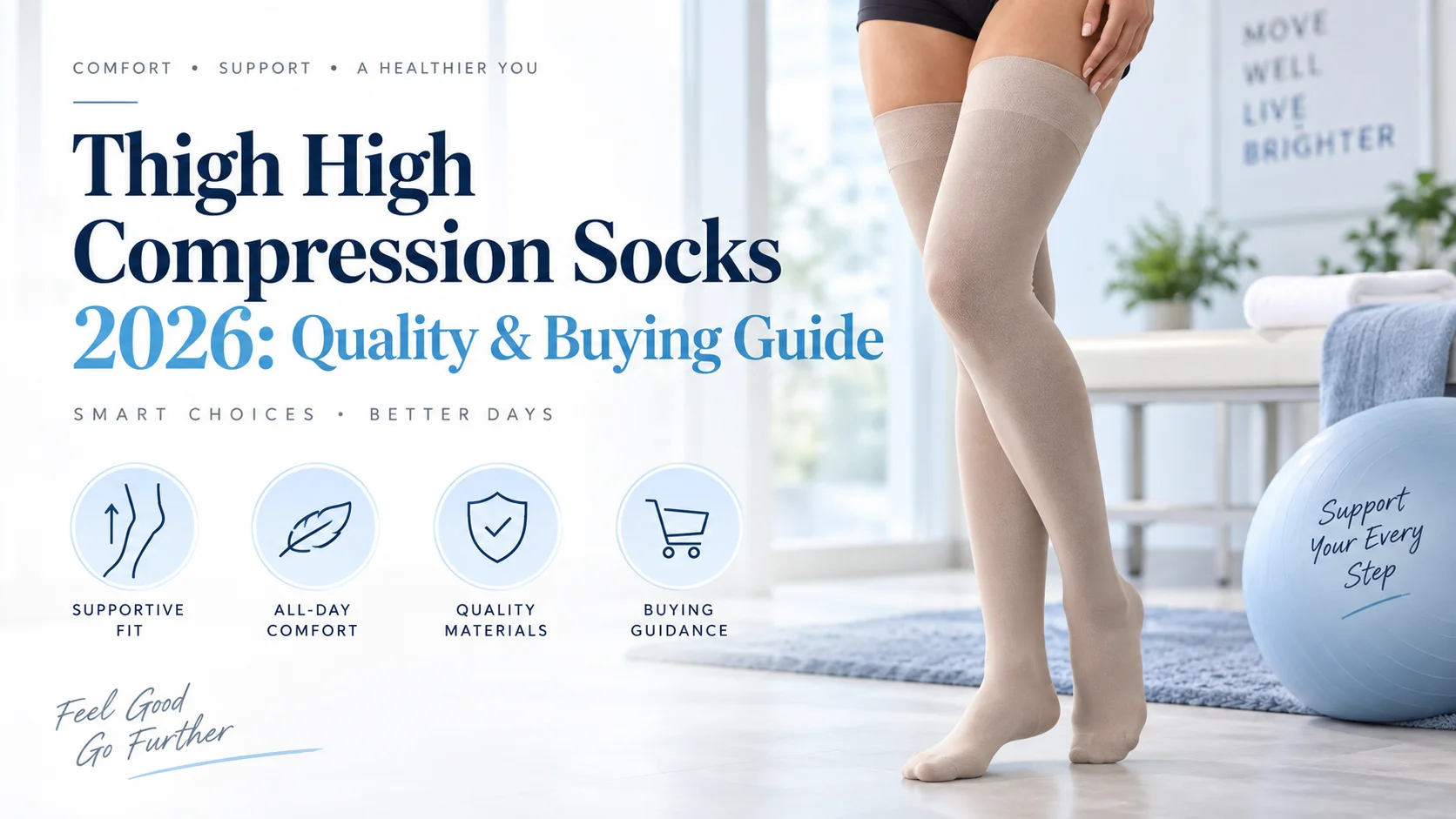
Choosing thigh high compression socks is not simply a matter of buying a longer sock. The important decisions are whether you actually need compression above the knee, what pressure level is appropriate, how the stocking should fit at the ankle, calf and thigh, and whether features such as an open toe or silicone top will make it practical to wear.
Thigh-high compression can be useful when swelling, venous symptoms or a clinician-directed treatment plan involves more of the leg than a knee-high garment covers. For other people, a correctly fitted knee-high is simpler and more comfortable. This guide explains 15–20, 20–30 and 30–40 mmHg options, sizing, stay-up features, travel and work use, pregnancy, postoperative considerations and key safety points.
Quick Answer: What Are Thigh High Compression Socks Used For?
Thigh-high compression stockings extend from the foot and ankle to the upper thigh. Most graduated designs apply the greatest pressure near the ankle and progressively less pressure higher up the leg. This pressure gradient is intended to support venous return and reduce blood and fluid pooling in the lower extremity.
They may be useful when symptoms or prescribed compression extend above the knee, when a clinician specifically recommends thigh-length compression, or when someone wants full-leg coverage without the waistband of compression pantyhose.
They are not automatically the best choice for every traveler, nurse, office worker or person with varicose veins. Garment length, pressure, fit and comfort are separate decisions.
How Thigh High Compression Stockings Work
Graduated compression uses external pressure to support the veins. Pressure is usually strongest at the ankle and decreases farther up the leg, helping oppose pooling and support blood flow back toward the heart. Compression can also help manage some forms of leg swelling by limiting fluid accumulation in tissues.
Walking still matters. The calf-muscle pump squeezes the deep veins during movement and helps move blood upward against gravity. Compression supports this system; it does not replace normal movement.
A thigh-high garment extends compression above the knee. That added coverage can be useful when the treatment area includes the thigh, but more fabric also creates more opportunity for heat, slipping, rolling and sizing problems.
15–20 vs 20–30 vs 30–40 mmHg Thigh High Compression
Compression strength is expressed in mmHg, or millimeters of mercury. Descriptions such as mild, moderate, firm and extra-firm vary somewhat by brand, so the pressure range matters more than the marketing label.
| Compression level | Typical context | Buying consideration |
|---|---|---|
| 15–20 mmHg | Lighter support for everyday comfort, mild swelling or some travel use | Usually easier to put on and tolerate |
| 20–30 mmHg | Firmer compression used for more substantial swelling or venous-management needs | Fit is critical; medical guidance is sensible when treating a diagnosed condition |
| 30–40 mmHg | High compression used in selected medical situations | Best chosen with professional assessment and fitting |
Mayo Clinic advises particular care with higher compression levels because some people have conditions that make strong compression unsuitable.
Do not combine length and pressure into one assumption. You can need thigh-high coverage without needing high compression, or need firmer compression without needing a thigh-length garment.
Thigh High vs Knee High Compression Socks

Thigh-high stockings are not inherently more effective simply because they cover more leg. A Cochrane review found insufficient high-quality evidence to establish that thigh-length stockings were better than knee-length stockings for DVT prevention after surgery. In a randomized trial of people with proximal DVT, thigh-length stockings did not provide better protection against post-thrombotic syndrome and were less well tolerated.
Thigh-high may make more sense when swelling or venous symptoms extend above the knee, when a clinician prescribes thigh-length compression, or when a knee-high ends below an area that needs support.
Knee-high may make more sense when the problem is mainly below the knee and ease of use matters. It is usually simpler to size, put on and keep in place. For long-distance travel, CDC guidance for travelers at increased VTE risk discusses properly fitted below-the-knee graduated stockings rather than assuming thigh-high coverage is required.
The practical choice is the least complicated garment that covers the area needing support, fits correctly and matches the intended use.
Best Thigh High Compression Socks by Use Case
There is no single “best” thigh-high stocking. The best design depends on why you are wearing it.
Swelling, Edema and Venous Insufficiency
Start with the location of swelling, the compression level and accurate measurements. Compression is commonly used to help manage swelling and discomfort associated with chronic venous insufficiency, but severe or unexplained swelling should be medically evaluated instead of treated by simply choosing a stronger stocking.
Sudden one-sided swelling, pain, warmth or discoloration needs prompt medical attention because these can occur with DVT.
Varicose Veins and Spider Veins
Thigh-high stockings may be useful when visible or symptomatic veins extend above the knee. Compression may help with symptoms related to venous pooling, but it does not remove the underlying vein problem.
Painful veins, bleeding, skin changes or marked swelling deserve professional assessment rather than simply moving to a stronger compression level.
Nurses, Standing Jobs and Long Work Shifts
For prolonged standing, focus on a top band that stays flat, enough length to avoid pulling at the knee, and a compression level you can realistically wear for the intended period.
Fabric matters too. Nylon, microfiber and elastane blends are common because they combine stretch with elastic recovery. Sheer styles can feel lighter, while opaque styles may feel more substantial and provide more coverage.
Sitting All Day
Compression can help some people manage dependent swelling or leg heaviness, but it should not replace movement.
Take regular walking breaks when possible and flex the ankles and calves during long periods of sitting.
Pregnancy
Pregnancy can increase leg swelling and DVT risk. ACOG notes that below-knee or full-length compression stockings may be used during travel but recommends discussing them with an obstetric clinician because some people have reasons not to use compression.
Thigh-high garments can also become harder to put on later in pregnancy, making ease of application and top-band comfort particularly important.
Travel and Long Flights
Travel lasting more than four hours can increase blood-clot risk, especially when other risk factors are present. CDC recommends movement and calf exercises and notes that some higher-risk travelers may benefit from graduated compression stockings after discussing prevention with a clinician.
Do not assume thigh-highs are necessary for flying. Properly fitted knee-high compression is often the more typical evidence-based travel option.
After Surgery, DVT or for Lymphedema
These are clinician-directed situations. Hospital anti-embolism stockings, everyday graduated compression socks and higher-pressure medical garments may look similar, but they are not interchangeable.
| Thigh-High Product | Compression | Best For | Key Features | Main Limitation | Amazon |
|---|---|---|---|---|---|
| Truform 0878 Thigh High Open Toe | 15–20 mmHg | Everyday support, travel & lighter compression | Graduated thigh-high compression, open-toe design and stay-up dot top | Thigh, calf and ankle measurements should match the size chart | Check Price on Amazon |
| Sigvaris Soft Opaque Thigh-High | 15–20 mmHg | Work, professional wear & travel | Soft opaque microfiber construction, grip top and thigh-high graduated compression | Exact toe style and size should be confirmed on the selected listing | Check Price on Amazon |
| Truform 0868 Thigh High Open Toe | 20–30 mmHg | Firmer graduated support when appropriate | Firm thigh-high compression, open toe and dot-top stay-up band | Firmer compression can be harder to apply and may require clinical guidance | Check Price on Amazon |
| mediven Comfort Thigh High | 20–30 mmHg | Comfort-focused firm compression | Soft thigh-high construction, moisture management, standard/petite lengths and open- or closed-toe options | Proper circumference and length measurements are important | Check Price on Amazon |
| JOBST Relief Thigh-High Compression Stockings | 30–40 mmHg | High compression when professionally recommended | Thigh-high graduated compression with durable reinforced foot construction | High compression should not be treated as a casual upgrade; professional guidance is important | Check Price on Amazon |
Note: Product availability, toe style, compression level and sizing can vary by listing. Verify the exact Amazon product and manufacturer size chart before ordering. Higher compression levels may require professional guidance.
After surgery, garment length, pressure and duration depend on the procedure, mobility and clot risk. Hospital guidance emphasizes assessment and correct fitting.
If you have a current or recent DVT, lymphedema or a postoperative compression plan, follow the instructions of the clinician managing the condition rather than choosing a level based only on online descriptions.
Open Toe vs Closed Toe Thigh High Compression Stockings

Open-toe thigh-high stockings leave the toes uncovered. They may suit people who want more forefoot room, more ventilation or easier visual access to the toes.
Closed-toe stockings cover the entire foot and may feel more like ordinary hosiery. They can also be convenient inside closed shoes.
Neither style is inherently more therapeutic. Check whether the heel sits correctly, the foot section feels comfortable and the garment matches the intended use.
Silicone Bands, Grip Tops and Stockings That Stay Up
Most thigh-high stockings use a stay-up system near the upper thigh. Silicone bands, silicone dots or grip tops can improve hold, but they cannot compensate for the wrong size.
Repeated slipping may mean the thigh circumference or leg length is wrong, the grip is worn, lotion is reducing traction, or the stocking is not distributed evenly.
If the top rolls into a narrow band, do not fold it over to make it stay. That can concentrate pressure. Recheck sizing and length instead.
Sensitive-skin users may prefer a wider, softer or non-silicone top. Persistent redness, itching or skin damage is a reason to stop and reassess the fit or material.
How to Measure for Thigh High Compression Socks

Shoe size alone is not enough. Thigh-high sizing usually depends on several leg measurements, and size charts differ between brands.
Measure when swelling is lowest, often early in the morning, with a soft measuring tape on bare skin. Mayo Clinic also recommends measuring when the legs are not swollen, generally early in the day.
- Ankle circumference: Measure the narrowest area above the ankle bone.
- Calf circumference: Measure the widest part of the calf.
- Thigh circumference: Measure the upper thigh at the location specified by the manufacturer, commonly below the gluteal fold.
- Leg length: Measure from the floor or heel area to the upper-thigh point specified by the size chart.
Thigh-high sizing guides commonly use ankle, calf, thigh and length measurements rather than shoe size alone.
Why Thigh-High Stockings Roll, Pinch or Bunch
If the garment is too long, material can gather behind the knee or near the top. If the thigh is too small for the selected size, the band may dig in or roll. If the ankle is too loose, the stocking may not provide the intended graduated fit even if the thigh feels comfortable.
Plus-size users should not simply size up without checking ankle and calf ranges. A wide-thigh or plus-size cut that still matches the lower-leg measurements is usually a better approach.
Petite users should check length carefully because excess fabric can bunch even when circumference measurements are correct.
How Should Thigh High Compression Socks Fit?
A properly fitted stocking should feel snug and supportive rather than painful. The heel should sit in place, the fabric should lie smooth, and the upper band should remain flat.
Remove the stocking and seek advice if you develop pain, numbness, tingling, skin discoloration, skin damage or worsening swelling. Cleveland Clinic specifically identifies these as warning signs that compression may be too tight or unsuitable.
Wrinkles and persistent bunching are not harmless details. Uneven folds create concentrated pressure and usually signal an application or sizing problem.
How to Put On and Remove Thigh High Compression Stockings
Application is usually easiest early in the day before swelling increases.
- Start with clean, dry skin.
- Turn the stocking partly inside out to the heel.
- Position the foot and heel correctly.
- Work the fabric over the ankle and calf in small sections.
- Continue up the thigh without pulling hard on the top band.
- Smooth out every wrinkle and leave the top band flat.
MedlinePlus recommends keeping compression stockings free of bunches and wrinkles and notes that a stocking donner can help if application is difficult.
To remove them, peel the garment down gradually instead of yanking from the top. Grip gloves can make handling easier and help protect sheer material from fingernails.
Can You Wear Thigh High Compression Socks All Day or Sleep in Them?
Some people are instructed to wear compression for most of the day, while others use it only during specific activities. MedlinePlus notes that prescribed compression may be worn all day, but the schedule should follow the instructions for the individual situation.
Sleeping in thigh-high compression is not a universal recommendation. Some postoperative anti-embolism protocols require overnight wear, while many everyday graduated stockings are used during waking hours.
Follow the plan for your specific garment and medical situation.
Who Should Use Caution With Thigh High Compression?
Professional assessment is especially important with known or suspected peripheral artery disease (PAD), severe or unexplained swelling, markedly reduced sensation from neuropathy, significant wounds or skin infection, or complex medical causes of leg swelling.
Cleveland Clinic advises provider guidance for PAD and careful risk-benefit assessment for people with severely reduced sensation, including diabetes-related neuropathy.
Diabetes by itself does not automatically make compression inappropriate. The bigger safety questions are whether diabetes is accompanied by neuropathy, arterial disease, wounds, skin injury or other circulation problems that can change how safely pressure is tolerated.
Seek prompt medical evaluation for sudden one-sided swelling, unexplained leg pain, warmth or discoloration.
Seek emergency care for unexplained shortness of breath, chest pain, coughing up blood, fainting or severe lightheadedness because these can occur with pulmonary embolism.
Thigh High Compression Socks Buying Guide
Before buying, check:
- Purpose: everyday comfort, swelling management, work, travel, pregnancy or clinician-directed treatment.
- Compression level: choose for the intended use, not by “strongest available.”
- Coverage: make sure compression above the knee is actually useful.
- Sizing: match ankle, calf, thigh and length to the exact product chart.
- Top band: it should stay flat without digging in.
- Toe design: choose open or closed toe for comfort and footwear.
- Fabric: balance durability, opacity, heat and breathability.
- Ease of use: higher compression is harder to apply; a donning aid can help.
- Skin tolerance: change the band or material if irritation persists.
- Care: follow washing directions to protect elasticity.
The best thigh-high compression socks are not necessarily the strongest. They are the ones that provide the intended pressure, fit all key measurements, stay smooth and are practical enough to wear consistently.
FAQs About Thigh High Compression Socks
Are Thigh High Compression Socks Better Than Knee High?
Not automatically. Thigh-highs provide more coverage, but research has not shown a universal advantage for DVT-related outcomes. The best length depends on the treatment area, fit, comfort and clinical purpose.
What mmHg Thigh High Compression Socks Should I Buy?
There is no single level for everyone. 15–20 mmHg is lighter, 20–30 mmHg is firmer, and 30–40 mmHg is high compression. Medical conditions and the reason for use can change what is appropriate.
Is 20–30 mmHg Too Strong?
It can be suitable for some people and unnecessarily strong for others. If you have vascular disease, neuropathy, significant swelling or are using compression after a medical event, get professional guidance.
Is 30–40 mmHg Thigh-High Compression Safe?
It is used in selected medical situations but should not be treated as a casual upgrade. Accurate fitting and professional assessment are particularly important.
Should Thigh High Compression Socks Reach the Groin?
They usually finish high on the thigh rather than being pulled tightly into the groin crease. Follow the specific brand’s measurement and placement instructions.
Why Do Thigh High Compression Stockings Roll Down?
Common reasons include the wrong thigh size, excessive length, a worn grip band, lotion interfering with silicone, or uneven application.
Are Silicone Bands Safe?
Many people tolerate them well, but silicone can irritate some skin. A band that causes persistent redness, itching, blistering or skin injury should not be ignored.
Can Thigh High Compression Socks Prevent Blood Clots?
They can be one part of prevention for selected people, but they cannot guarantee prevention and do not replace movement, medical risk assessment or prescribed medication.
Can I Wear Thigh High Compression Stockings After Surgery?
Only according to your surgical or medical team’s instructions. Postoperative anti-embolism stockings and everyday compression products may have different intended uses.
Are Thigh High Compression Socks Safe With Diabetes or Neuropathy?
Not automatically. Reduced sensation, PAD, wounds and circulation problems can change the risk, so suitability and compression level may need professional assessment.
Final Takeaway
Thigh high compression socks are most useful when compression genuinely needs to extend above the knee. The right pair depends on the reason for use, pressure level, ankle-to-thigh measurements, leg length, top-band comfort and your ability to wear the garment correctly.
Do not treat thigh-high length or stronger mmHg as an automatic upgrade. For routine work, travel or mild symptoms, a simpler option may be enough. For DVT, post-surgery care, significant edema, lymphedema, PAD, neuropathy or other vascular concerns, the safest choice is guided by a qualified healthcare professional.
Medical information notice: This article provides general educational information and is not a substitute for individualized medical advice. If you have diagnosed circulation disease, significant or unexplained swelling, loss of sensation, wounds, a recent blood clot or a postoperative compression plan, ask a qualified healthcare professional what type and level of compression is appropriate.
Sources & Medical References
- Cleveland Clinic — Compression therapy and current compression-sock safety guidance.
- MedlinePlus — Compression stockings, fit, wear and application guidance.
- Mayo Clinic Store — Compression stocking measurement and compression-level guidance.
- CDC — Travel-associated DVT risk and graduated compression guidance.
- American College of Obstetricians and Gynecologists (ACOG) — Pregnancy, travel and DVT prevention guidance.
- Cochrane — Knee-length versus thigh-length graduated compression stockings after surgery.
- PubMed — Randomized comparison of thigh-length and below-knee stockings following proximal DVT.

1 thought on “Thigh High Compression Socks 2026: Quality & Buying Guide”