

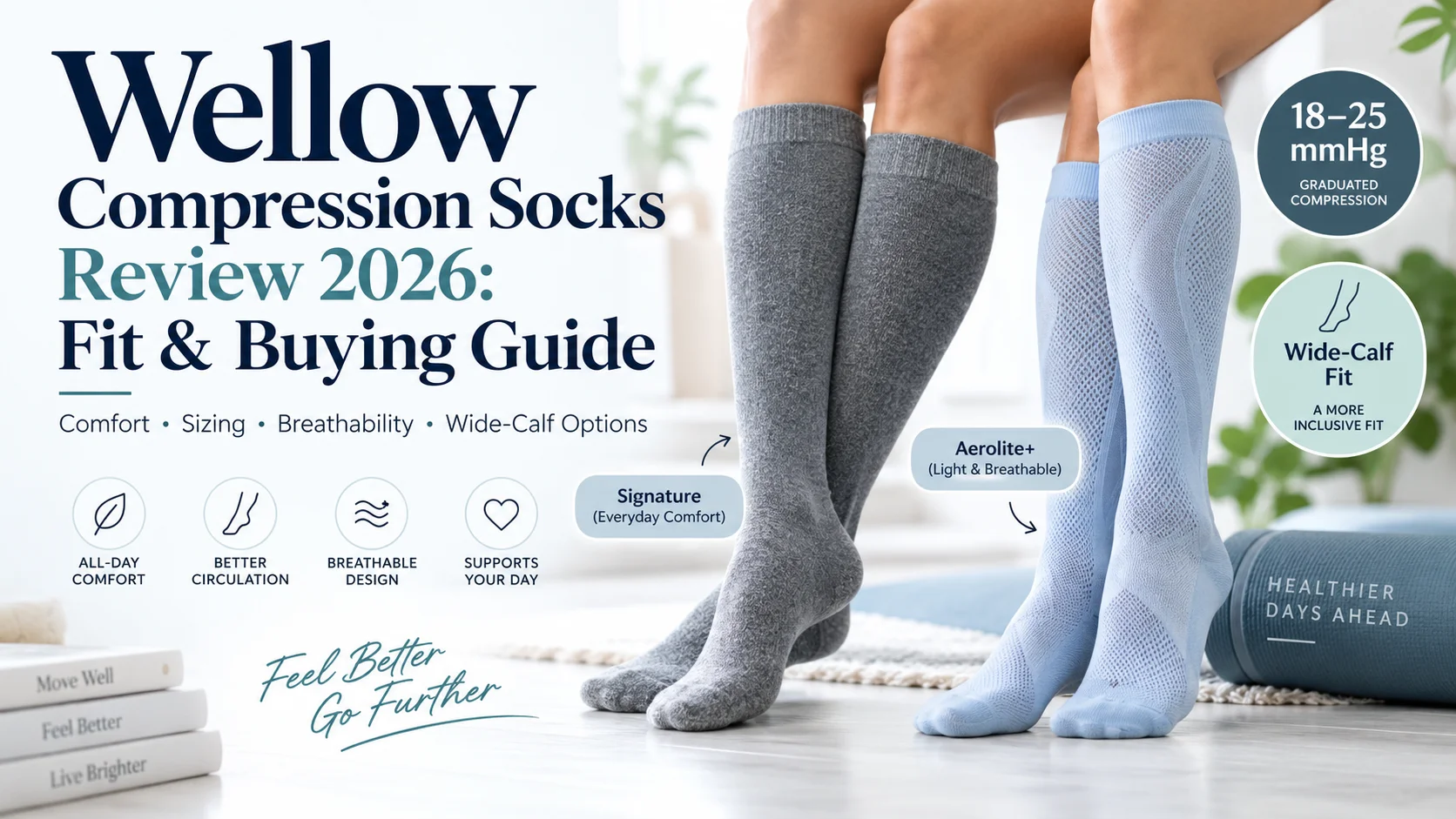
If you are considering Wellow Compression Socks, the useful questions are whether the 18–25 mmHg compression level matches your needs, whether the knee-high length and calf sizing will fit correctly, and whether Signature or Aerolite+ makes more sense for your day.
For 2026, Wellow’s main knee-high options are the Signature line for plush, year-round wear and Aerolite+ for a lighter, cooler feel. Both use graduated 18–25 mmHg compression and come in standard and wide-calf sizing. The range is especially relevant to people who stand or sit for long periods, travelers, nurses, teachers, office workers, and buyers who have struggled with narrow compression socks.
Wellow is not automatically right for everyone, though—especially if a clinician has prescribed another compression level or you have a condition that makes compression unsafe without medical guidance.
Quick Answer: Are Wellow Compression Socks Good?
Wellow has a clear niche: soft-feeling, knee-high graduated compression with broad calf options and an 18–25 mmHg range.
Signature uses a bamboo-viscose blend and focuses on cushioned everyday comfort, while Aerolite+ adds open-knit ventilation, cooling technology and 19,000 micro-perforations. Wellow states that Aerolite+ tested 23.6% more breathable than its original knee-high sock in independent laboratory testing in May 2025.
They make the most sense for buyers who want noticeable daily support but do not specifically need a standard 20–30 mmHg product.
They may be less suitable if you need open-toe stockings, thigh-high coverage, a prescription compression class, a very short petite length, or a wool-heavy compression sock.
| Best fit for | Why Wellow may suit them |
|---|---|
| Long shifts and standing jobs | Knee-high graduated compression with a softer everyday construction |
| Desk work and prolonged sitting | Moderate support for long sedentary periods |
| Wide calves | Wide-calf line is advertised for 18–22-inch calves |
| Warm-weather wear | Aerolite+ focuses on ventilation and cooling |
| Soft-fabric preference | 63% viscose made from bamboo in the verified blend |
| Travelers | Knee-high design suited to long periods of sitting |
What Wellow Offers in 2026

Wellow’s lineup is simpler than brands selling several compression classes.
Signature and Aerolite+ knee-high socks use the same 18–25 mmHg pressure range, so the main choice is about fabric feel and temperature rather than stronger versus weaker compression.
Wellow Signature Compression Socks
Signature is the classic Wellow knee-high. The company positions it as its plush, year-round option.
The verified blend is:
- 63% viscose made from bamboo
- 29% polyester
- 5% elastane
- 3% nylon
Wellow also describes four-way stretch, moisture management, a seamless toe and a comfort-focused cuff.
Signature makes sense if softness matters more than maximum ventilation. It may also suit cooler weather or air-conditioned workplaces.
If you wear close-fitting dress shoes or narrow sneakers, remember that sock thickness can affect shoe fit.
Wellow Aerolite+ Compression Socks
Aerolite+ keeps the same 18–25 mmHg compression but is designed around heat management.
Wellow says it uses dual cooling technology, 19,000 micro-perforations and open-knit airflow. The company reports that it was 23.6% more breathable than its original compression sock in independent lab testing completed in May 2025.
That makes Aerolite+ the more logical Wellow option for hot climates, summer travel, healthcare shifts, teaching or anyone who tends to overheat in tall socks.
The breathability figure is a manufacturer-reported product comparison. It should not be interpreted as evidence that Aerolite+ provides better medical outcomes.
Wellow Signature vs Aerolite+: Which One Fits Your Use?
Both models provide the same stated graduated compression, so choosing between them is mainly a comfort decision.
| Feature | Signature | Aerolite+ |
|---|---|---|
| Compression | 18–25 mmHg | 18–25 mmHg |
| Main focus | Plush, year-round comfort | Cooler, lighter warm-weather wear |
| Fabric base | Bamboo-viscose blend | Bamboo-viscose blend |
| Cooling design | Standard knit | Dual cooling + micro-perforations |
| Best match | Daily wear, cooler months | Summer, travel, long shifts |
| Wide sizes | Available | Available |
If you normally stop wearing compression socks because they feel hot, Aerolite+ addresses the more relevant problem.
If temperature is not a major concern and you prefer a softer, fuller feel, Signature is the simpler option.
Neither model fixes an incorrect compression level, wrong calf size or excessive sock length.
What Does 18–25 mmHg Compression Mean?

mmHg means millimeters of mercury, a unit used to describe pressure.
Graduated knee-high compression applies greater pressure toward the lower part of the leg and progressively less pressure farther upward. This can help support venous blood flow and limit fluid accumulation in appropriate users.
Wellow calls 18–25 mmHg moderate compression.
It overlaps the space between common 15–20 mmHg and 20–30 mmHg retail ranges, but shoppers should not assume that every brand’s category labels are interchangeable.
If a healthcare professional prescribed a specific compression range, follow that instruction rather than substituting a nearby number simply because another sock looks more comfortable.
Compression stockings can help reduce lower-leg swelling and support blood flow in some situations. Cleveland Clinic explains that compression socks apply pressure to the legs, helping limit fluid buildup and support blood flow toward the heart. Mayo Clinic also notes that compression stockings may help with leg swelling and may be recommended in some long-distance travel situations.
Stronger compression is not automatically better. The appropriate level depends on why you are wearing compression and, for medical conditions, on clinical assessment.
Wellow Compression Socks for Work, Standing and Sitting
Nurses, healthcare workers, teachers, retail staff and others who spend long shifts standing often care about three things: support that remains tolerable for hours, a cuff that stays in place, and fabric that does not become excessively hot.
Wellow’s knee-high construction, 18–25 mmHg pressure and stretch fabric align with those priorities.
Aerolite+ may be especially interesting for nurses, teachers or other workers in warmer environments because its design focuses more heavily on airflow.
Desk workers face a different issue: prolonged sitting means less frequent calf-muscle movement.
Compression can provide external support, but it should not replace movement. Standing periodically, walking when possible and moving your ankles are still useful habits during a long workday.
A work compression sock should feel snug and supportive, not painful.
If the top band rolls into a tight cord, fabric bunches behind the knee, your foot becomes numb, or your toes develop unusual color changes, address the fit instead of assuming the sock simply needs to be “broken in.”
Wellow Compression Socks for Travel and Flying
Long flights combine prolonged sitting with limited leg movement, which can contribute to temporary ankle and foot swelling.
Mayo Clinic notes that sitting for long periods can cause blood to pool in leg veins and that compression stockings can help reduce swelling during long flights. People at higher risk of blood clots should discuss appropriate travel precautions with a healthcare professional.
Wellow can be a practical travel option for people who already know that 18–25 mmHg compression is appropriate for them.
Aerolite+ may have an additional comfort advantage during warm airport days or lengthy travel because ventilation is one of its main design priorities.
Compression socks are only one part of travel comfort. Change position, move your ankles and legs, and walk periodically when it is safe to do so.
Do not use Wellow or another retail compression sock as self-treatment for a suspected blood clot or unexplained one-sided swelling.
Wellow for Swelling, Tired or Heavy Legs
Compression socks are commonly purchased for ankle swelling, heavy legs and end-of-day fatigue, but these symptoms can have many causes.
In suitable users, graduated compression may help limit fluid accumulation and provide supportive pressure during the day. That does not mean a sock can diagnose or treat the underlying cause of swelling.
Persistent, severe or unexplained swelling deserves medical evaluation.
Sudden swelling in one leg—particularly when accompanied by pain, warmth or a skin-color change—can be associated with deep vein thrombosis and should not be managed simply by putting on compression socks.
For ordinary end-of-day heaviness after long periods of standing or sitting, fit matters almost as much as pressure.
A correctly fitted knee-high should lie smoothly against the leg without deep folds or concentrated pressure bands.
Wellow Compression Socks Sizing: Calf Measurement Matters
For knee-high compression socks, shoe size alone is not enough.
Wellow instructs users to measure around the widest part of the calf and use that measurement together with shoe size.
Current options include:
- S
- M
- L
- XL
- M-Wide
- L-Wide
- XL-Wide
Wellow currently advertises its wide-calf knee-high collection for calves measuring 18–22 inches.
Measure with the tape level around the fullest part of your calf without pulling it deeply into the skin.
If your shoe size suggests one size but your calf circumference points in another direction, use Wellow’s current size chart rather than guessing.
What if Wellow Compression Socks are too long?
Wellow lists approximate sock lengths of:
- Small: 15 inches
- Medium: 15 inches
- Large: 15.4 inches
- XL: 15.8 inches
Length matters because excess fabric can bunch behind the knee or encourage the wearer to fold the cuff downward.
Cleveland Clinic advises avoiding wrinkles or bunching and not folding over the top of compression stockings.
Petite users should therefore consider lower-leg length as well as calf circumference.
A technically correct calf size can still feel uncomfortable if the sock extends too high on a shorter leg.
Why do Wellow socks roll down or feel too tight?
Rolling is often a fit issue rather than proof that the compression level itself is wrong.
Possible causes include:
- An oversized sock sliding down
- An undersized cuff digging into the calf
- Too much sock length
- Fabric bunching
- Uneven application
Wide-calf users should not simply size up in the foot to gain more calf room. A dedicated wide size helps preserve a more appropriate relationship between foot, ankle and calf fit.
Materials, Breathability and Skin Comfort

Wellow’s verified fabric blend—63% viscose made from bamboo, 29% polyester, 5% elastane and 3% nylon—helps explain the brand’s soft, stretchy construction.
“Bamboo compression socks” can be confusing shorthand.
Wellow specifically describes the material as viscose made from bamboo, rather than raw bamboo fiber. That is the more accurate way to describe the material.
People who are sensitive to heat may prefer Aerolite+. People who want a more substantial year-round sock may lean toward Signature.
If any compression sock causes persistent itching, rash or skin irritation, remove it and investigate the cause instead of continuing to wear it through discomfort.
How to Put On Wellow Compression Socks More Easily
Compression socks are generally easier to put on when your legs are dry and before significant swelling develops.
A practical method is:
- Reach inside the sock and bring it inside out to the heel.
- Place your foot completely into the foot section.
- Make sure the heel sits inside the heel pocket.
- Gradually bring the remaining fabric upward over the calf.
- Smooth wrinkles instead of pulling forcefully from the top cuff.
The heel should sit correctly, the toe section should not pull excessively across the toes, and the upper band should lie flat.
Grip gloves or a stocking aid can help people who have difficulty with hand strength, flexibility or bending.
If Wellow socks are consistently difficult to put on, do not automatically buy a larger size. Recheck both calf and shoe measurements first.
An oversized compression sock may become easier to pull on but can slide, bunch or fit differently from its intended design.
How Long Can You Wear Wellow Compression Socks?
Wellow says its moderate compression socks are designed for daytime all-day wear. The company recommends several hours of daytime wear and says it does not recommend wearing compression socks while sleeping for long periods unless a medical provider specifically advises doing so.
Cleveland Clinic similarly advises putting compression stockings on in the morning and generally removing them before bed unless your healthcare professional gives different instructions.
Pay attention to your skin and symptoms rather than simply watching the clock.
Remove the stockings and seek appropriate advice if you develop pain, numbness, tingling, skin discoloration, skin damage or worsening swelling.
How to Wash Wellow Compression Socks
Wellow recommends either hand washing or machine washing in cold water on a gentle cycle with mild detergent.
The company says its socks may be air-dried or placed in a dryer on low heat. Bleach and oxygen boosters are discouraged.
Care matters because compression depends on elastic fibers maintaining their shape.
Replace the socks when they become noticeably stretched, damaged or no longer maintain their intended supportive fit.
Where to Buy Wellow Compression Socks and Current Price
The most directly verifiable place to buy Wellow Compression Socks is Wellow’s official website.
| Wellow Product | Compression | Best For | Key Features | Main Limitation | Amazon |
|---|---|---|---|---|---|
| Wellow Signature Compression Socks | 18–25 mmHg | Everyday wear, work, standing & travel | Plush bamboo-viscose blend, graduated compression, 4-way stretch and year-round comfort | Fuller construction may feel warmer than Aerolite+ in hot conditions | Check Price on Amazon |
| Wellow Aerolite+ Compression Socks | 18–25 mmHg | Summer, travel & long warm-weather shifts | Dual cooling design, 19,000+ micro-perforations, bamboo-viscose blend and graduated compression | Cooling advantage is a comfort feature, not evidence of better medical outcomes | Check Price on Amazon |
| Wellow Signature Wide-Calf Compression Socks | 18–25 mmHg | Wide calves, work & everyday wear | Dedicated wide sizes, soft bamboo-viscose construction and calf-friendly knee-high fit | Calf and shoe measurements should both match the current size chart | Check Price on Amazon |
| Wellow Aerolite+ Wide-Calf Compression Socks | 18–25 mmHg | Wide calves, summer & long shifts | Wide-calf sizing plus Aerolite+ ventilation, cooling design and moisture-management features | Users near the upper calf-size limit should verify the exact current sizing | Check Price on Amazon |
| Wellow Aerolite+ Multi-Pair Bundle | 18–25 mmHg | Frequent wear, work rotation & travel | Multiple Aerolite+ pairs with cooling construction, graduated support and standard/wide sizing options | Confirm that the selected Amazon bundle has the correct size, width and exact model | Check Price on Amazon |
Note: Product availability, sizing, colors and bundle contents may change. Verify the exact Amazon listing, 18–25 mmHg compression specification and current Wellow size chart before ordering.
As of September 2026, current official product pages list many Signature knee-high styles at approximately $31.99 per pair and Aerolite+ at approximately $36.99 per pair before promotions or multi-pair discounts. Prices, shipping thresholds, colors and stock can change, so check the current listing before purchasing.
If buying through a third-party marketplace, verify the seller, exact compression range, size and model rather than assuming every listing using the Wellow name has identical specifications.
Wellow vs Bombas vs Comrad vs Sockwell

Wellow is easiest to compare by compression range, fabric and fit instead of declaring one brand universally better.
| Brand | Verified compression options | Main distinction |
|---|---|---|
| Wellow | 18–25 mmHg knee-high | Bamboo-viscose softness; wide calves up to 18–22 inches |
| Bombas | 15–20 and 20–30 mmHg options | Choice of common medium and firm ranges; some merino options |
| Comrad | 10–15, 15–20 and 20–30 mmHg | Multiple compression strengths and performance styles |
| Sockwell | 15–20 and 20–30 mmHg graduated styles | Merino wool/bamboo-rayon blends and cushioning choices |
Bombas currently lists medium 15–20 mmHg and firm 20–30 mmHg compression collections.
Comrad publishes light 10–15 mmHg, moderate 15–20 mmHg and firm 20–30 mmHg options.
Sockwell sells both 15–20 and 20–30 mmHg graduated compression styles, often using merino-wool and bamboo-rayon blends.
The useful question is not which brand is universally better. It is which combination of pressure range, calf fit, material, temperature control and intended use matches what you need.
Who Should Use Caution With Wellow Compression Socks?
Compression is not appropriate for every leg or every medical situation.
Ask a qualified healthcare professional before using compression if you have:
- Peripheral artery disease
- Severe or unexplained swelling
- Markedly reduced sensation
- Peripheral neuropathy
- Significant skin fragility
- Open wounds
- Skin infection
- Another vascular or medical condition for which compression has not been cleared
Cleveland Clinic specifically highlights peripheral artery disease, severe swelling, open wounds or skin infection, and severely reduced sensation as circumstances in which compression may require avoidance or professional guidance.
Pregnancy-related swelling is common, and some pregnant people use support stockings, including during travel.
However, new, severe, painful or one-sided swelling during pregnancy should not simply be self-treated with compression socks.
Diabetes also requires nuance.
Having diabetes does not automatically mean compression is inappropriate. However, peripheral neuropathy, reduced sensation, skin problems or peripheral arterial disease can substantially change the risk-benefit calculation.
Diabetic socks and compression socks are not automatically interchangeable products.
Wellow Compression Socks Buying Guide: Are They Worth It for You?
Wellow is worth considering when its actual features match your priorities.
Before buying, check these seven factors:
- Confirm the compression range. Wellow knee-highs use 18–25 mmHg. Do not substitute them for a clinician-specified range.
- Measure your calf. The wide-calf collection targets 18–22-inch calves, but use the current Wellow size chart.
- Check sock length. Shorter legs can experience bunching behind the knee even when calf circumference is correct.
- Choose by temperature. Signature is the plush year-round model; Aerolite+ prioritizes airflow and warm-weather comfort.
- Consider your shoes. Sock thickness can change how close-fitting footwear feels.
- Plan for donning and doffing. Limited grip strength or mobility can make a stocking aid useful.
- Separate comfort from medical treatment. A comfortable compression sock is only appropriate if its pressure level suits the reason you are wearing it.
For everyday standing, sitting, travel or general leg support, Wellow occupies a useful middle ground between lighter compression and many traditional 20–30 mmHg options.
For prescribed medical compression, complex edema, significant vascular disease or persistent unexplained swelling, product selection should begin with healthcare guidance rather than brand preference.
Frequently Asked Questions
Are Wellow Compression Socks really 18–25 mmHg?
Yes. Wellow currently lists both Signature and Aerolite+ knee-high models at graduated 18–25 mmHg compression.
Are Wellow Compression Socks good for wide calves?
They come in dedicated wide sizes. Wellow currently advertises its wide-calf knee-high collection for calves measuring approximately 18 to 22 inches. Shoe size should still be checked when selecting the correct size.
Do Wellow Compression Socks fit a 22-inch calf?
Wellow currently states that its wide-calf knee-high category fits calves from 18–22 inches. If your measurement is at the upper limit, verify the current size chart before ordering.
Are Wellow Compression Socks good for nurses and teachers?
Their knee-high design, 18–25 mmHg compression and wide-sizing options make them relevant to people working long standing shifts. Aerolite+ may be more comfortable for workers who frequently feel hot. Fit and medical suitability still come first.
Are Wellow Compression Socks good for flying?
They can be a practical option for travelers for whom 18–25 mmHg compression is appropriate. Compression stockings may help reduce travel-related lower-leg swelling, while walking and regular leg movement remain important.
Can you wear Wellow Compression Socks all day?
Wellow designs its knee-high compression socks for daytime all-day wear. Remove them if they cause pain, numbness, tingling, unusual discoloration, skin damage or worsening swelling.
Can you sleep in Wellow Compression Socks?
Wellow advises against wearing compression socks while sleeping for long periods unless a medical provider recommends doing so.
Are Wellow socks actually bamboo?
The verified fabric description is viscose made from bamboo. It is blended with polyester, elastane and nylon, so describing the socks as pure bamboo would be inaccurate.
Which is better: Wellow Signature or Aerolite+?
Neither is universally better. Signature prioritizes plush year-round comfort, while Aerolite+ emphasizes airflow and warm-weather wear. Both use the same 18–25 mmHg compression.
What should I do if Wellow Compression Socks roll down?
Recheck calf circumference, shoe size and sock length, then make sure the fabric is applied smoothly without wrinkles. Avoid folding the cuff downward to shorten the sock because that can concentrate pressure around one area of the calf.
How long do Wellow Compression Socks last?
There is no useful universal lifespan for every wearer because laundering frequency, rotation between pairs, stretching and daily use all affect elasticity. Replace a pair when it becomes damaged, noticeably loose or no longer maintains its intended compression fit.
Final Takeaway
Wellow Compression Socks stand out for their combination of 18–25 mmHg graduated support, a soft bamboo-viscose blend, wide-calf sizing and a clear choice between plush Signature and ventilated Aerolite+ designs.
For everyday standing, desk work, travel and general leg support, that combination may be appealing—particularly for people who have found conventional compression stockings too narrow, stiff or warm.
The most important buying decision is still fit.
Measure your calf, check the appropriate shoe-size range and consider lower-leg length before ordering. Do not choose compression based only on the word “moderate” or assume that stronger compression would automatically work better.
If you have unexplained swelling, peripheral artery disease, neuropathy or loss of sensation, wounds, significant circulation problems or another medical condition, get professional guidance on whether compression—and which pressure level—is appropriate for you.
Medical information notice: This article provides general educational and product-selection information and is not a diagnosis or substitute for individualized medical advice.
Sources & Medical References
- Wellow official Signature and Aerolite+ product information, sizing guide and FAQ, accessed September 2026.
- Cleveland Clinic, What You Need To Know About Compression Socks, updated July 16, 2026.
- Cleveland Clinic, Compression Therapy: Types and Benefits.
- Mayo Clinic, Foot swelling during air travel: A concern?
- Mayo Clinic, Edema and Deep vein thrombosis (DVT).
- Bombas, Comrad and Sockwell official compression/product pages, accessed September 2026.
