

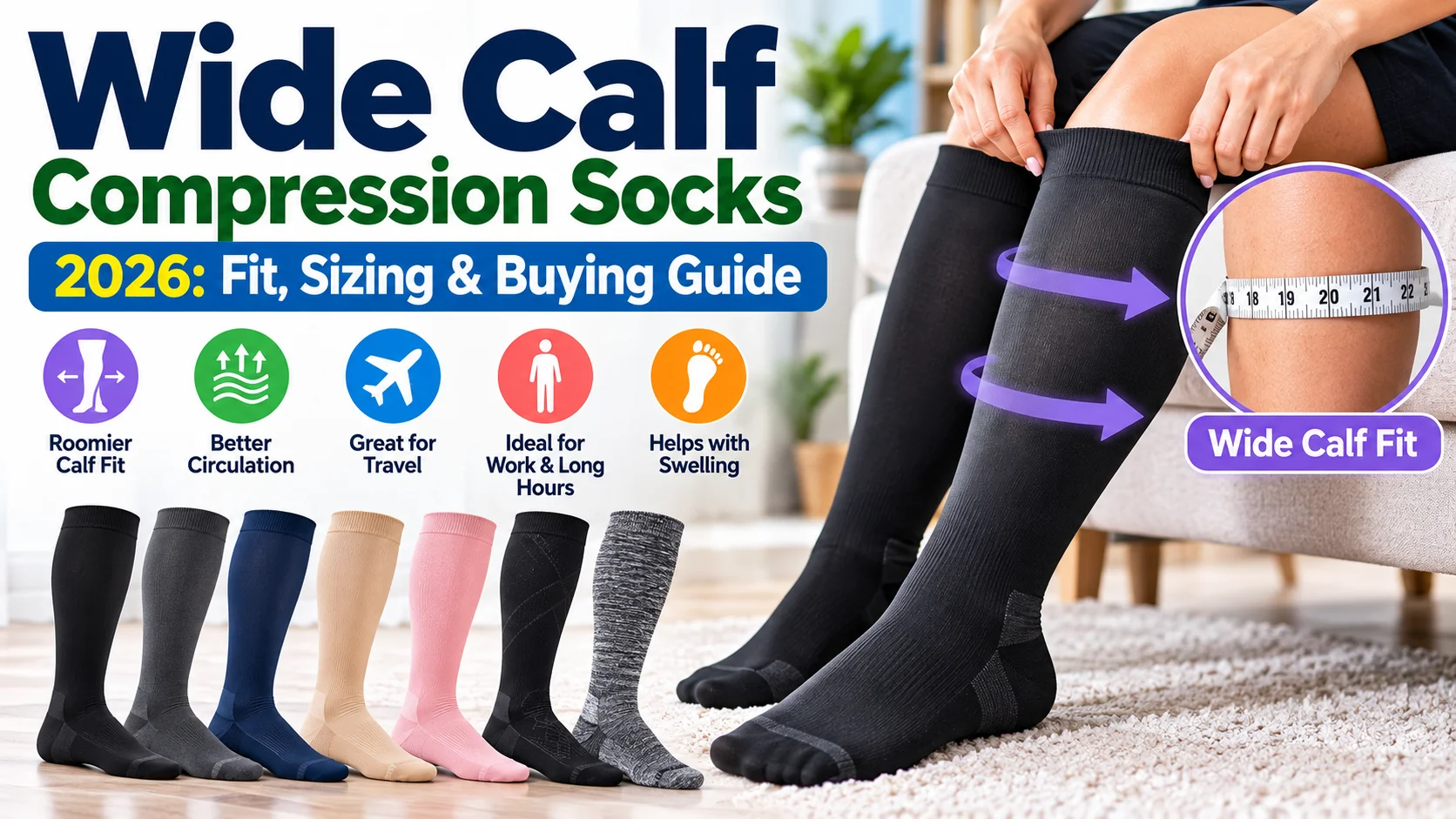
If regular compression socks fit your feet but dig into your calves, roll below the knee, or become painfully tight during the day, the problem may be the sock’s shape rather than compression itself. Wide calf compression socks add room through the lower leg while still providing controlled compression.
Choosing the right pair takes more than picking XL. “Wide calf” is not a universal size, and a larger shoe size does not automatically mean a larger calf. You also need to separate two decisions: fit and compression strength. This guide explains measurement, 15–20 vs 20–30 mmHg, bad-fit warning signs, common use cases, and when medical guidance matters.
Quick Answer: What Should You Look For?
A good wide-calf compression sock should match your calf circumference, ankle circumference, foot size and lower-leg length according to the manufacturer’s exact chart. It should feel snug and supportive, not painful, numb, sharply pinching or rolled into a tight band.
Prioritize:
- A calf range that includes your measurement
- An ankle and foot size that also fits correctly
- An appropriate compression level for your purpose
- Enough length to reach below the knee without bunching
- A cuff that lies flat instead of folding or digging
- Breathable fabric and a toe style that works with your shoes
- Clear care instructions and a practical exchange policy
Do not choose 20–30 or 30–40 mmHg simply because it sounds more effective. Stronger compression is not automatically better.
What Are Wide Calf Compression Socks?
Wide calf compression socks are usually knee-high graduated compression socks built for a fuller lower-leg circumference. In a graduated design, pressure is intended to be greatest around the ankle and decrease farther up the leg. This external pressure can support venous blood flow and help limit fluid accumulation in appropriate users.
Clinical guidelines recognize compression as a management option for venous symptoms and edema, although evidence strength varies by condition. The 2025 SCAI guideline suggests compression therapy for symptomatic chronic venous disease and notes that discomfort and difficulty putting garments on are common barriers.
For wide-calf users, the key point is that a sock can carry the right labeled mmHg and still fit poorly if its proportions do not match the leg. A garment stretched beyond its intended calf range may become excessively tight at the top, while simply sizing up can make the ankle or foot too loose.
Wide Calf vs Regular Compression Socks
A regular knee-high is built around a standard relationship between foot size, ankle size and calf circumference. A true wide-calf version gives more room through the calf without necessarily enlarging every part of the sock equally.
Wide Calf vs Plus-Size Compression Socks
The terms overlap but are not identical. “Plus size” may describe a broader overall size range, while “wide calf” specifically indicates extra lower-leg room. Some plus-size garments also enlarge the ankle, foot or length.
Buy from the measurements, not the label.
What Calf Size Is Considered “Wide”?
There is no universal calf circumference at which everyone should switch to a wide size. Current brand charts make this clear. Comrad lists wide knee-high options with calf ranges that vary by size, including 17–19 inches, while Sockwell describes its women’s wide-calf construction as roughly 15–20% wider than its regular fit rather than using one universal cutoff.
Specialty sellers also offer extra-wide products into the mid-20-inch range and beyond. So a 20-, 24- or 28-inch calf does not equal the same labeled size across brands.
| Your situation | Better approach |
|---|---|
| Regular sock fits foot but digs into calf | Check the same foot size in a wide-calf construction |
| Calf falls outside the regular chart | Move to a verified wide or extra-wide range |
| Calf is 20+ inches | Compare specialty charts carefully |
| Calf is 24–30 inches | Look for extended sizing; custom fitting may help if ready-to-wear proportions do not match |
| One leg is noticeably larger | Measure both legs and follow the product or clinician’s instructions |
| Leg size changes substantially during the day | Consider professional fitting instead of guessing from one measurement |
The question “What size compression socks for an 18-, 20- or 22-inch calf?” cannot be answered with one universal letter size. An 18-inch calf could be one brand’s wide size and another brand’s different size entirely.
How to Measure for Wide Calf Compression Socks

For knee-high compression, calf circumference is often more useful than shoe size alone. Medical fitting guidance also commonly recommends measuring when the leg is least swollen, often earlier in the day.
1. Measure Your Ankle
Wrap a soft tape around the narrowest part of the ankle above the ankle bone. Keep it level and snug without indenting the skin.
2. Measure the Widest Part of Your Calf
Measure around the fullest part of the calf. Check both legs if they differ in size or swelling.
3. Check Lower-Leg Length
Use the measurement method requested by the brand, often from the floor or heel area to just below the knee crease. A sock that is too long can bunch or fold even when circumference is correct.
4. Confirm Shoe Size
Shoe size still matters because the heel and toe must sit correctly. The mistake is using shoe size as the only measurement for a wide calf.
5. Match the Exact Product Chart
Do not assume a 2XL in one brand equals a 2XL in another. If you sit on a size boundary, follow that brand’s instructions rather than deliberately sizing down for “more compression.”
15–20 vs 20–30 vs 30–40 mmHg for Wide Calves
“mmHg” means millimeters of mercury, a unit used to describe pressure. It is separate from calf width. A wide-calf 15–20 mmHg sock and a 20–30 mmHg sock may fit the same leg size but feel very different.
| Compression level | General context | What to keep in mind |
|---|---|---|
| Under 20 mmHg / commonly 15–20 | Lighter support, often chosen for work, travel or mild tired-leg/swelling concerns | Still needs correct sizing; not a treatment for unexplained swelling |
| 20–30 mmHg | Firmer range commonly used in venous care | May suit certain diagnosed venous problems; harder to put on |
| 30–40 mmHg | High compression | More often used for specific medical indications; professional guidance is sensible |
Vascular literature generally classifies under 20 mmHg as lower pressure, 20–30 mmHg as moderate, and above 30 mmHg as higher compression, although classification systems differ internationally.
For chronic venous disease, compression can help manage symptoms or edema in selected patients, but the appropriate strength depends on diagnosis, arterial circulation, symptoms, tolerance and clinical guidance. The 2023 SVS/AVF/AVLS guideline also notes discomfort, irritation and application difficulty among practical limitations.
How Should Wide Calf Compression Socks Fit?

A properly fitted pair should feel firm from the ankle upward without creating a painful “cut-off” point at the top.
Look for these signs:
- The heel sits in the heel pocket.
- Fabric is smooth without major wrinkles.
- The cuff stays below the knee crease.
- The sock does not roll into a narrow band.
- Toes remain comfortable and their color does not change.
- You can sit and walk without sharp pinching.
- The sock stays in place instead of bunching.
A faint temporary fabric imprint is not necessarily a problem by itself. Deep grooves combined with pain, worsening swelling, numbness, tingling, color change or skin damage are different. Cleveland Clinic advises removing compression socks if they cause pain, numbness, tingling, skin discoloration or damage, or worsening swelling.
Why Wide Calf Compression Socks Roll, Pinch or Leave Deep Marks
The Calf Is Outside the Intended Range
If the calf is too large for the garment, the upper section may be overstretched. The cuff can dig in or roll because it is accommodating more circumference than intended.
The Sock Is Too Long
If a knee-high reaches into the knee crease, extra fabric may fold or migrate downward. Do not solve this by folding the top over; clinical fitting instructions warn that rolling or folding compression hosiery can concentrate pressure.
The Ankle Is Too Loose
Buying a larger standard sock only to gain calf room may create excess space around the ankle, leading to wrinkles, slipping or a poor graduated fit.
The Compression Is Harder to Manage
A correctly sized 20–30 mmHg sock will generally feel firmer and may be harder to put on than a lighter garment. If hand strength, arthritis or limited mobility makes donning difficult, a stocking aid or grip gloves may help.
Your Leg Size Changes With Swelling
If ankle or calf circumference changes substantially during the day, a sock that fits in the morning may feel very different by evening. Significant or unexplained edema deserves medical assessment rather than repeated self-sizing.
Best Wide Calf Compression Socks by Use Case

There is no single “best” pair for every wide-calf user. Start with the use case, then verify fit.
Standing All Day: Nurses, Teachers and Retail Workers
Prioritize a secure knee-high fit, moisture management and a cuff that stays flat through a long shift. Synthetic blends with elastane often dry quickly; merino blends can help manage temperature but may feel thicker in tight shoes.
Travel and Flying
Fit and comfort matter when you will be sitting for hours. Evidence supports graduated compression stockings for reducing travel-related leg swelling in some travelers, but socks do not replace movement or individualized clot-prevention advice for people at elevated medical risk.
Swollen Ankles or Legs
Compression can help manage some forms of venous or dependent edema, but swelling has many possible causes. New, severe, one-sided or unexplained swelling should be evaluated rather than treated by guessing at a pressure level.
Varicose Veins or Chronic Venous Insufficiency
Compression may reduce aching, heaviness or swelling for some people with venous disease. It does not remove varicose veins or correct every underlying cause.
Pregnancy
Pregnancy can cause lower-leg swelling, and some people use compression for comfort. New, marked or asymmetric swelling should be discussed with a prenatal clinician rather than self-treated with stronger compression.
Materials, Toe Styles and Comfort
Material affects heat, drying time, thickness and shoe compatibility.
- Nylon/polyester with spandex or elastane: Stretchy, shape-retaining and common in graduated compression.
- Cotton blends: Familiar and soft but sometimes thicker and slower to dry.
- Bamboo-derived viscose: Often soft; treat breathability claims as comfort features, not medical benefits.
- Merino blends: Useful for temperature and moisture management but can take more room in a shoe.
Closed-toe styles give full foot coverage. Open-toe styles expose the toes and may suit people who dislike toe pressure or want more footwear flexibility. Neither is universally better.
A “non-binding” top can improve comfort, but a compression sock still applies controlled pressure; non-binding does not mean pressure-free.
Wide Calf Compression Socks Buying Checklist
Before buying, confirm:
- Purpose: Everyday comfort, travel, occupational standing and prescribed medical use are different.
- Compression level: Choose for the need, not because higher mmHg sounds stronger.
- Calf and ankle range: Both should match.
- Length: A knee-high should finish below the knee without bunching.
- Foot fit: Heel and toe placement still matter.
- Material and thickness: Check climate and shoe space.
- Toe style: Open or closed according to comfort.
- Ease of use: Consider a donning aid if needed.
- Exchange policy: Useful when fit cannot be predicted from the label alone.
How to Put Them On Without Overstretching the Cuff
Compression socks are often easier to apply when the leg is less swollen, commonly earlier in the morning. Turn the sock inside out to the heel, place the foot and heel correctly, then gradually work the fabric up the ankle and calf.
Do not pull only from the top band. Smooth wrinkles as you go and redistribute excess fabric instead of folding the cuff. NHS fitting guidance similarly recommends gradual application, correct heel positioning and avoiding folds.
If donning requires extreme force, recheck both size and compression level.
Washing and Maintaining Compression
Follow the product’s care label because fibers and construction differ. Medical centers commonly advise gentle washing, avoiding direct heat and allowing stockings to dry naturally. Heat and harsh handling can damage elastic fibers.
Replace garments when the manufacturer or clinician recommends it, or sooner if the fabric is damaged, the cuff is stretched or the garment no longer maintains its intended fit.
Who Should Use Extra Caution?
Wide-calf sizing does not make compression automatically safe for everyone.
Get medical guidance before using compression—especially stronger medical compression—if you have known or suspected peripheral artery disease (PAD), markedly reduced sensation or neuropathy, significant unexplained swelling, active wounds, skin infection, fragile skin or a diagnosed vascular condition. Cleveland Clinic specifically flags PAD, severe swelling and severely reduced sensation as situations where professional guidance is important.
People with diabetes should not assume that diabetic socks and compression socks are interchangeable. Traditional diabetic socks often emphasize a non-binding top, low-friction seams and skin protection, while compression socks intentionally apply pressure. Diabetes accompanied by neuropathy, wounds or arterial disease changes the safety discussion.
Seek prompt medical evaluation for sudden one-sided leg swelling, severe pain, major color change, shortness of breath, chest pain, an open wound or signs of infection rather than trying a tighter sock.
Frequently Asked Questions
Are Wide Calf Compression Socks Worth It?
They can be a better fit when standard compression socks match your foot but are too tight around the calf. The benefit comes from correct proportions, not the word “wide.”
What Size Is Considered Wide Calf?
There is no universal cutoff. Some brands begin wide sizing in the mid-to-upper teen inches, while specialty ranges extend much farther. Use your measurement and the exact chart.
What Size Compression Sock Should I Buy for an 18- or 20-Inch Calf?
Choose a chart that includes your calf measurement and also check ankle and foot size. Do not convert 18 or 20 inches into a universal L, XL or 2XL.
Are There Compression Socks for 24-, 26-, 28- or 30-Inch Calves?
Yes, specialty extra-wide ranges exist, but there are fewer options. With very large circumferences or unusual leg proportions, custom or professional fitting may be more reliable than sizing up a standard sock.
Is 15–20 mmHg Enough for Swelling?
It may help mild dependent or venous swelling in some people, but the cause and severity matter. New, severe or unexplained swelling should be medically evaluated.
Is 20–30 mmHg Too Tight for Large Calves?
Calf size alone does not decide whether 20–30 mmHg is appropriate. A properly sized wide-calf garment can still provide 20–30 mmHg. The medical reason, arterial circulation, comfort and ability to apply it also matter.
Can Compression Socks Cut Off Circulation?
A poor fit, rolled cuff or inappropriate compression can create excessive localized pressure. Pain, numbness, tingling, color change, skin damage or worsening swelling are reasons to remove the garment and seek advice.
Why Do My Compression Socks Roll Down?
Common causes include a calf outside the size range, excessive sock length, poor cuff placement or a style that does not match your leg shape.
Can I Sleep in Wide Calf Compression Socks?
Routine overnight wear is generally not advised for ordinary daytime compression unless a clinician or product-specific plan says otherwise. Guy’s and St Thomas’ advises not wearing compression stockings to bed unless instructed by a doctor or specialist nurse.
Can People With Diabetes Wear Wide Calf Compression Socks?
Some can, but diabetes does not automatically make compression appropriate. Neuropathy, arterial disease, wounds and reduced sensation are important safety factors.
How Long Can I Wear Wide Calf Compression Socks?
For many daytime uses, they are put on in the morning and removed at night. Medical indications can require different schedules, so follow the plan given by your clinician when compression is being used as treatment.
Final Takeaway
The best wide calf compression socks are not simply the biggest pair available. They should match your calf and ankle measurements, sit at the right height, provide an appropriate compression level and remain comfortable enough to wear correctly.
Measure first, compare the exact size chart, and treat fit and mmHg as separate decisions. If a sock rolls, creates deep painful bands, causes numbness or changes skin color, do not assume discomfort means the compression is “working.” Recheck the fit and get professional advice when medical conditions, substantial swelling or stronger compression are involved.
Medical information notice: This article provides general educational and product-selection information, not individualized medical advice. If you have a diagnosed circulation disorder, significant or unexplained swelling, neuropathy, wounds, skin infection or another medical concern, ask a qualified healthcare professional what type of compression, if any, is appropriate for you.
Sources & Medical References
- Society for Cardiovascular Angiography & Interventions (SCAI), 2025 Clinical Practice Guidelines for the Management of Chronic Venous Disease.
- Society for Vascular Surgery, American Venous Forum and American Vein & Lymphatic Society, 2023 Clinical Practice Guidelines for Varicose Veins of the Lower Extremities.
- Cleveland Clinic, What To Know About Compression Socks.
- Guy’s and St Thomas’ NHS Foundation Trust, Compression Stockings: Overview, Application and Care.
- Mayo Clinic, Tips for Using Compression Stockings.
- Evidence-based consensus statement on medical compression stockings in venous and lymphatic disorders.
- Current sizing references used only to illustrate why “wide calf” is not a universal measurement: Comrad and Sockwell sizing information.
