

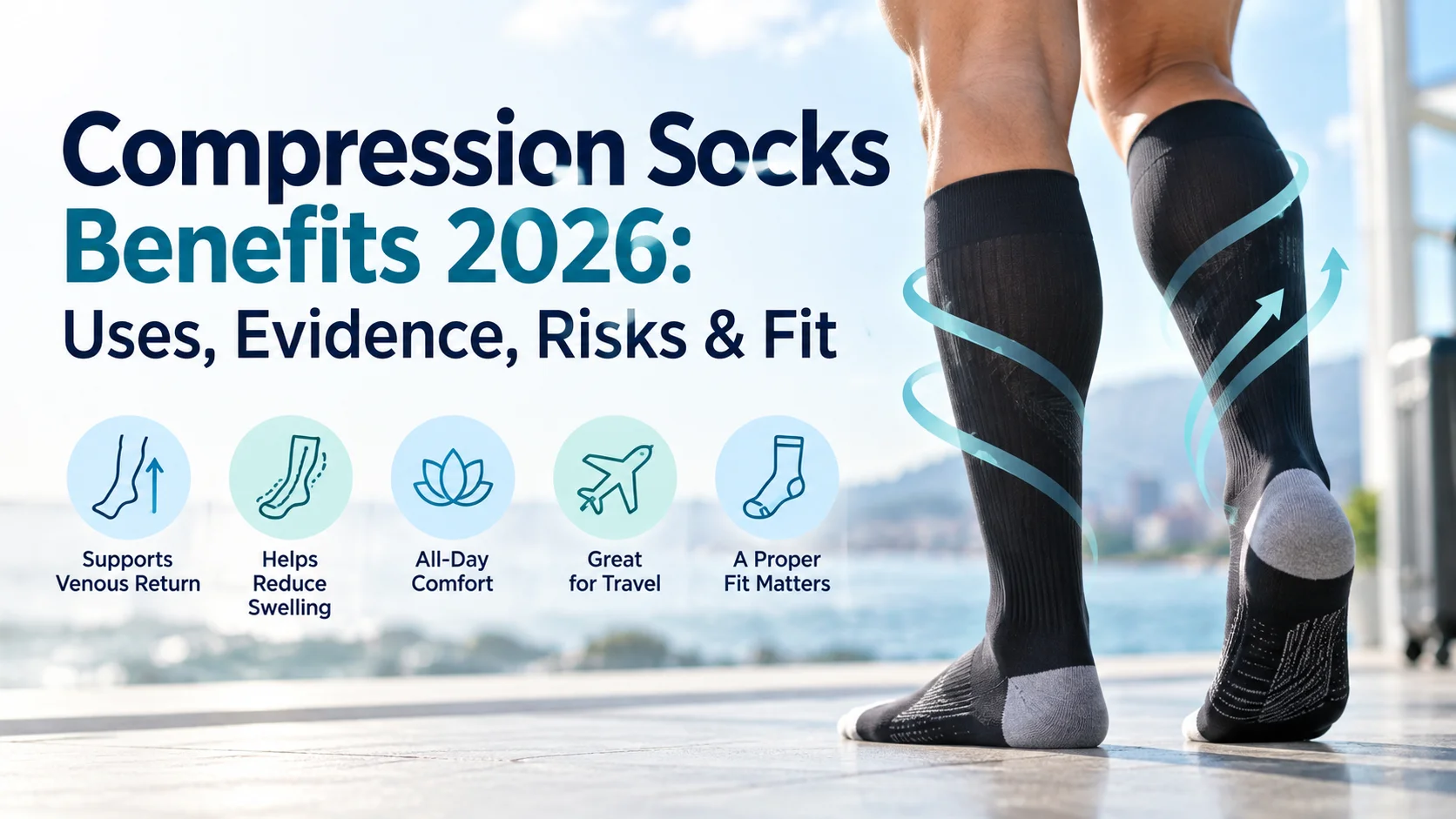
If your legs feel heavy after a long shift, your ankles puff up during travel, or you are trying to understand whether compression socks are actually useful, the answer depends on why you want them. The main compression socks benefits come from controlled external pressure that supports venous return and limits fluid pooling in the lower legs. They can be useful for everyday comfort, certain venous conditions, travel, pregnancy-related swelling and some medical care plans—but they are not a universal “circulation fix.”
This guide is for U.S. adults comparing compression socks for daily wear, work, travel, exercise or health-related reasons. It explains what the evidence supports, where benefits are more limited, how compression levels differ, and when self-selecting compression may be unsafe.
Quick Answer: What Are the Main Benefits of Compression Socks?
Properly fitted compression socks may:
- Reduce ankle and lower-leg swelling caused by prolonged sitting, standing or some venous problems.
- Support venous return, helping limit blood pooling in the lower legs.
- Reduce feelings of heaviness, aching or fatigue for some people with chronic venous disease or long periods on their feet.
- Improve comfort during long-distance travel, with graduated compression sometimes used as part of DVT-prevention strategies for higher-risk travelers.
- Form part of treatment for chronic venous insufficiency, lymphedema or venous leg ulcers when selected and monitored appropriately.
- Help some pregnant people manage routine leg and ankle swelling.
- Possibly reduce perceived post-exercise soreness, although evidence for improved athletic performance or recovery is inconsistent.
The benefit depends on the problem, fit, compression level and your vascular health. Stronger compression is not automatically better.
How Do Compression Socks Work?

Most medical-style products use graduated compression: pressure is greatest around the ankle and decreases up the leg. Compression is measured in millimeters of mercury (mmHg).
When you are upright, blood in the leg veins must move against gravity. One-way venous valves and the calf-muscle pump help push it toward the heart. Long periods of sitting or standing, vein-valve problems and certain medical conditions can allow more blood or fluid to collect in the lower legs.
Graduated pressure can narrow superficial veins, support venous flow and reduce the space available for fluid to accumulate. That is why “improved circulation” is better understood as support for venous return and fluid control, not as a treatment for blocked arteries. Compression therapy is commonly used for venous and lymphatic problems, but it needs more caution when arterial blood supply is impaired.
Compression socks also work best when paired with movement. Walking and ankle motion activate the calf muscles, which help pump venous blood upward. Socks do not replace regular movement, especially during travel or desk work.
1. Compression Socks May Reduce Swelling and Fluid Pooling
Swelling is one of the best-established reasons people use compression. The pressure can help limit accumulation of interstitial fluid around the ankles and lower legs and may help manage dependent edema—swelling that becomes more noticeable after being upright or inactive for a long time.
For someone whose ankles feel tighter in shoes by evening after a standing shift, a properly fitted knee-high sock may be more useful than an ankle-only style because it covers more of the lower leg. For unexplained, severe, one-sided or rapidly worsening swelling, however, buying stronger socks should not be the first step; the cause needs evaluation.
Compression is also part of clinical management for some forms of edema, including chronic venous disease and lymphedema. The National Cancer Institute describes compression garments as one component of lymphedema care, usually alongside professional fitting and other treatment strategies.
2. They Can Help Heavy, Tired or Aching Legs
People who stand for hours—such as nurses, healthcare workers, teachers and retail employees—or sit for much of the day may notice tired, heavy or achy legs even without a diagnosed vein disorder.
Compression can reduce venous pooling and may improve comfort during a long shift. That does not mean everyone needs medical-grade pressure. A healthy person seeking comfort has a different decision than someone being treated for chronic venous insufficiency.
The practical point is to separate comfort use from medical compression. If you are generally healthy and your goal is mild end-of-day fatigue, lower compression may be sufficient. If symptoms are persistent, one-sided, worsening, associated with skin changes or accompanied by significant swelling, professional assessment matters more than simply increasing mmHg.
3. Compression Can Support Chronic Venous Insufficiency and Varicose-Vein Symptoms

Chronic venous insufficiency (CVI) occurs when leg veins and their valves do not move blood upward efficiently. Symptoms can include swelling, heaviness, aching and skin changes. Compression is a standard conservative tool for controlling venous hypertension and related symptoms.
Research in people with chronic venous disease has found improvements in edema and symptoms with compression stockings, although the exact garment and pressure should reflect disease severity and individual tolerance.
Compression socks can also help symptoms associated with varicose veins, but they do not erase or cure varicose veins. They are better viewed as symptom-management tools. Spider veins are similar: stockings may support venous function, but they should not be marketed as a way to make visible veins disappear.
4. Travel Benefits: Swelling Relief and a Role in DVT Prevention for Some Travelers
Long-distance travel often combines immobility, bent knees and limited space, which can encourage venous pooling. Walking periodically, moving the ankles and contracting the calf muscles are core preventive measures.
The CDC advises travelers with additional blood-clot risk factors to discuss prevention with a clinician; some may benefit from graduated compression stockings. The CDC Yellow Book notes that graduated compression stockings appear to reduce asymptomatic DVT in long-distance travelers, but the decision is particularly relevant to people with elevated clot risk.
For a healthy traveler, compression socks may mainly improve comfort and reduce swelling. They should not create a false sense of protection: movement remains important, and socks do not replace prescribed anticoagulation for someone who medically requires it.
5. Pregnancy Swelling May Improve With Support Stockings
Gradual ankle and foot swelling is common during pregnancy. Supportive or compression stockings may be suggested during the day to improve comfort and help control swelling. Mayo Clinic includes compression stockings among measures a healthcare professional may suggest for pregnancy-related ankle swelling.
Pregnancy also changes blood-clot risk, so sudden painful one-sided swelling is different from routine gradual swelling and should be assessed promptly. Compression should not be used to “self-treat” a suspected clot or pregnancy complication.
6. Compression Has Important Medical Uses Beyond Everyday Socks
Medical compression may be part of care for venous leg ulcers, lymphedema, postoperative swelling and symptoms after a DVT. These uses are more specialized than buying a pair for work or flying.
For venous leg ulcers, Cochrane evidence indicates compression bandages or stockings probably improve healing compared with no compression, and ongoing compression may reduce ulcer recurrence in some patients. These are wound-care decisions that require assessment of arterial circulation and proper fitting.
After DVT, an important distinction is often missed: NICE advises against routinely offering graduated compression stockings specifically to prevent post-thrombotic syndrome or recurrent VTE after DVT, while still allowing stockings to be used to manage leg symptoms after DVT.
7. Do Compression Socks Help Athletes and Muscle Recovery?
Running and recovery socks are heavily marketed, but the evidence is more modest than the advertising.
Some studies suggest compression garments may reduce perceived soreness or support certain recovery measures. However, a 2026 systematic review of endurance athletes found soreness results uncertain and evidence for improved subsequent performance unresolved. Earlier reviews have also found no clear improvement in muscle-strength recovery.
For runners and active users, compression may still feel supportive or comfortable. It is reasonable to choose it for comfort, but not to assume it will make you faster, prevent injury or guarantee faster recovery.
Who May Benefit Most?
| Situation | Potential Benefit | What Matters Most |
|---|---|---|
| Standing all day | Less heaviness or lower-leg swelling | Comfortable fit, breathable fabric, correct calf size |
| Desk work or prolonged sitting | Less pooling and ankle swelling | Movement breaks plus appropriate compression |
| Long flights or road trips | Swelling control; clot-prevention role for some higher-risk travelers | Mobility, personal DVT risk, clinician advice when needed |
| Chronic venous insufficiency | Symptom and edema management | Medical assessment, correct pressure and fit |
| Pregnancy | Support for routine leg/ankle swelling | Comfort, changing leg size, obstetric advice if symptoms are unusual |
| Lymphedema or venous ulcers | Part of structured medical treatment | Professional fitting and disease-specific care |
| Running/exercise | Possible comfort or soreness benefit | Do not expect guaranteed performance improvement |
Men and women can receive the same physiologic benefits; the more important differences are leg measurements, health status and intended use. Seniors may benefit from swelling or venous-symptom control, but are also more likely to have PAD, fragile skin or difficulty applying stockings, so fit and safety deserve extra attention.
15–20 vs 20–30 vs 30–40 mmHg: Which Benefits Change?
In the United States, common product ranges include 8–15, 15–20, 20–30 and 30–40 mmHg. Cleveland Clinic describes 8–15 as mild, 15–20 as moderate, 20–30 as firm and 30–40 as extra-firm medical-grade compression.
| Compression Range | Typical Context | Key Caution |
|---|---|---|
| 8–15 mmHg | Light everyday support | May be too light for medical indications |
| 15–20 mmHg | Travel, work, mild swelling or fatigue for some users | Still requires correct sizing |
| 20–30 mmHg | Common medical-grade range for selected venous problems | Better chosen with clinical guidance when treating a condition |
| 30–40 mmHg | Higher medical compression | Should not be self-selected casually; professional supervision is appropriate |
These are not universal prescriptions. Classification labels can vary by brand or region, and a person’s diagnosis, arterial circulation, skin condition, sensation and ability to put the garment on all affect what is appropriate.
A stronger stocking can also be harder to don and more likely to create pressure problems if the size is wrong. “More mmHg” is not a quality score.
Knee-High, Thigh-High or Ankle Compression?

Knee-high compression socks are practical for many lower-leg needs because they cover the ankle and calf while being easier to wear than thigh-high garments.
Thigh-high stockings may be prescribed when more proximal coverage is needed, but they can be hotter, harder to put on and more sensitive to sizing around the thigh.
Ankle compression socks or sleeves may suit localized foot/ankle comfort or sport use, but they do not provide the same calf coverage as knee-high graduated stockings. Do not assume an ankle sleeve is equivalent to a medical knee-high sock for venous swelling.
Open-toe versus closed-toe is mostly a fit and comfort decision. Open-toe styles may feel cooler or work better for people who dislike toe pressure; closed-toe styles can feel more like a regular sock and may work better in some shoes.
Can You Wear Compression Socks Every Day or All Day?
Many people wear compression stockings during waking hours, especially when upright. A common practical approach is to put them on in the morning before swelling builds and remove them later in the day or before bed. Cleveland Clinic advises that continuous overnight use is generally unnecessary for routine daytime compression.
That is not a rule for every medical situation. Anti-embolism stockings used for hospitalized or bed-bound patients are different from everyday graduated socks, and postoperative or wound-care instructions can vary.
If a sock becomes increasingly painful, creates numbness, tingling, skin discoloration or worsening swelling, remove it and seek guidance rather than “pushing through” the discomfort.
Compression Socks Side Effects, Risks and Who Should Use Caution
Compression is safe for many people when the garment is appropriate and fits correctly, but it can be harmful when applied over impaired arterial circulation or vulnerable tissue.
Ask a qualified healthcare professional before using compression for a medical purpose if you have peripheral artery disease (PAD), markedly reduced sensation, significant neuropathy, open wounds, active skin infection, severe unexplained swelling, heart failure or another major vascular condition. Severe PAD is a recognized contraindication to sustained medical compression stockings, and severe sensory loss can increase the risk of unnoticed pressure injury.
Diabetes by itself does not automatically mean “no compression,” but diabetes can coexist with PAD, neuropathy, ulcers and fragile skin. That is why people with diabetes should not assume compression socks and non-binding diabetic socks are interchangeable.
Common fit-related problems include:
- A cuff that rolls and creates a narrow pressure band.
- Wrinkles or bunching behind the knee or around the ankle.
- Toe pressure or cold-feeling toes.
- Skin irritation.
- Numbness, tingling or pain.
- Swelling above or below the garment.
New one-sided swelling, unexplained leg pain, warmth or redness can be signs of DVT and should be medically evaluated rather than managed by trying a tighter sock. Chest pain, sudden shortness of breath, fainting or coughing blood requires urgent medical attention.
Compression Socks Pros and Cons
Pros: Non-drug option; reusable; may reduce swelling and heaviness; useful for many work and travel situations; available in multiple lengths and fabrics; important role in some venous and lymphatic treatment plans.
Cons: Can be hot or difficult to put on; wrong sizing can roll or pinch; stronger compression may be uncomfortable; not appropriate for every vascular condition; benefits for athletic performance are uncertain; they do not cure the underlying cause of most vein problems.
How to Choose Compression Socks That Actually Fit

Start with the reason for wearing them, then choose pressure, length and size.
For knee-high socks, calf circumference is often more important than shoe size. Measure the ankle at its narrowest point, the widest part of the calf, and the lower-leg length according to the manufacturer’s chart. Wide-calf users should choose a size designed for their measurements rather than simply sizing up, because an oversized ankle can reduce the intended pressure gradient.
Also consider:
- Fabric and heat: Nylon/spandex blends often provide structured compression; merino or moisture-managing blends may feel more comfortable in certain climates.
- Thickness and shoes: Cushioned socks can change shoe fit, especially around the forefoot.
- Ease of donning: Stronger compression is harder to pull on; donning aids may help people with limited hand strength or mobility.
- Sock length: An overly long knee-high can bunch behind the knee; one that is too short may pull excessively at the calf.
- Toe style: Choose open or closed toe based on comfort, footwear and any toe sensitivity.
- Care: Follow washing instructions; heat and wear can gradually reduce elasticity.
For a diagnosed condition, the “best compression socks for circulation” are not simply the strongest pair online. The better choice is the garment that provides the appropriate pressure, fits your measurements and can be worn consistently without creating skin or nerve problems.
Frequently Asked Questions
Do Compression Socks Really Work?
Yes, for the right purpose. Evidence and clinical guidance support compression for managing venous pooling, swelling and several venous or lymphatic conditions. Benefits are less certain for goals such as improving sports performance.
Do Compression Socks Increase Blood Circulation?
They mainly support venous return—blood moving from the legs back toward the heart—and help control fluid pooling. Saying they “increase circulation” can be misleading if it implies they improve blocked arterial blood flow.
Are Compression Socks Worth Wearing for Standing All Day?
They can be worthwhile if you develop tired, heavy or mildly swollen legs during long shifts. Comfort, correct calf sizing and a wearable compression level matter more than choosing the highest mmHg.
Do Compression Socks Prevent Blood Clots?
They can be part of DVT-prevention strategies in selected situations, including some higher-risk travelers and medical settings, but they are not a guarantee and are not a substitute for movement or prescribed medication.
Can Compression Socks Get Rid of Varicose Veins?
No. They may reduce swelling, aching and heaviness associated with venous disease, but they do not remove existing varicose veins.
Are Compression Socks Safe for People With Diabetes?
Sometimes, but not automatically. Diabetes may coexist with neuropathy, PAD, wounds or reduced sensation. People with those risks should have compression suitability and pressure level assessed professionally.
Can Compression Socks Be Harmful With PAD?
Yes, particularly in severe PAD, because external pressure can further compromise tissue perfusion. Known or suspected arterial disease is a reason to seek medical guidance before using medical compression.
Can I Sleep in Compression Socks?
Routine daytime compression generally does not need to be worn during sleep. If you were prescribed stockings for a specific postoperative, vascular or wound-care plan, follow those instructions instead.
Are 20–30 mmHg Socks Better Than 15–20 mmHg?
Not automatically. They provide more pressure, but the appropriate range depends on your goal and health status. Higher compression also requires more attention to fit, skin condition and arterial circulation.
Who Should Not Self-Select Compression Socks?
People with known PAD, major circulation problems, severe neuropathy or reduced sensation, wounds or infection, severe unexplained swelling, or significant heart/vascular disease should get individualized guidance before using medical compression.
Bottom Line
The most meaningful compression socks benefits occur when the goal matches what the garment actually does: support venous return, reduce fluid pooling and help manage certain forms of swelling and venous discomfort. They can be useful for long shifts, travel, pregnancy-related swelling and specific medical conditions, but the benefits are not identical for everyone.
Choose compression based on purpose, pressure, length and fit—not on the idea that stronger is better. If you have a diagnosed vascular condition, diabetes with neuropathy, PAD, wounds, sudden swelling or symptoms that are new or worsening, professional assessment should come before self-treating with compression.
Medical Information Notice: This article provides general educational information and is not a substitute for individualized medical advice. If you have a diagnosed circulation disorder, significant or unexplained swelling, loss of sensation, wounds, a history of blood clots or another medical concern, ask a qualified healthcare professional what type of compression, if any, is appropriate for you.
Sources & Medical References
- CDC — Blood Clots During Travel / Venous Thromboembolism guidance: Long-distance travel, movement, DVT risk and graduated compression stockings.
- Cleveland Clinic — What To Know About Compression Socks: Graduated compression, mmHg ranges, daily use, safety, PAD and neuropathy considerations.
- Cleveland Clinic — Compression Therapy: Venous return, swelling and clinical uses of compression.
- NICE — Venous thromboembolic diseases guidance: Use of compression stockings after DVT and post-thrombotic syndrome prevention.
- Cochrane — Compression for venous leg ulcers: Evidence concerning ulcer healing and recurrence.
- National Cancer Institute — Lymphedema: Compression garments as part of lymphedema management.
- Mayo Clinic — Ankle swelling during pregnancy: Support stockings and pregnancy-related swelling.
- International consensus statement on medical compression: Contraindications, PAD, neuropathy, pressure injury and safe compression use.
- 2026 systematic review of compression garments in endurance athletes: Current evidence on soreness and performance recovery.

2 thoughts on “Compression Socks Benefits 2026: Uses, Evidence, Risks & Fit”