

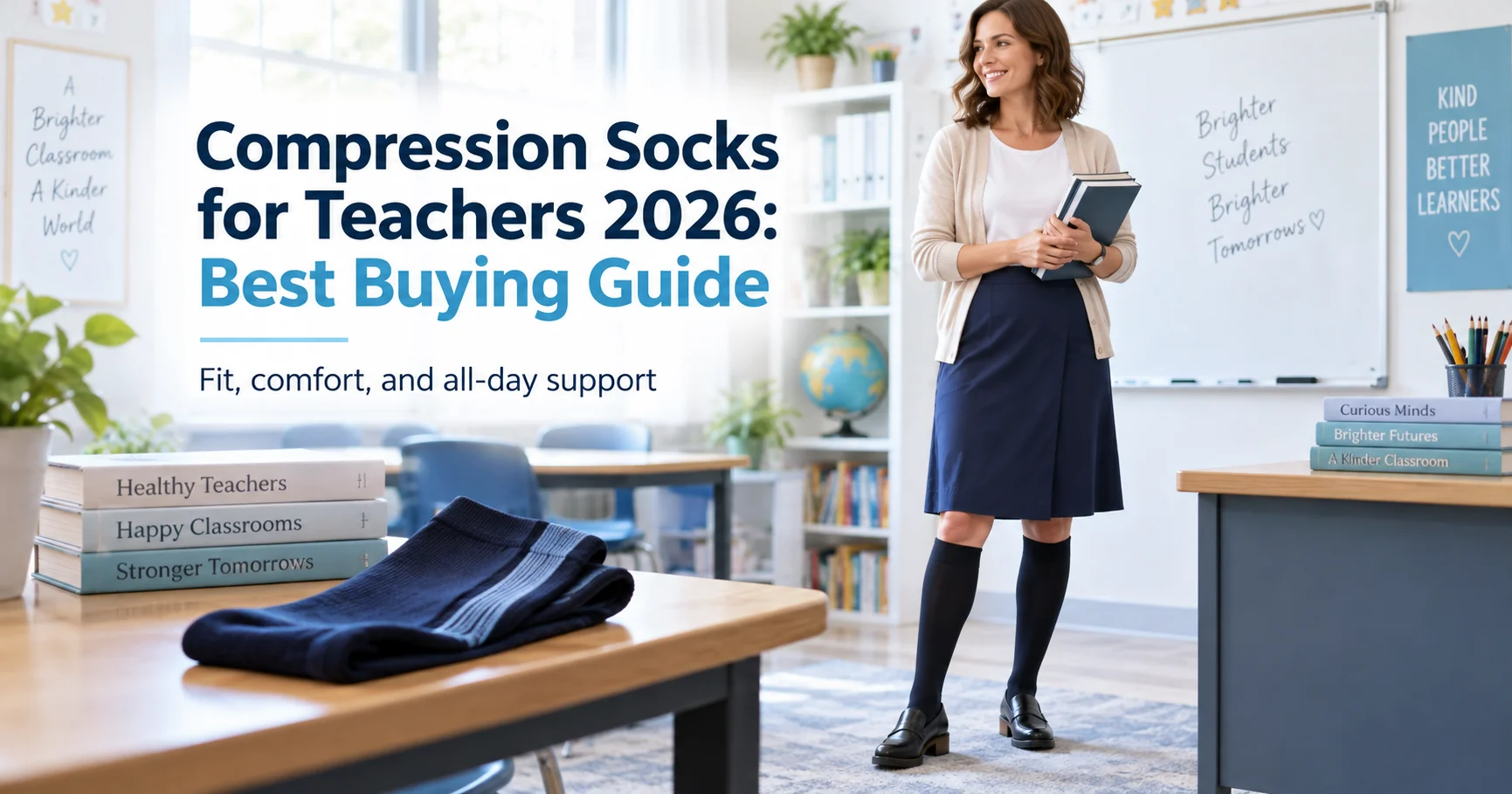
A teaching day can mean hours at the board, circulating between desks, supervising hallways, climbing stairs, and staying late for meetings. If your ankles feel puffy or your calves feel heavy by the last bell, compression socks for teachers may be worth considering.
The useful question is not simply, “Which pair is strongest?” It is which compression level, length, fit, fabric, and footbed work for your school day without creating pressure points or making your shoes uncomfortable. This guide focuses on everyday occupational standing, tired legs, mild swelling, sizing, materials, footwear, and situations where medical advice matters.
Quick Answer: What Are the Best Compression Socks for Teachers?
For many otherwise healthy teachers who want everyday support during long periods of standing, a properly fitted knee-high graduated compression sock in the lower-to-moderate range is a practical place to compare options. A 15–20 mmHg sock is commonly used for everyday occupational support, but the right pressure is individual rather than universal.
Look for a sock that matches your ankle and calf measurements, stays below the knee crease, does not roll, breathes well inside your normal teacher shoes, and has enough stretch to put on correctly.
Teachers with persistent swelling, diagnosed vein disease, diabetes with reduced sensation, peripheral artery disease, wounds, or other circulation concerns should ask a healthcare professional what level of compression—if any—is appropriate.
Why Teachers Consider Compression Socks for Standing All Day

Standing upright for hours changes how fluid behaves in the lower legs. Gravity raises pressure in the veins below the heart, while walking helps activate the calf-muscle pump that assists venous return. A school day often alternates between walking and relatively static standing, so some teachers notice end-of-day heaviness, aching, or ankle swelling.
Research on workers with prolonged standing—not specifically teachers—suggests graduated compression can reduce occupational lower-leg swelling and related symptoms. A randomized crossover study involving hairdressers found that 15–20 mmHg compression hosiery reduced leg-volume increase and discomfort during prolonged standing. Another occupational study found less measurable ankle swelling after an eight-hour standing workday when compression stockings were worn.
That does not mean every sore foot is a circulation problem. Compression socks mainly address lower-leg pressure and fluid accumulation. They do not replace supportive shoes, normal movement, or evaluation of unexplained symptoms.
What Graduated Compression Means
Graduated compression socks apply the greatest pressure near the ankle and progressively less pressure higher on the leg. That pressure gradient is designed to support venous return and limit fluid accumulation in the lower legs.
A regular athletic sock can feel tight without providing a specified graduated mmHg pressure.
What Compression Level Is Best for Teachers?

The label mmHg means millimeters of mercury and describes the pressure range of a compression garment.
There is no single best mmHg for every teacher, and brands do not always use exactly the same descriptive labels.
| Compression Level | Common Description | When a Teacher Might Compare It |
|---|---|---|
| 8–15 mmHg | Light or mild | Light support, new users, minimal end-of-day heaviness |
| 15–20 mmHg | Mild to moderate | Long school days, prolonged standing, mild occupational ankle swelling |
| 20–30 mmHg | Firm | More significant venous symptoms or medical indications; professional guidance may be appropriate |
Is 15–20 mmHg Good for Teachers?
For an otherwise healthy adult with mild end-of-day leg fatigue or modest ankle puffiness from occupational standing, 15–20 mmHg is a reasonable level to compare because this range has been studied in prolonged-standing workers.
Even mild compression can feel too tight when sizing is wrong. Calf circumference, ankle circumference, and sock length matter as much as the pressure number.
Is 20–30 mmHg Better for Long Teaching Days?
Not automatically.
One occupational study comparing 15–20 mmHg with 20–30 mmHg found greater reduction in measured workday edema with the higher pressure under some conditions. That finding does not establish 20–30 mmHg as the best choice for every healthy worker.
Stronger compression can also be harder to put on and requires especially careful fit.
A teacher with diagnosed varicose veins, recurrent swelling, or another venous condition may be advised to use a firmer level. That is different from telling every classroom teacher to start at 20–30 mmHg.
Persistent symptoms deserve assessment rather than simply escalating compression pressure.
Best Compression Socks for Teachers by Work Need

Match the sock to the problem you are actually trying to solve rather than relying on a generic “best overall” label.
| Product | Compression | Best For | Key Features | Watch For | Amazon |
|---|---|---|---|---|---|
| CHARMKING Compression Socks | 15–20 mmHg | Budget & daily classroom wear | Knee-high graduated compression, multipack options, everyday use | Sizing chart carefully check karein | Check Price on Amazon |
| SB SOX Compression Socks | 15–20 mmHg | Long school days | Lightweight, breathable, cushioned heel, graduated compression | Correct ankle/calf sizing important hai | Check Price on Amazon |
| Sockwell Moderate Graduated Compression Socks | 15–20 mmHg | Breathability & professional wear | Merino/bamboo blend, seamless toe, arch support, ultra-light cushioning | Basic synthetic options se mehnga ho sakta hai | Check Price on Amazon |
| Sockwell Featherweight Compression Socks | 15–20 mmHg | Warm classrooms | Lightweight yarn, breathable merino/bamboo blend, seamless toe | Minimal cushioning sab ko pasand nahi aayegi | Check Price on Amazon |
| Physix Gear Compression Socks | 20–30 mmHg | Firmer compression comparison | Knee-high graduated compression, work/standing use | Healthy teacher ko sirf “stronger” hone ki wajah se choose nahi karna chahiye | Check Price on Amazon |
| Teacher Need | Features to Prioritize | Mistake to Avoid |
|---|---|---|
| Everyday classroom standing | Knee-high graduated compression, accurate sizing, breathable knit | Buying by shoe size alone |
| Tired or heavy lower legs | Comfortable pressure, stay-up cuff | Assuming firmer is always better |
| Mild ankle swelling after work | Graduated knee-high coverage | Putting socks on only after swelling is pronounced |
| Warm classrooms | Lightweight, moisture-wicking knit | Choosing thickness mainly for softness |
| Wide calves | Separate ankle and calf measurements, wide-calf sizing | Sizing up without checking ankle fit |
| Sensitive toes | Smooth or low-profile toe seam | Accepting rubbing because calf fit is good |
| Hard classroom floors | Cushioned footbed plus suitable shoes | Expecting compression to replace footwear cushioning |
| Varicose veins or recurring swelling | Clinician-guided level when symptoms are significant | Self-selecting stronger compression from online advice |
This framework applies to elementary school teachers, high-school teachers, specialists who move between classrooms, and other educators or school staff who spend much of the day standing.
The best teacher compression sock still depends on the person’s measurements, symptoms, footwear, and medical history.
Are Knee-High Compression Socks Best for Teachers?
For teacher-specific use, knee-high compression socks are often the most practical style because they cover the ankle and calf while fitting under many professional and casual work outfits.
They also cover the areas where occupational ankle swelling and lower-leg heaviness are commonly noticed.
The top of the sock should end below the knee crease. A sock that is too long can bunch behind the knee or tempt you to fold the cuff.
Folding or rolling compression material can create a tighter localized band, so choosing an appropriate leg length is better than folding an overly long sock.
Crew or ankle compression socks can be cooler and more discreet, but they do not provide the same lower-leg coverage.
If calf heaviness or ankle swelling is the main reason you are shopping, knee-high graduated compression generally makes more sense than an ankle-only design.
How Teacher Compression Socks Should Fit

A good compression sock should feel snug and controlled, not painfully tight.
It should lie smoothly against the skin without large wrinkles, folds, or a rolled cuff.
For knee-high styles, follow the manufacturer’s sizing chart. Common measurements include:
- Ankle circumference at the narrowest point above the ankle bones.
- Calf circumference at the widest point.
- Lower-leg length to just below the knee when the brand uses a length measurement.
- Shoe size, usually as an additional sizing input rather than the only measurement.
Calf circumference can matter more than shoe size when fitting a knee-high compression sock.
A teacher with wide calves should not automatically buy a larger standard size. Doing so may solve the calf problem while making the ankle too loose, potentially changing the intended pressure gradient.
Signs the Fit May Be Wrong
Reassess a compression sock that:
- Slides down repeatedly.
- Bunches around the ankle.
- Digs sharply behind the knee.
- Leaves painful pressure marks.
- Causes new numbness or tingling.
- Causes concerning skin discoloration.
- Makes swelling or pain worse.
Cleveland Clinic specifically advises removing compression socks and seeking medical advice if symptoms such as pain, numbness, tingling, skin discoloration or damage, or worsening swelling develop.
If one brand’s medium fits but another company’s medium does not, that is not unusual. Compression-sock sizing is not universally standardized.
What Material Is Best for Teacher Compression Socks?
No single fiber is best for every classroom.
Choose based on classroom temperature, sweating, skin feel, shoe volume, and how frequently the socks will be washed.
Nylon or Polyester With Spandex or Elastane
These performance blends are common because they can combine stretch, compression retention, durability, and moisture management.
Lightweight versions can work particularly well in warm classrooms and with sneakers.
Merino-Wool Blends
Merino blends can offer useful temperature and moisture management.
They may feel comfortable across changing temperatures but can be thicker and more expensive than lightweight synthetic compression hosiery.
Cotton Blends
Cotton can feel soft against the skin.
However, a fabric with a high cotton content may retain moisture longer than many performance synthetics. A well-designed cotton-blend compression sock can still work for classroom use when its thickness and elastic construction suit your shoes.
Bamboo-Derived Blends
Products marketed as bamboo socks commonly contain regenerated cellulose fibers such as viscose or rayon derived from bamboo.
The word “bamboo” alone does not prove that the finished sock will be more breathable, durable, moisture-wicking, or effective at maintaining compression.
Teachers with hot feet should compare the actual knit thickness and moisture-management design instead of relying only on fiber marketing.
Cushioning, Toe Seams and Teacher Shoes Matter Too
Compression can support the lower leg, but standing on hard classroom flooring also makes underfoot comfort important.
A lightly cushioned footbed may feel better inside sneakers or roomy work shoes.
More cushioning is not automatically better.
A thick sock can make an otherwise well-fitting shoe too tight, increasing pressure around the toes or forefoot. If you normally wear narrow dress shoes or flats, a thinner compression sock may be more practical.
A smooth or low-profile toe seam can reduce rubbing during long teaching days.
Reinforced heels and toes are also worth considering if the socks will go through frequent work-and-wash cycles.
Compression socks should not be expected to fix heel pain, arch pain, plantar foot discomfort, or poorly fitting shoes by themselves. Those problems may require different footwear, inserts, activity changes, or professional evaluation depending on the cause.
Wide-Calf, Petite and Plus-Size Compression Socks for Teachers
Inclusive compression sizing involves more than adding an XL label.
Wide-calf users need a garment that accommodates both the ankle and calf, while petite teachers need an appropriate lower-leg length so fabric does not accumulate behind the knee.
Look for sizing charts that provide actual circumference ranges.
Plus-size shoppers should not assume their normal clothing size predicts their compression-sock size.
For shorter legs, look for petite or short-length options when available. Excess fabric is particularly inconvenient in compression wear because wrinkles and bunching can create localized pressure during a long school day.
When Should Teachers Put Compression Socks On?
For workday use, compression socks are generally easiest to put on in the morning, before noticeable swelling develops.
Cleveland Clinic similarly recommends putting compression stockings on before the feet, ankles, and legs begin swelling and removing them before bed for ordinary daytime use.
Smooth the sock upward rather than repeatedly pulling hard on the top band.
Make sure:
- The heel is correctly positioned.
- The fabric is smooth around the ankle.
- Wrinkles are removed.
- The cuff remains flat.
- The top is not rolled down.
A teacher can often wear an appropriate, correctly fitted pair through the school day if it remains comfortable.
But “all day” should never mean ignoring pain, numbness, tingling, concerning skin changes, or worsening swelling.
Can Teachers Wear Compression Socks Every Day?
Many people use compression garments repeatedly for work, but daily wear depends on comfort, skin condition, proper sizing, and medical context.
Owning several pairs makes sock rotation and laundering easier, although there is no medical rule requiring every teacher to own a specific number.
Follow the manufacturer’s washing and drying instructions.
Elastic fibers gradually wear. Excessive heat, damage, or repeated stretching can affect the garment’s ability to maintain its intended compression.
Replace socks that become damaged, badly stretched, or noticeably lose their original tension.
Compression Socks for Teachers With Swollen Feet or Varicose Veins
Mild ankle swelling after prolonged standing is one reason workers try compression stockings, and occupational research supports reductions in workday lower-leg edema when correctly fitted compression is worn.
But swelling is a symptom, not a diagnosis.
New, persistent, substantial, painful, or one-sided swelling should not simply be managed by buying stronger compression socks.
A clinician can evaluate whether the swelling may have a venous, medication-related, injury-related, systemic, or another cause.
Compression may also be used as part of symptom management for some people with varicose veins, but the appropriate compression pressure depends on the individual rather than the person’s occupation.
Diabetes, Neuropathy and Circulation Problems: Extra Caution
A teacher with diabetes does not automatically need compression socks, and diabetic socks are not the same as compression socks.
Diabetic socks commonly emphasize features such as:
- Non-binding tops.
- Smooth seams.
- Moisture management.
- Reduced friction.
- Foot protection.
Compression stockings deliberately apply measured pressure.
The distinction matters when a person has reduced sensation. Neuropathy may make excessive pressure, rubbing, or skin injury more difficult to notice.
Cleveland Clinic advises that people with severely reduced sensation, including diabetes-related peripheral neuropathy, need careful consideration of the risks and benefits of compression stockings.
An international consensus statement on medical compression likewise recommends particular caution in people with neuropathy and identifies severe peripheral arterial occlusive disease as a contraindication to sustained medical compression stockings.
If you have diagnosed peripheral artery disease, markedly reduced sensation, a foot or leg wound, significant skin damage, major circulation problems, or unexplained swelling, ask a qualified healthcare professional before choosing compression on your own.
Teacher Compression Socks Buying Checklist
Before buying, check these ten points:
- Purpose: Are you trying to manage ordinary workday heaviness, mild swelling, heat, shoe friction, or a diagnosed condition?
- Compression level: Compare actual mmHg pressure ranges rather than assuming the strongest sock must be the best.
- Measurements: Use ankle and calf circumference and lower-leg length when the manufacturer provides it.
- Length: Knee-high compression is usually the most relevant coverage when calf heaviness or ankle swelling is the concern.
- Cuff: Look for a broad stay-up band that stays flat instead of rolling or digging into the leg.
- Fabric: Match sock thickness and moisture management to your classroom temperature and footwear.
- Footbed: Choose cushioning only if your work shoes have enough room for the added thickness.
- Toe construction: Smooth or low-profile seams can reduce rubbing during long periods on your feet.
- Ease of use: A sock that is technically suitable but too difficult for you to put on correctly may not be the best practical choice.
- Health context: Vascular disease, neuropathy, skin problems, or persistent swelling should change the buying decision.
Common Mistakes Teachers Make
Buying only by shoe size. Knee-high compression fit depends heavily on ankle and calf measurements.
Starting with the strongest pressure. Higher mmHg is a pressure range, not a quality score.
Rolling the cuff. Folding the top can concentrate pressure into a narrower area.
Ignoring shoe volume. A thick cushioned compression sock may make a comfortable work shoe feel cramped.
Treating every swollen ankle as a standing problem. Occupational standing can contribute to lower-leg swelling, but persistent or unusual swelling deserves proper evaluation.
Frequently Asked Questions
1. Are Compression Socks Good for Teachers?
They can be useful for some teachers who spend long periods standing or walking and develop lower-leg heaviness or mild workday swelling.
Evidence from other prolonged-standing occupations suggests graduated compression can reduce occupational leg swelling and discomfort, but fit and individual health history remain important.
2. Do Compression Socks Help When Standing All Day?
Studies involving prolonged-standing workers have found reductions in lower-leg swelling and related symptoms while compression stockings were worn.
They are a supportive measure, not a guarantee that every type of foot, ankle, or leg discomfort will improve.
3. What mmHg Compression Socks Should Teachers Wear?
There is no universal number.
Many otherwise healthy adults compare lighter ranges such as 8–15 mmHg or 15–20 mmHg for everyday work support. Firmer 20–30 mmHg compression may be appropriate in some situations but should not be treated as automatically better.
4. Can Teachers Wear Compression Socks for an 8-Hour School Day?
A correctly fitted compression sock may be worn throughout a normal workday if it remains comfortable and is appropriate for the wearer.
Remove it if you develop pain, numbness, tingling, concerning discoloration, skin injury, or worsening swelling.
5. Should Teachers Put Compression Socks On Before Work?
Usually, yes.
Putting them on in the morning before noticeable ankle or lower-leg swelling develops is generally easier and aligns with commonly recommended daytime compression use.
6. What Are the Most Comfortable Compression Socks for Teachers?
Comfort usually comes from the right combination of compression pressure, ankle and calf fit, leg length, breathable fabric, smooth seams, and footwear compatibility.
A soft sock that is too long or excessively tight around the calf will not remain comfortable simply because its fabric feels pleasant.
7. Are Knee-High Compression Socks Better Than Ankle Socks for Teachers?
For calf heaviness or ankle swelling, knee-high graduated compression provides more relevant lower-leg coverage.
Shorter compression styles may suit someone mainly interested in foot or arch support, but they are not equivalent to knee-high graduated compression.
8. Can Compression Socks Help Teacher Foot Fatigue?
They may help when the tired feeling is associated with prolonged standing and lower-leg heaviness.
They cannot address every source of foot fatigue, including poorly fitting shoes, inadequate underfoot cushioning, or certain musculoskeletal foot problems.
9. Can Teachers With Wide Calves Wear Compression Socks?
Yes, provided the garment is sized appropriately for both ankle and calf circumference.
Do not simply move up to a larger standard size without checking the manufacturer’s measurements, because the ankle portion may then fit too loosely.
10. When Should a Teacher Not Self-Select Compression Socks?
Get professional guidance if you have known peripheral artery disease, significant or unexplained swelling, major circulation problems, substantial loss of sensation, wounds, significant skin problems, or another condition that may affect compression safety.
Final Takeaway
The best compression socks for teachers are not defined by the highest mmHg or the strongest “all-day support” claim.
For long school days, focus on an appropriate graduated compression range, accurate ankle-and-calf sizing, enough length without bunching, breathable material, and a thickness that works with your normal teacher shoes.
For many otherwise healthy educators, lower-to-moderate compression is a sensible range to compare for everyday standing-related heaviness or mild swelling.
If symptoms are persistent, substantial, one-sided, painful, or associated with diabetes, neuropathy, vascular disease, wounds, or other medical concerns, seek individualized medical advice rather than simply choosing stronger compression.
Medical Information Notice: This article provides general educational and product-selection information and is not a substitute for diagnosis or individualized medical advice. If you have a circulation disorder, significant swelling, loss of sensation, skin wounds, or another medical concern, ask a qualified healthcare professional what type of compression, if any, is appropriate.
Sources & Medical References
- Blazek C, et al. Compression hosiery for occupational leg symptoms and leg volume: a randomized crossover trial in a cohort of hairdressers. PubMed. The study evaluated 15–20 mmHg compression hosiery during prolonged standing work.
- Belczak CEQ, et al. Comparison of 15–20 mmHg versus 20–30 mmHg Compression Stockings in Reducing Occupational Oedema in Standing and Seated Healthy Individuals.
- Gonçalves LC, et al. Evaluation of the effectiveness of wearing compression stockings for prevention of occupational edema in hairdressers.
- Cleveland Clinic. What To Know About Compression Socks. Used for graduated-compression basics, daytime use, warning symptoms, and neuropathy precautions.
- Rabe E, et al. Risks and contraindications of medical compression treatment — A critical reappraisal. An international consensus statement. Used for compression-safety guidance involving peripheral arterial disease, neuropathy, correct sizing, and pressure-related risks.

1 thought on “Compression Socks for Teachers 2026: Best Buying Guide”