

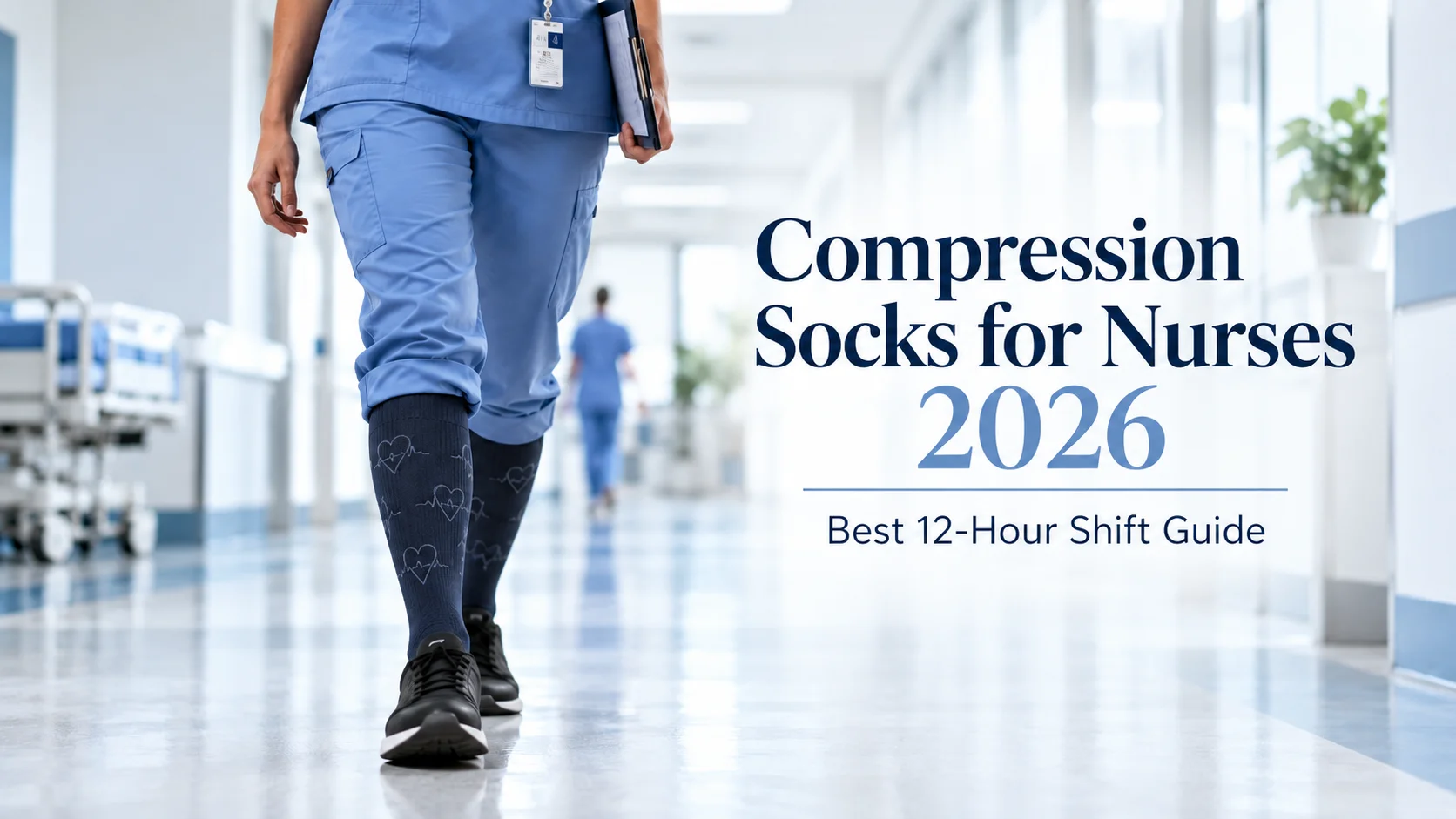
A 12-hour nursing shift can mean hours of walking, standing at bedsides, charting on your feet, and moving between units with little true rest. By handoff, some nurses notice tired legs, heavy calves, puffy ankles, or shoes that feel tighter than they did at clock-in. That is why compression socks for nurses are common workwear.
The best pair is not simply the tightest sock. For long nursing shifts, a better choice combines graduated compression, accurate ankle-and-calf sizing, breathability, and a cuff that stays up without digging into the skin.
For many otherwise healthy nurses seeking everyday support during prolonged standing, knee-high graduated compression in the 15–20 mmHg range is a practical starting point. Some people use 20–30 mmHg, but stronger compression is not automatically better. The right level depends on why you are wearing it, your symptoms, health history, and fit. Cleveland Clinic classifies 15–20 mmHg as moderate and 20–30 mmHg as firm compression.
Quick Answer: What Are the Best Compression Socks for Nurses?
For routine shift support, look for:
- Graduated compression that is strongest near the ankle and decreases up the calf
- A clearly stated compression level, commonly 15–20 mmHg for everyday occupational use
- Knee-high coverage
- Sizing based on ankle and calf circumference, not shoe size alone
- Breathable, moisture-managing fabric
- A smooth toe area and enough room inside nursing shoes
- A stay-up cuff that does not roll or pinch
- Reinforced heels and toes for frequent wear
- Wide-calf or petite sizing when standard dimensions do not match your legs
Research in people who work on their feet for long periods supports compression hosiery for reducing occupational lower-leg swelling and discomfort. Trials have found benefits around 15–20 mmHg, and one 12-hour standing study found similar effects with 15–20 and 20–30 mmHg stockings. That does not mean every nurse needs compression or that one pressure fits everyone.
Why Nurses Wear Compression Socks During Long Shifts

When you remain upright for hours, gravity encourages blood and fluid to collect in the lower legs. Calf-muscle contractions help push venous blood upward, but standing relatively still at a bedside, workstation, or operating table provides less calf-pump activity than active walking.
Graduated compression socks apply greater pressure near the ankle and less pressure higher on the leg. This pressure gradient can help limit fluid accumulation and support venous return. Cleveland Clinic describes graduated compression socks as tightest around the ankle and progressively looser higher on the leg.
For nurses, that may mean less end-of-shift swelling, heaviness, or lower-leg discomfort. In a crossover trial of workers standing more than eight hours per day, many of whom were healthcare workers and mostly nurses, medical compression stockings prevented the workday increase in leg edema seen without compression. Another randomized trial found that below-knee stockings around 18–21 mmHg reduced occupational lower-leg volume and complaints.
Compression socks are supportive workwear, not a cure for leg pain or a substitute for evaluating persistent swelling, vascular disease, injury, or another medical problem.
What Compression Level Is Best for Nurses?

Compression pressure is measured in millimeters of mercury, or mmHg. Higher numbers mean greater external pressure.
| Compression level | Typical role for nurses | Main consideration |
|---|---|---|
| 8–15 mmHg | Light support | Easier to tolerate but may feel too mild |
| 15–20 mmHg | Everyday moderate support | Common option for healthy adults standing for long periods |
| 20–30 mmHg | Firmer compression | May suit some people; fit, tolerance, and medical history matter |
| 30–40 mmHg | Extra-firm medical compression | Use with professional guidance |
Cleveland Clinic currently lists 8–15 mmHg as mild, 15–20 mmHg as moderate, 20–30 mmHg as firm, and 30–40 mmHg as extra-firm compression.
Is 15–20 mmHg Good for Nurses?
For an otherwise healthy nurse seeking support for prolonged standing, 15–20 mmHg is often a reasonable starting range. It provides meaningful graduated pressure while generally being easier to put on and tolerate than firmer stockings.
A randomized crossover study in hairdressers found that 15–20 mmHg stockings modestly reduced pain, feelings of swelling, and lower-leg volume compared with no compression. In a 12-hour standing study, both 15–20 and 20–30 mmHg stockings attenuated lower-leg fatigue, edema, and discomfort, with similar benefits between the compression groups.
That is important because choosing more pressure “just in case” can make a sock harder to wear without necessarily adding benefit for a healthy occupational user.
Is 20–30 mmHg Better for a 12-Hour Shift?
Not automatically. Someone who already uses 20–30 mmHg compression socks comfortably, or has been advised to use firmer compression for a medical reason, may prefer it. But first-time wearers should not assume 20–30 mmHg is superior just because it is tighter.
Firm compression is harder to put on and less forgiving of sizing errors. If you have persistent swelling, varicose-vein symptoms, diabetes-related complications, neuropathy, peripheral artery disease, or another circulation concern, ask a healthcare professional what level is appropriate rather than simply moving to stronger compression.
Best Compression Socks for Nurses by Work Need

Different nursing roles can favor different features even when the shift length is the same.
| Product | Compression | Best For | Key Features | Amazon |
|---|---|---|---|---|
| CHARMKING Compression Socks for Nurses, 3 Pairs | 15–20 mmHg | Budget & daily shift rotation | Graduated compression, multipack, nurse-focused styles | Check Price on Amazon |
| Comrad CloudCotton Compression Socks | 15–20 mmHg | Comfort & wider calves | Soft fabric, knee-high design, wide-size options | Check Price on Amazon |
| FITRELL 3 Pairs Compression Socks | 20–30 mmHg | Firmer support & multipack value | Graduated compression, moisture-wicking construction, seamless toe | Check Price on Amazon |
| Physix Gear Sport Compression Socks | 20–30 mmHg | Firm compression | Knee-high graduated compression, athletic/work-oriented construction | Check Price on Amazon |
| Sockwell Elevation Firm Compression Socks | 20–30 mmHg | Merino blend & long wear | Merino-blend fabric, graduated compression, light cushioning | Check Price on Amazon |
Best for 12-Hour Nursing Shifts
For compression socks for nurses working 12-hour shifts, prioritize knee-high graduated compression, accurate sizing, moisture management, and a cuff that stays flat through the shift. A 15–20 mmHg sock may be enough for many healthy users; firmer compression should be chosen deliberately.
A sock that feels fine at 7 a.m. but rolls, bunches, or cuts into the calf by mid-shift is not a successful fit.
Best for Standing All Day
If your role includes long periods at the bedside, in surgery, during procedures, or at a workstation, consistent graduated compression matters more than decorative features. Research on prolonged-standing occupations suggests compression can reduce occupational edema.
Compression does not replace normal movement, calf-muscle activity, appropriate breaks, or supportive footwear.
Best for Swollen Ankles or Tired Legs
Mild end-of-shift puffiness can occur after prolonged upright work, and compression may help some people limit it. But recurrent or substantial edema deserves more attention than buying a tighter sock.
Sudden swelling, especially in one leg with pain, warmth, tenderness, or discoloration, can be a sign of deep vein thrombosis and should be assessed promptly. Shortness of breath or chest pain can indicate pulmonary embolism and requires urgent medical care.
Best for Wide-Calf or Petite Nurses
Wide-calf compression socks for nurses should come from a chart that includes calf circumference. Do not simply buy a larger shoe-size sock; that may leave the ankle too loose while the calf still fits poorly.
Petite nurses should also check garment length. A knee-high sock that is too long can bunch behind the knee or encourage the cuff to fold. Match ankle circumference, calf circumference, and lower-leg length whenever the manufacturer provides all three.
Best for Travel Nurses and Nursing Students
Travel nurses should prioritize durable, breathable socks that work both on the floor and during travel, while remembering that prolonged sitting and prolonged standing are different situations. People with blood-clot risk factors should get individualized travel advice.
Nursing students need the same fundamentals as experienced nurses: appropriate graduated compression, correct measurements, comfortable shoe fit, and enough pairs for their clinical schedule.
How Should Nurse Compression Socks Fit?

A good compression sock should feel snug and supportive, not painful. It should lie smoothly without deep folds, twisted fabric, or a rolled cuff.
For knee-high compression socks, check these measurements when the brand provides them:
- Ankle circumference at the narrowest point above the ankle bone
- Calf circumference at the widest point
- Lower-leg length to just below the knee, following that brand’s instructions
Shoe size can help with foot length, but it is not enough by itself for reliable knee-high compression sizing.
Persistent pain, numbness, tingling, skin discoloration, skin damage, worsening swelling, or a painful top band are reasons to remove the garment and reassess the size or seek medical advice. Cleveland Clinic specifically advises removing compression socks if these symptoms occur.
A faint temporary fabric mark is different from a painful, deeply indented band.
What Material Is Best for Nurse Compression Socks?

There is no single best fiber for every hospital environment. Compression socks usually combine elastic fibers such as spandex or elastane with nylon, polyester, cotton, wool, or other materials.
Nylon and synthetic blends are common because they can provide stretch, durability, shape retention, and moisture handling. They often suit nurses who wash work socks frequently, although some people find highly synthetic fabrics warmer.
Merino-wool blends can feel soft and help with temperature management. They may be thicker, so make sure they do not crowd the toes inside fitted work shoes.
Cotton or bamboo-derived blends may feel softer or more familiar, but the entire knit construction matters more than one fiber name. For a long shift, breathability, drying speed, durability, and compression retention are more useful buying criteria than marketing claims about a single material.
Features That Matter Most for Healthcare Workers
A good nurse compression sock must function inside a complete work setup.
Graduated pressure: The product should clearly state that it is graduated compression and show its mmHg range.
Stay-up cuff: A broad cuff can reduce slipping, but it should remain flat rather than roll into a tight band.
Moisture management: Warm, damp feet can become uncomfortable during long shifts, so breathable fabrics that handle moisture are useful.
Smooth toe construction: Bulky seams can irritate toes inside close-fitting shoes. This is particularly important for anyone with reduced sensation.
Reinforced heel and toe: These high-wear zones matter when socks are used and washed frequently.
Moderate cushioning: Padding may improve underfoot comfort, but too much thickness can make nursing shoes tight.
Accurate size range: Wide-calf, petite, and extended sizes are functional features because correct dimensions help the pressure sit where intended.
Can Nurses Wear Compression Socks Every Shift?
Many healthy adults can wear properly fitted compression socks during waking hours, and using them for work shifts is common. Cleveland Clinic advises putting them on in the morning before the legs and ankles have had time to swell and removing them before bed.
For a night-shift nurse, the clock time matters less than the principle: put them on before prolonged upright activity and before noticeable swelling develops. Do not sleep in compression socks unless a healthcare professional has specifically told you to.
To put them on, position the heel correctly and smooth the garment upward in sections. Work out wrinkles rather than pulling hard on the top. Do not fold the cuff down to shorten the sock because that concentrates pressure into a narrow band. NHS compression-stockings guidance similarly recommends applying the garment smoothly without twisting, folding, or wrinkling it.
How Many Pairs Should a Nurse Own?
There is no medical rule. The practical goal is to have a clean, fully dry pair for each planned shift.
If you work three shifts per week, three to four wearable pairs make rotation easier. More frequent schedules may justify five or more. Rotation also reduces the temptation to use a damp pair or repeatedly expose the same sock to aggressive drying.
How to Wash Compression Socks
Follow the care label because fabric blends differ. In general:
- Wash after each wear or as the manufacturer directs
- Use mild detergent
- Avoid fabric softener unless specifically permitted
- Avoid high heat that can damage elastic fibers
- Air-dry when recommended
- Replace socks when they become stretched, damaged, unusually easy to pull on, or no longer stay positioned
Prescribed medical stockings are often replaced periodically because their performance declines with wear. NHS guidance for medical compression hosiery also recommends keeping multiple pairs available so one can be worn while another is being washed and dried.
For ordinary work socks, follow the manufacturer’s replacement guidance and pay attention to loss of elasticity and fit.
Compression Socks and Nursing Shoes
Socks cannot compensate for poorly fitting work shoes. A thicker compression sock reduces available toe-box room, while added cushioning or an orthotic changes shoe volume further.
Try your nursing shoes with the exact sock thickness you plan to wear. Your toes should not feel crowded, and the shoe should not create new pressure at the forefoot or heel.
This is easy to overlook: a compression sock can fit the leg correctly and still be the wrong choice if it makes the shoe too tight.
When Nurses Should Get Medical Advice Before Using Compression

Most healthy people can use consumer compression socks safely, but there are important exceptions.
Ask a qualified healthcare professional before using compression if you have known or suspected peripheral artery disease (PAD), severely reduced sensation, significant neuropathy, severe or unexplained swelling, heart failure, recent vascular surgery, fragile skin, open wounds, or active skin infection.
An international consensus statement identifies severe peripheral arterial disease as an important contraindication to sustained medical compression and recommends particular caution with severe diabetic neuropathy and sensory loss. Cleveland Clinic also advises professional guidance for PAD, severe swelling, and severely reduced sensation.
Diabetes alone does not automatically mean compression is unsafe or necessary. The decision changes with arterial circulation, neuropathy, skin condition, swelling, wounds, and other complications.
Remove the sock and seek advice if it causes pain, numbness, tingling, skin discoloration, skin damage, or worsening swelling.
Common Buying Mistakes
The first mistake is choosing by shoe size alone. For knee-high stockings, ankle and calf dimensions can determine whether the pressure is distributed correctly.
The second is assuming tighter means better. Compression level and fit are separate decisions; a properly fitted 15–20 mmHg sock may be more useful than a poorly fitted 20–30 mmHg garment.
Another mistake is ignoring shoe compatibility. If a sock’s cushioning makes your work shoe cramped, the overall setup is wrong even if the sock itself is well made.
Nurse Compression Sock Buying Checklist
Before ordering, ask:
- Is the compression range clearly stated in mmHg?
- Is it graduated rather than simply described as “tight”?
- Does the chart include ankle and calf circumference?
- Is petite or wide-calf sizing available if needed?
- Will it reach just below the knee without folding?
- Is the fabric breathable enough for your unit and climate?
- Is the toe area smooth and roomy inside your nursing shoes?
- Does the cushioning work with your shoes or orthotics?
- Can you realistically follow its washing instructions?
- Is the pressure appropriate for your health history and reason for wearing it?
A product that answers these questions well is a better choice than one selected only because it has the highest compression number, the most reviews, or medical-sounding marketing.
FAQs About Compression Socks for Nurses
Why do nurses wear compression socks?
Nurses often wear them for lower-leg support during prolonged standing and walking. Graduated compression can help limit occupational swelling and may reduce feelings of heaviness or discomfort in some people.
Are compression socks good for 12-hour nursing shifts?
They can be. Studies in prolonged-standing workers have found that compression stockings can reduce or prevent lower-leg edema during long work periods. Comfort still depends on pressure, size, length, material, and shoe fit.
What mmHg compression socks should nurses wear?
There is no single level every nurse should use. For healthy adults seeking everyday occupational support, 15–20 mmHg is a common moderate range. A 20–30 mmHg sock is firmer and may suit some people, but stronger is not automatically better.
Are knee-high compression socks best for nurses?
Knee-high styles are practical for many nurses because they cover the calf while fitting easily under scrub pants. Thigh-high stockings usually are not necessary for routine occupational support unless there is a medical reason.
How tight should compression socks be?
They should feel consistently snug, not painful. The garment should stay smooth without rolling or bunching. Pain, numbness, tingling, skin discoloration, damage, or worsening swelling are warning signs.
Can compression socks help swollen feet or ankles after a shift?
They may help limit swelling related to prolonged standing, but swelling has many causes. New, substantial, persistent, or one-sided swelling should not simply be managed with tighter socks without medical assessment.
Can nurses with diabetes wear compression socks?
Some can, but diabetes alone does not determine the answer. If diabetes is accompanied by neuropathy, reduced sensation, peripheral artery disease, wounds, or other circulation problems, a healthcare professional should help decide whether compression is appropriate.
Are compression socks safe for varicose veins?
Compression stockings are commonly used to help manage symptoms associated with venous conditions such as aching or swelling. Painful or worsening varicose veins, skin changes, or a diagnosed vascular condition deserve individualized medical guidance.
How often should nurses wash compression socks?
Follow the care label. Washing after each workday is a practical hygiene routine for many people. Avoid methods that damage elastic fibers, particularly excessive heat when air-drying is recommended.
Should nurses wear compression socks every day?
Healthy users who tolerate them well may choose to wear them for each work shift. They are generally worn during waking, upright hours rather than during sleep unless a clinician instructs otherwise.
Final Takeaway
The best compression socks for nurses deliver an appropriate amount of graduated pressure while remaining wearable for the real shift. For many otherwise healthy nurses, that can mean knee-high 15–20 mmHg compression sized using the ankle and calf, with breathable fabric and a cuff that stays flat.
If you prefer or medically need firmer support, 20–30 mmHg may be appropriate, but do not treat higher pressure as an automatic upgrade. Fit, comfort, health history, and the reason for compression all matter.
For a 12-hour shift, use a simple buying strategy: choose a clearly stated graduated compression level, measure carefully, make sure the socks work with your nursing shoes, keep enough pairs for rotation, and pay attention to how your skin and legs respond.
Medical information notice: This article provides general educational information and is not a substitute for individualized medical advice. If you have significant or unexplained swelling, peripheral artery disease, reduced sensation, neuropathy, open wounds, a vascular condition, or another medical concern, ask a qualified healthcare professional what type of compression, if any, is appropriate for you.
Sources & Medical References
- Cleveland Clinic — What You Need To Know About Compression Socks, updated July 16, 2026. Covers graduated compression, common mmHg levels, wearing time, fit and safety considerations.
- PubMed — Improvement of occupational leg edema and discomforts, randomized crossover trial examining approximately 18–21 mmHg medical compression stockings.
- PubMed — Compression hosiery for occupational leg symptoms and leg volume, randomized crossover trial examining 15–20 mmHg stockings in a prolonged-standing occupation.
- Applied Ergonomics / PubMed — Comparison of Physiological Effects Induced by Two Compression Stockings and Regular Socks During Prolonged Standing Work, comparing 15–20 and 20–30 mmHg during 12-hour standing shifts.
- BMC Musculoskeletal Disorders — Compression stockings for workers with edema and pain after prolonged standing, including healthcare workers.
- International consensus statement — Risks and contraindications of medical compression treatment, covering peripheral arterial disease, neuropathy and compression-related precautions.
- CDC — Venous Thromboembolism, signs and symptoms of DVT and pulmonary embolism.

1 thought on “Compression Socks for Nurses 2026: Best 12-Hour Shift Guide”