

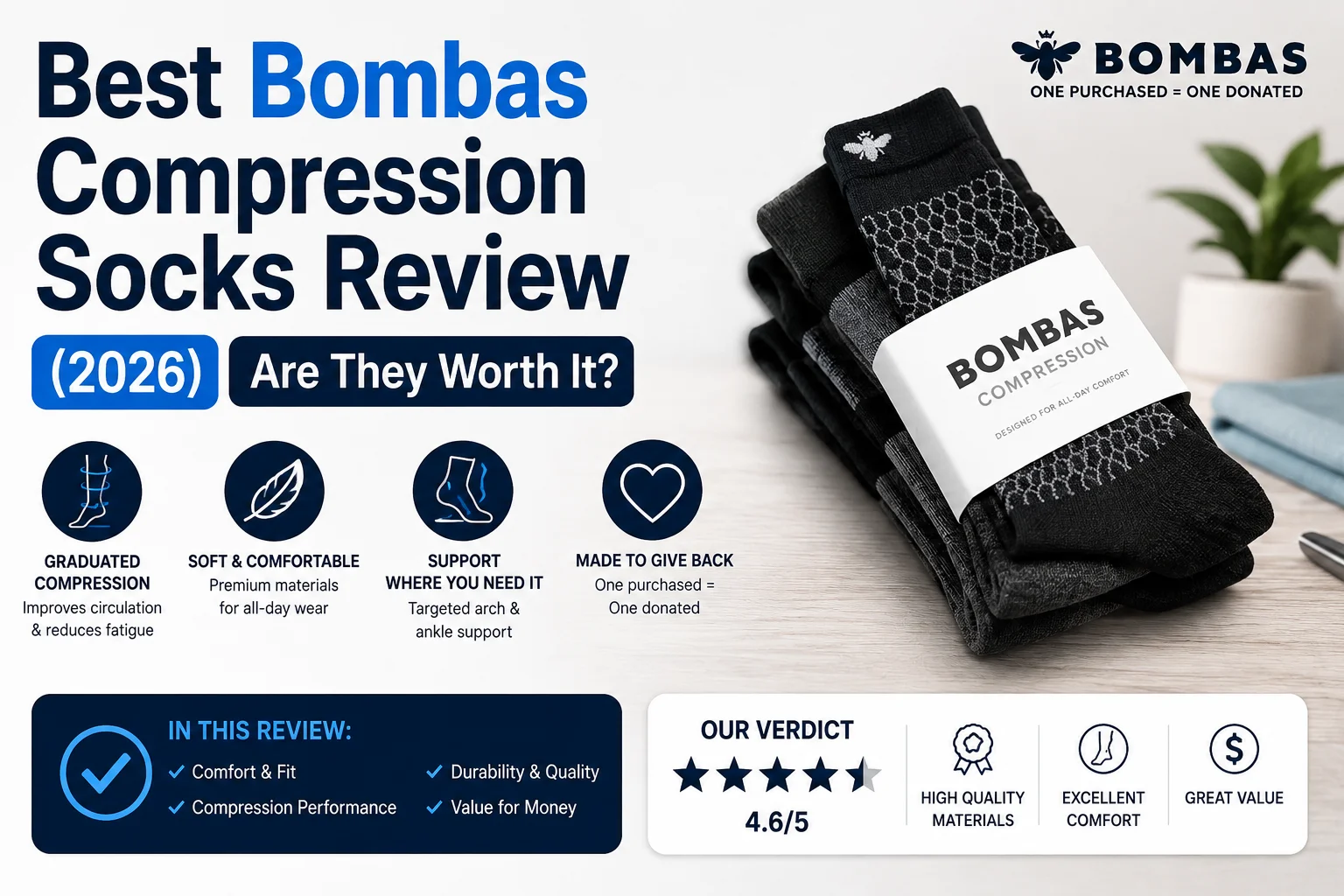
Buying Bombas compression socks is a little more complicated than picking a color and your usual shoe size. Bombas sells different compression strengths and styles, and the better choice depends on why you want compression, how your calves are shaped, and how much pressure is appropriate for you.
For someone looking for everyday support during work or travel, the brand’s 15–20 mmHg knee-high socks may make more sense than jumping directly to a stronger option. Bombas also sells 20–30 mmHg compression socks for people looking for firmer support, but higher compression isn’t automatically better.
This Bombas compression socks review looks beyond brand recognition. We’ll examine the current lineup, compression levels, fit, men’s and women’s options, wide-calf considerations, travel use, limitations, and the health questions you should understand before buying.
Quick Verdict: Are Bombas Compression Socks Worth It?
Bombas compression socks are worth considering if you value graduated compression, cushioned comfort, mainstream styling, and several compression options. Their biggest potential limitation is fit: a well-made compression sock still won’t work well if the calf, foot, or leg length is wrong for your body.
The current Bombas lineup includes Everyday Compression Knee High Socks at 15–20 mmHg, while stronger Medical Grade and Sport/Performance options reach 20–30 mmHg. Bombas describes its knee-high designs as graduated, meaning pressure is greatest near the ankle and decreases farther up the leg.
Here’s the practical breakdown:
| Consideration | Bombas Compression Socks |
|---|---|
| Everyday compression | 15–20 mmHg options available |
| Stronger compression | 20–30 mmHg options available |
| Primary length | Knee-high is prominent in the range |
| Compression style | Graduated |
| Men’s options | Yes |
| Women’s options | Yes |
| Travel-focused options | Yes |
| Merino-blend options | Yes |
| Best reason to consider them | Comfort-focused compression for everyday, work, travel or sport depending on model |
| Main issue to check | Correct sizing, calf fit and appropriate compression level |
The question isn’t simply, Are Bombas compression socks worth it? A better question is whether a specific Bombas model matches your intended use and measurements.
What Do Bombas Compression Socks Actually Do?

Compression socks apply controlled external pressure to the lower leg. With graduated compression, the pressure is designed to be stronger toward the ankle and decrease farther up the leg. This can assist venous blood movement and reduce pooling in appropriate users. MedlinePlus notes that compression stockings can help move blood up the legs and help with swelling in people for whom compression is suitable.
That explains many searches around what do compression socks do, what are compression socks used for, and what are compression socks good for.
They are commonly considered for situations such as prolonged standing, prolonged sitting and travel, as well as certain medical conditions under professional guidance. Compression should not, however, be presented as a cure for poor circulation, neuropathy, chronic pain, blood clots or another underlying disorder.
Bombas itself offers different compression strengths because one level doesn’t fit every purpose. Its Everyday knee-high line uses 15–20 mmHg, while its stronger products include 20–30 mmHg options.
15–20 mmHg vs. 20–30 mmHg Bombas Socks
The mmHg number describes pressure in millimeters of mercury.
For a general shopper, the distinction matters more than branding:
- 15–20 mmHg: moderate compression commonly used for everyday support and travel-type applications.
- 20–30 mmHg: substantially firmer compression and more likely to require careful consideration of medical history, fit and intended use.
Bombas markets its 15–20 mmHg Everyday socks for all-day wear and calls 20–30 mmHg its strongest compression range.
Don’t interpret 20–30 mmHg as the automatic “upgrade.” The appropriate pressure depends on the reason you’re wearing compression and, in medical situations, professional assessment.
Bombas Everyday Compression Socks: The Most Versatile Starting Point

For many people researching compression socks Bombas or Bombas socks compression, the Everyday knee-high model is the most logical product to investigate first.
Bombas currently lists the Everyday Compression Knee High at 15–20 mmHg and describes it as graduated compression with the firmest support at the ankle. The women’s six-pack listing also describes the construction as midweight, intended to provide some cushioning without being excessively bulky in everyday shoes.
That combination is potentially useful for:
- travelers spending hours sitting;
- nurses and other workers who spend much of a shift standing;
- office workers who sit for prolonged periods;
- people who simply prefer moderate leg support;
- shoppers new to compression who don’t specifically need a stronger medical level.
A key practical consideration is footwear. Even moderate compression socks may contain more cushioning than thin dress socks. If your shoes already fit tightly across the toes or forefoot, extra sock thickness can make an otherwise comfortable shoe restrictive.
Bombas also offers a merino-wool-blend Everyday Compression option at 15–20 mmHg, providing another choice for shoppers who prioritize temperature regulation and a different fabric feel.
| Product | Compression | Best For | Key Feature | Amazon |
|---|---|---|---|---|
| Bombas Everyday Compression Knee High | 15–20 mmHg | Everyday, work & travel | Graduated compression + cushioning | → Check Price |
| Bombas Sport/Performance Compression | 20–30 mmHg | Sport & firmer support | Stronger compression | → Check Price |
| Bombas Merino Compression | 15–20 mmHg | Travel & cooler conditions | Merino-blend fabric | → Check Price |
Bombas Compression Socks for Women
The Bombas compression socks women collection currently includes moderate and stronger compression options rather than a single universal sock. Women’s Everyday Compression Knee High Socks are available at 15–20 mmHg, while stronger 20–30 mmHg styles are also part of the range.
For women comparing bomba compression socks for women with other compression socks for women, prioritize these factors:
Calf circumference
A sock can match your shoe size but still be wrong for your calf. If the upper band digs deeply into the skin, the material rolls, or the sock feels progressively painful, don’t assume that’s simply how compression should feel.
Leg length
A knee-high sock that is too long can bunch behind the knee. Folding the top down isn’t a good fix because doubled material creates a tighter pressure band. NHS guidance similarly warns against folding or wrinkling compression stockings while they’re being worn.
Intended use
A nurse wearing compression during a long shift, a pregnant traveler and someone using prescribed compression for a vascular condition don’t necessarily need the same product.
Pregnancy-related swelling is common, but pregnancy also changes medical risk considerations. If swelling is sudden, severe, one-sided or accompanied by other concerning symptoms, it should be medically assessed rather than managed simply by purchasing socks.
Bombas Compression Socks for Men
The same principle applies to Bombas compression socks men searches. Bombas currently offers men’s Everyday 15–20 mmHg knee-high socks as well as 20–30 mmHg stronger compression products.
For someone reading Bombas men’s compression socks reviews, the most useful question isn’t whether another man’s pair felt comfortable. Compression fit is measurement-dependent.
Men with larger calves, muscular lower legs or long legs should pay particular attention to how the size chart corresponds to their body. Shoe size alone doesn’t tell you whether a knee-high garment will fit the calf correctly.
For work, travel and ordinary daily wear, moderate compression may be the more relevant category unless a clinician has recommended something different. For sport or a medical reason, a 20–30 mmHg model may be considered, but it should be selected because the compression level fits the purpose—not because “stronger” sounds more effective.
Bombas Wide-Calf Compression Socks: Check the Product, Not Just the Brand

Wide calf compression socks deserve extra attention because compression and size are two separate issues.
A common mistake is buying a larger standard sock simply because the calf feels tight. That can create a poor foot fit while still failing to provide the correct leg dimensions.
Bombas sells wide-calf socks elsewhere in its sock collection, including Ultra Stretch styles, but a wide-calf regular sock shouldn’t automatically be treated as equivalent to a purpose-designed graduated compression sock. Bombas’ women’s Ultra Stretch calf sock, for example, is marketed around additional stretch rather than as the same product as its graduated Everyday Compression Knee High.
So if you’re specifically searching for Bombas wide calf compression socks, verify that the exact product page identifies the garment as compression and provides the level you need. Don’t assume every relaxed, stretchy or supportive Bombas sock delivers measured graduated compression.
Signs the fit deserves reconsideration
A compression sock should feel snug, but “snug” isn’t the same as painfully restrictive.
Recheck the size or seek professional fitting help if you experience persistent pain, pronounced pinching, unusual numbness, skin discoloration, a deeply cutting top band, or material that repeatedly rolls into a narrow band.
That distinction answers two common questions: Are compression socks supposed to be tight? Yes, they are intended to apply pressure. Can compression socks be too tight? Yes—incorrect sizing, bunching or an inappropriate compression level can cause problems.
Bombas Compression Socks for Flying
Travel is one of the clearest everyday use cases for compression socks.
Long periods of sitting can contribute to leg and foot swelling, and Mayo Clinic notes that compression stockings can help reduce lower-leg swelling during long flights. Movement still matters: compression socks aren’t a substitute for periodically walking, moving the ankles and avoiding prolonged immobility.
Bombas currently sells travel-oriented compression products, including a women’s Travel Compression Knee High line at 15–20 mmHg with lightweight cotton and merino-wool components.
For flying, consider:
- Compression strength: Don’t automatically choose the strongest pair.
- Calf fit: Several hours in an incorrectly fitted sock can become uncomfortable.
- Breathability: Warm cabins and long wear make moisture and heat management relevant.
- Shoe room: Feet may swell during travel, so avoid creating additional restriction with tight shoes.
- Mobility: Walk and move your legs periodically when possible.
People with a history of blood clots or significant vascular conditions should get individualized medical advice instead of relying on a retail travel recommendation.
How to Measure for Bombas Compression Socks

This is one of the most important parts of the purchase.
For ordinary socks, shoe size often does most of the work. With knee-high compression, calf circumference and leg proportions can materially affect fit.
Before ordering, check the current Bombas size chart for the exact product rather than assuming the same size applies across every model.
Useful measurements can include:
- shoe or foot size;
- circumference around the widest part of the calf;
- ankle circumference when requested by the manufacturer;
- lower-leg length if the sizing system provides it.
Measure against the actual chart for the product you’re buying.
If you’re between sizes, resist the temptation to automatically size down for “better compression.” Compression strength is engineered into the garment. Making the sock too small isn’t a reliable way to increase therapeutic compression and may simply create a poor fit.
How to Put On Compression Socks Without Fighting Them
Putting on compression socks can be more difficult than putting on ordinary socks—especially with stronger compression.
A simple approach is:
- Put them on when the legs are relatively less swollen, often earlier in the day if that matches your care instructions.
- Reach inside and turn the upper portion inside out down toward the heel.
- Position the foot and heel correctly first.
- Gradually work the material up the leg.
- Smooth wrinkles rather than pulling aggressively from the top.
- Keep the upper edge flat instead of rolling or folding it.
NHS guidance specifically warns against folding or wrinkling compression stockings, because concentrated pressure can be created where material doubles over.
People with limited hand strength, arthritis or mobility problems may find stronger compression difficult to apply. A stocking donner or similar assistive device can sometimes make the process easier; Mayo Clinic also notes stocking aids as an option for putting compression stockings on.
How Long Should You Wear Bombas Compression Socks?

There isn’t one universal answer to how long should you wear compression socks.
For ordinary daytime use, many compression stockings are worn during waking hours and removed before bed. Medical instructions may be different depending on the condition, procedure or reason compression was prescribed. NHS patient guidance generally advises removing compression garments at bedtime unless a clinician has instructed otherwise.
So, can you wear compression socks all day? For an otherwise appropriate user wearing a correctly fitted everyday product, extended daytime wear may be reasonable. But prescribed compression should be worn according to the healthcare professional’s instructions.
Inspect your skin after removing the socks. Persistent irritation, soreness, marked discoloration or other unusual changes deserve attention.
Can You Sleep in Bombas Compression Socks?
For most general retail users, don’t assume that daytime compression socks should also be worn to bed.
Clinical guidance commonly recommends removing compression stockings at night unless you’ve specifically been instructed to keep them on. There are exceptions—for example, some patients receive medical instructions to use specific compression garments overnight following procedures or during periods of reduced mobility.
That means searches such as can you sleep in compression socks, can I wear compression socks to bed, should you sleep in compression socks, and why should you not wear compression socks at night all come back to the same principle: follow the instructions appropriate to the garment and your medical situation.
Don’t turn somebody else’s routine into your own medical regimen.
Who Should Be Careful With Compression Socks?
Compression isn’t appropriate for every circulation problem.
Peripheral arterial disease (PAD), for example, reduces arterial blood flow to the limbs. Medical literature identifies severe peripheral arterial disease as an important contraindication to sustained compression, and broader clinical guidance recommends careful vascular assessment when arterial disease is suspected.
Talk with an appropriate healthcare professional before choosing compression if you have known or suspected significant arterial disease, major circulation impairment, loss of sensation, significant neuropathy, wounds, serious skin problems or a medical condition for which compression has been discussed as treatment.
This is especially relevant to the question do compression socks help neuropathy? Compression socks aren’t a general treatment for neuropathy, and reduced sensation can make pressure or skin injury harder to detect. A review of graduated compression stockings lists severe peripheral neuropathy or other significant sensory impairment among important contraindication considerations.
Likewise, people with diabetes shouldn’t assume that compression socks and diabetic socks are interchangeable. Diabetic socks commonly prioritize minimizing friction, pressure points and restrictive cuffs, while compression socks intentionally apply external pressure. Someone with diabetes, neuropathy, wounds or known circulation problems may need professional advice about whether compression is appropriate.
Seek prompt medical assessment rather than self-treating with socks if you develop sudden unexplained one-sided swelling, significant leg pain, concerning color changes, a wound, major loss of sensation or symptoms that could indicate a vascular problem.
Bombas vs. Other Compression Sock Brands

Bombas isn’t the only option. Shoppers researching the best compression socks commonly encounter Comrad compression socks, Jobst compression socks, Sockwell, Copper Fit, Wellow and other brands.
The useful comparison isn’t “Which logo is best?” Consider:
| Priority | What to compare |
| Medical use | Appropriate compression level and professional recommendations |
| Everyday standing | Comfort, moderate compression, durability |
| Travel | Breathability, calf fit, easy all-day wear |
| Wide calves | Actual circumference range |
| Running | Moisture management, cushioning, movement stability |
| Warm weather | Yarn weight and breathability |
| Sensitive feet | Toe construction, friction and fit |
| Easy dressing | Stretch and donning difficulty |
Bombas becomes attractive when its particular combination of compression, cushioning and sizing works for you. Another brand may be the better decision if it offers a calf range, fabric, toe style, compression level or medical sizing system that suits you better.
Where to Buy Bombas Compression Socks
If you’re wondering where to buy Bombas compression socks, the most straightforward place to check current models, sizing and availability is Bombas’ official U.S. website. Its current compression collections include dedicated men’s and women’s products.
For third-party sellers, verify:
- the exact model name;
- compression level in mmHg;
- size;
- whether the product is new;
- seller credibility;
- return terms;
- whether specifications match Bombas’ current listing.
Avoid choosing a medical or stronger compression product only because an online marketplace has the lowest price. Correct fit and the correct compression level matter more.
Common Mistakes to Avoid
A few purchasing mistakes can turn a good compression sock into a bad experience.
Choosing by shoe size alone. Calf fit can determine whether a knee-high sock feels comfortable or restrictive.
Thinking tighter is always better. It isn’t. Higher pressure should have a reason behind it.
Rolling down the cuff. This concentrates pressure into a narrow band instead of letting the garment sit as designed.
Ignoring footwear. A thicker cushioned sock can change how a shoe fits.
Expecting compression to diagnose or treat unexplained symptoms. Swelling, pain and numbness can have many causes. Compression should not be used to guess at the cause.
Buying “wide-calf” by simply sizing up. Proper wide-calf sizing should accommodate calf circumference without leaving the foot excessively loose.
FAQ About Bombas Compression Socks
Are Bombas compression socks good for standing all day?
Bombas’ 15–20 mmHg Everyday Compression line is marketed for everyday wear and uses graduated compression. It may appeal to people who spend long periods standing, provided the socks fit correctly and compression is appropriate for them.
Do compression socks help with swelling?
They can help reduce certain forms of lower-leg swelling by applying pressure and limiting venous pooling, but swelling has many possible causes. Cleveland Clinic notes that compression socks can decrease swelling in appropriate users. New, severe or unexplained swelling should be medically evaluated rather than self-diagnosed.
How tight should compression socks be?
They should feel consistently snug without causing significant pain, numbness, concerning color change or a rolled band cutting into the leg. The appropriate sensation varies with compression level and fit.
Are Bombas compression socks medical grade?
Bombas currently describes its 20–30 mmHg Medical Grade Compression Knee High Socks as falling within its medical-grade range. That marketing category doesn’t mean the product is automatically appropriate for every medical condition; clinical compression decisions can require professional assessment.
Are Bombas compression socks good for pregnancy?
Compression stockings are sometimes used during pregnancy, but individual needs vary. Bombas offers moderate compression products that may interest pregnant shoppers, yet significant or concerning pregnancy-related swelling deserves discussion with an obstetric healthcare professional rather than self-treatment.
Are Bombas compression socks good for men and women?
Bombas currently maintains separate men’s and women’s compression collections with both moderate and stronger options. The better choice depends less on the gender label than on measurements, compression requirements, fabric preferences and intended use.
How long can you wear compression socks?
Many people wear appropriately fitted compression socks during the daytime and remove them before sleeping. Medical instructions can differ considerably, particularly after surgery or when compression is prescribed for a diagnosed condition.
Final Verdict on Bombas Compression Socks
Bombas compression socks make the most sense for shoppers who want a comfort-focused compression sock and are willing to choose by compression level and fit rather than brand name alone.
The 15–20 mmHg Everyday line is likely to be the most relevant starting point for general daily, work or travel searches, while Bombas’ 20–30 mmHg products serve a stronger-compression category.
Before buying, check three things: why you’re wearing compression, what pressure level is appropriate, and whether the exact size accommodates both your foot and calf. Those decisions matter more than color, popularity or review count.
Bombas can be a strong candidate, but no compression sock is universally “best.” If you have significant circulation disease, neuropathy, wounds, unexplained swelling or another medical concern, determine first whether compression itself is appropriate for you.
Medical information notice: This article provides general educational and product-selection information and isn’t a substitute for individualized medical advice. If you have diagnosed circulation disease, significant or unexplained swelling, reduced sensation, wounds, or another vascular or medical concern, ask a qualified healthcare professional what type of compression, if any, is appropriate.
Sources & Medical References
- Bombas — Current Women’s and Men’s Compression collections and product specifications for Everyday 15–20 mmHg, Performance 20–30 mmHg, Medical Grade 20–30 mmHg, merino-blend and travel compression products.
- MedlinePlus, U.S. National Library of Medicine — Venous insufficiency and peripheral arterial disease information.
- Cleveland Clinic — Current educational guidance on compression socks, swelling and circulation.
- Mayo Clinic — Guidance concerning compression stockings, travel-related swelling and DVT-related care.
- NHS healthcare guidance — Wearing, removing and safely positioning compression stockings.
- International consensus review, Phlebology — Risks and contraindications of medical compression treatment, including severe peripheral arterial occlusive disease.

1 thought on “Best Bombas Compression Socks Review (2026): Are They Worth It?”