

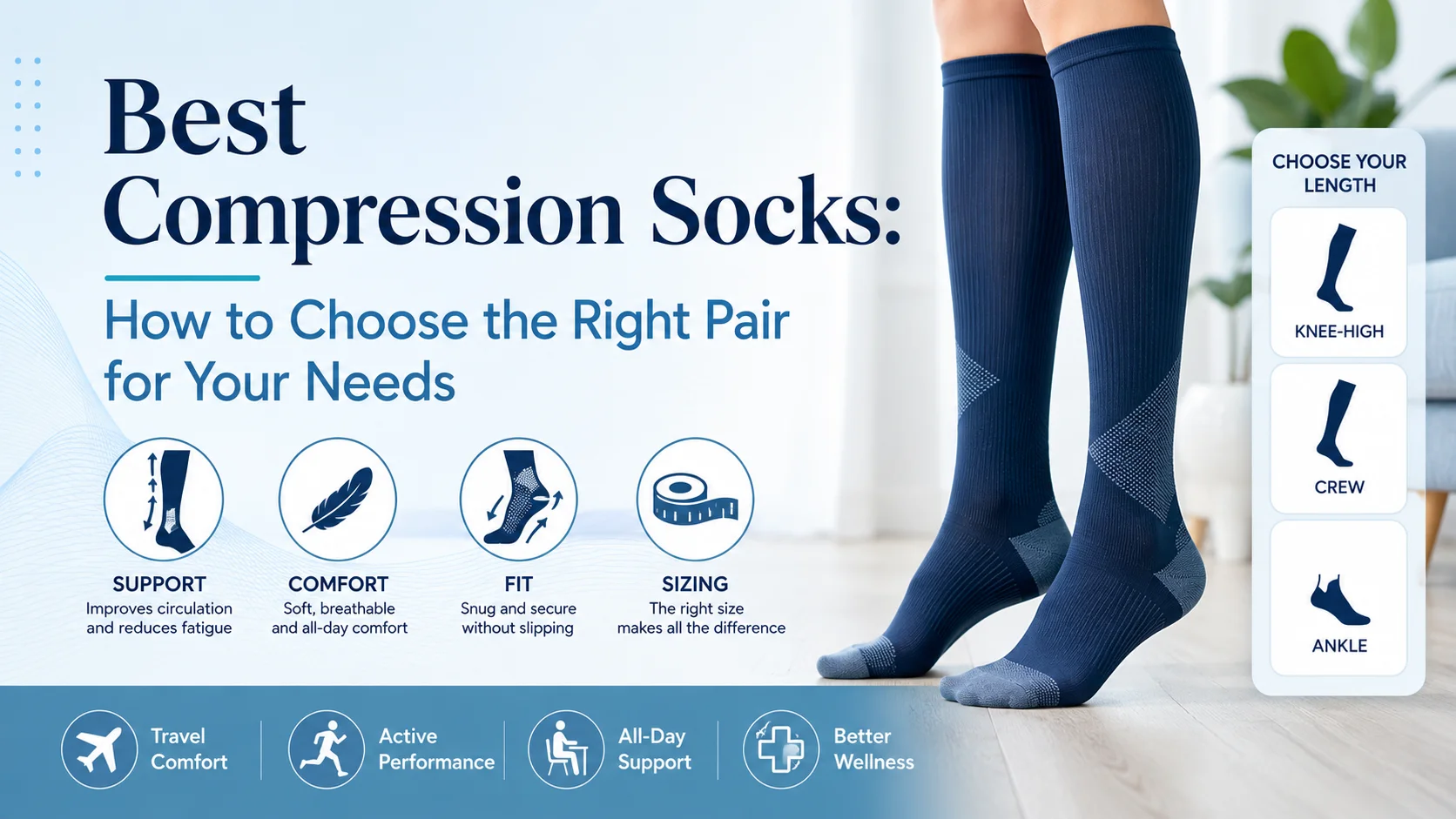
The “best” compression socks are not simply the tightest pair or the pair with the highest rating. A good choice matches three things: why you want compression, the pressure level appropriate for that goal, and a size that fits your ankle, calf and leg length.
For everyday support, travel or long hours of sitting or standing, comfort and fit matter as much as the mmHg number. Medical uses are more individualized. This guide helps you compare the best compression socks without treating every user as if they need the same thing.
Quick Picks: Best Compression Socks by Use Case
These are editorial examples based on currently published product specifications, not claims of personal testing. Availability, materials and sizing can change, so check the current manufacturer chart before buying.
| Best for | Example | Compression | Why it stands out | Main limitation |
|---|---|---|---|---|
| Everyday wear and travel | Bombas Everyday Compression Knee High | 15–20 mmHg | Moderate graduated compression in an everyday knee-high format | May not be enough for a medically directed higher-pressure need |
| Wide calves | Wellow Wide Calf Knee-High | 18–25 mmHg | Dedicated wide-calf sizing for calves listed at 18–22 inches | Pressure range differs from conventional 15–20 or 20–30 mmHg categories |
| Warm weather | Wellow Aerolite+ | 18–25 mmHg | Designed as a lighter, more breathable option for people who run hot | Buyers still need to confirm calf and leg-length fit |
| Firm everyday support | Comrad Knee-High | 20–30 mmHg | Firm graduated compression with a thin, moisture-wicking nylon construction | Firmer socks can be harder to put on |
| Merino-blend firm support | Sockwell Firm Compression | 20–30 mmHg | Merino-wool/bamboo-rayon blend options offer a different feel from all-synthetic socks | Firm compression is not appropriate for every user |
| Medical-compression range | JOBST | Multiple levels and styles | Broad compression range with everyday and medical-oriented styles | Best pressure and style may require professional guidance |
No single entry is the best medical compression sock for circulation for everyone. If compression is part of medical care, follow the recommended pressure and style rather than relying on a general best-of list.
What Do Compression Socks Do?

Compression socks apply external pressure to the lower leg. Graduated compression is strongest around the ankle and decreases higher up the leg. This pressure pattern can support venous blood return and help limit fluid pooling in the lower legs. MedlinePlus notes that compression stockings are used to support blood flow in leg veins and can help with leg swelling; they are also used in some situations related to blood-clot prevention.
A tight athletic sock is not automatically a graduated compression sock. Compression products are commonly labeled in millimeters of mercury, or mmHg, so you can compare their pressure range.
The goal also matters. A worker may care about end-of-day swelling, a traveler about prolonged sitting, and a person with venous disease may be following a treatment plan. Similar-looking socks can therefore serve different needs.
How to Choose the Best Compression Level
One of the most common buying mistakes is assuming stronger compression must be better. It is not. Pressure should match the intended use, your tolerance, your fit and, when medical conditions are involved, professional guidance.
Common ranges include:
- 8–15 mmHg: light compression often sold for gentle everyday support.
- 15–20 mmHg: moderate compression commonly found in travel, work and daily-wear socks.
- 20–30 mmHg: firm compression that may be used for stronger support and in some medical contexts.
- 30–40 mmHg: extra-firm compression that should generally be selected with medical guidance.
Cleveland Clinic lists these common pressure ranges and recommends professional input when compression is being used for a medical concern. The key point is that “medical grade” is not a reason to automatically move up a level. A sock can be technically impressive and still be wrong for the person wearing it.
For general travel or standing-day comfort, lower or moderate compression may be easier to wear consistently. For diagnosed venous disease, substantial edema, post-surgical needs or another condition, the best medical-grade compression socks are the ones that match the pressure and garment style recommended for you.
Fit Matters More Than Most Buyers Expect

Many shoppers start with shoe size. For knee-high compression socks, calf circumference and ankle circumference can be equally or more important because those measurements determine how the garment distributes pressure.
Measure when your legs are relatively least swollen, commonly earlier in the day. Follow the specific brand’s sizing chart rather than assuming that a “large” in one brand equals a “large” in another.
A good fit should feel snug and supportive, but it should not cause pain, numbness, tingling, skin discoloration or worsening swelling. Cleveland Clinic advises removing compression and reassessing the situation if symptoms such as these occur.
Leg length matters too. A sock that is too long can bunch behind the knee, while a rolling cuff can create an uncomfortable pressure band. Do not simply size up; re-measure and use wide-calf or short/petite sizing when available.
Best Compression Socks for Large or Wide Calves
Wide-calf users should look for a sizing chart that explicitly includes calf circumference, not merely a larger shoe-size range. Wellow, for example, currently lists a dedicated wide-calf knee-high option for 18–22-inch calves. That is more useful information than a generic “XL” label.
The best compression socks for wide calves should stay up without digging into the top band while still fitting closely enough at the ankle to deliver the intended graduated pressure. If the ankle is loose but the calf is tight, the proportion is wrong even if you can physically pull the sock on.
Plus-size users should use the same principle: buy for measured dimensions, not the size name. If no standard chart matches your ankle, calf and leg length together, a medical supply professional may be able to help with a better-fitting garment.
Best Materials for Comfort, Summer and Daily Wear

There is no single best material for compression socks. Most rely on elastic fibers such as spandex or elastane combined with nylon, polyester, wool or cellulose-based fibers.
Nylon-rich blends are common because they can be thin, smooth and durable. Comrad’s current 20–30 mmHg knee-high, for example, uses moisture-wicking nylon.
Merino-wool blends can be appealing when you want temperature management and a less clinical feel. Sockwell’s firm-compression range includes blends using fine merino wool, bamboo rayon and stretch fibers.
Bamboo-derived viscose blends are often selected for a softer feel. Wellow’s current products use a bamboo-viscose blend, while its Aerolite+ line is positioned as a lighter option for warm weather and long shifts.
For the best compression socks for summer, thickness and knit structure may matter as much as the fiber name. A lightweight synthetic sock can feel cooler than a heavily cushioned blend. Also consider your shoes: a thick compression sock can make an otherwise well-fitting shoe too tight across the toes.
Best Compression Socks for Women and Men
Women’s and men’s compression socks are often more similar than marketing suggests. Pressure, foot size, calf circumference, leg length and toe-box shape usually matter more than the label. A wide-calf user may fit better in a unisex model, while petite users should check sock length so the cuff does not sit in the knee crease.
Pregnancy can change swelling and sizing needs. Compression is sometimes used during pregnancy, but new, sudden or one-sided swelling deserves medical evaluation rather than self-treatment with a stronger sock. Cleveland Clinic includes pregnancy among situations where compression may sometimes be recommended.
So when comparing the best compression socks for women or the best compression socks for men, start with anatomy, use case and sizing rather than assuming the gender label determines performance.
Best Compression Socks for Seniors and People Who Struggle to Put Them On
For older adults, the “best” pair may be the one that can be put on correctly. Arthritis, limited mobility and firmer fabric can make donning difficult.
A sock aid or compression-stocking donner can help. Rigid frames reduce bending, while donning sleeves or gloves can improve grip and help the fabric slide into place.
To put on a knee-high compression sock:
- Start in the morning before significant swelling develops.
- Reach inside and turn the sock partly inside out to the heel.
- Place the foot fully into the heel pocket.
- Pull the fabric gradually over the ankle.
- Smooth it upward over the calf instead of yanking from the top band.
- Remove wrinkles and make sure the cuff is flat.
Do not fold or roll the top down to make the sock shorter. That can create a concentrated band of pressure.
For someone with limited hand strength, finding the best sock aid for compression socks can be just as important as comparing sock brands.
Compression Socks for POTS: Knee-High Is Not the Whole Story

People searching for the best compression socks for POTS should know that the evidence is not limited to ordinary knee-high socks.
A 2021 study in adults with postural orthostatic tachycardia syndrome found that abdominal and lower-body compression reduced orthostatic tachycardia and improved symptoms during tilt testing. Research and expert reviews have also discussed compression extending beyond the calves in POTS management.
That means a fashionable knee-high pair should not automatically be presented as the best POTS solution. If compression is part of your POTS management plan, ask the clinician managing your condition about garment height, abdominal compression and pressure level. A waist-high garment or abdominal component may address more of the blood-pooling area than a calf-only sock.
Circulation, Swelling, Foot Pain, Neuropathy and Restless Legs
Compression socks can support venous circulation and may help with certain types of lower-leg swelling, but “poor circulation” is too broad a phrase to use as a diagnosis. Arterial disease and venous disease are different problems, and compression that is useful in one setting may require caution in another.
For foot pain, compression may feel supportive when discomfort accompanies swelling or long periods of standing, but it is not a treatment for every cause of foot pain, plantar fasciitis or nerve pain.
Likewise, compression socks are not a universal treatment for restless legs syndrome. Persistent, disruptive or new symptoms deserve evaluation rather than simply increasing compression.
People with diabetes should be especially careful about self-selecting compression if they have neuropathy, reduced sensation, wounds or known circulation problems. The CDC explains that diabetes-related nerve damage can reduce the ability to feel injuries, while poor blood flow can complicate healing.
Diabetic socks and compression socks also serve different purposes. Many diabetic socks prioritize low-friction seams, cushioning and nonbinding tops rather than graduated pressure. Having diabetes does not automatically mean that compression is appropriate.
Compression Socks for Flying, Work and Long Periods of Sitting
For long flights, graduated compression stockings have evidence behind them. A Cochrane review found high-certainty evidence that airline passengers similar to those studied had fewer symptomless DVTs when wearing compression stockings, although the trials did not establish reductions in symptomatic DVT, pulmonary embolism or death.
Compression should still be only one part of sensible travel habits. Move your legs, walk when practical and follow individualized advice if you have known clotting risk factors.
For nurses, healthcare workers and others who stand for long periods, a comfortable knee-high is often more practical than a thigh-high garment. Breathability, a non-bunching cuff and enough room in the shoe may matter more than choosing the firmest pressure.
Office workers face long periods of sitting, but the same rule applies: a sock that pinches and gets removed after an hour is not a good everyday choice.
When Is the Best Time to Wear Compression Socks?
For most daytime uses, morning is a practical time to put them on, before the legs have had much time to swell. MedlinePlus specifically advises putting compression stockings on early in the morning, and Cleveland Clinic similarly recommends wearing them before swelling develops.
How long should you wear compression socks? There is no universal number of hours. Some people wear them through a workday or travel day, while medical users may have a schedule given by their clinician. MedlinePlus notes that prescribed stockings may sometimes be worn throughout the day depending on instructions.
Can you wear compression socks all day? Often, yes, when the garment is properly fitted and the use is appropriate. But “all day” should not mean ignoring pain, numbness, tingling, skin changes or increasing swelling.
Can You Sleep in Compression Socks?
For routine daytime compression, sleeping in the same socks is usually unnecessary. Cleveland Clinic explains that much of the benefit is relevant while you are upright, when gravity promotes pooling in the legs, and advises most routine users to remove them before bed.
Certain medical situations may use nighttime compression, but that should be directed by a healthcare professional.
So if you are asking “can I sleep in compression socks?”, “can you sleep with compression socks on?” or “should you wear compression socks to bed?”, the safest general answer is: not as a routine habit unless your care plan specifically calls for nighttime compression.
How to Buy the Best Compression Socks Online or Near You

When you buy compression socks online, do not start with star ratings. Start with the sizing chart and pressure rating. The best-rated compression socks can still fit you badly if reviewers have different calf proportions or goals.
Check five things before ordering:
- Clearly stated mmHg range.
- Ankle and calf measurements, not just shoe size.
- Garment length and toe style.
- Material and thickness for your climate and footwear.
- Return or exchange policy in case the size is wrong.
Independent review roundups, including publications such as Wirecutter, can be useful for narrowing the field, but no universal ranking can replace your measurements or medical requirements.
Consumer brands such as Copper Fit compression socks and Crazy Compression socks also sell compression lines; compare their current mmHg range, sizing and construction rather than assuming a material treatment or colorful design makes a sock medically better.
If you search “compression socks near me,” pharmacies and medical-supply stores can be especially useful when you want help measuring. MedlinePlus notes that medical equipment stores may measure the legs to help achieve a proper fit. That can be worth more than saving a few dollars online if you have struggled with sizing.
Care, Durability and Common Mistakes
Compression socks depend on elastic structure, so follow the manufacturer’s washing instructions and avoid care practices that damage stretch fibers. Rotate pairs if worn daily, and replace socks that are stretched, damaged or no longer stay in place.
Common mistakes include buying only by shoe size, assuming stronger is better, folding the cuff, wearing wrinkled fabric, choosing a sock that is too long, and ignoring a shoe that becomes tight once a thicker sock is added.
Fit and compression level are separate decisions. A perfectly chosen 20–30 mmHg rating will not compensate for a sock that is too long, too narrow at the calf or loose around the ankle.
Who Should Not Wear Compression Socks Without Medical Guidance?
Compression socks are safe for many people, but not for everyone. Cleveland Clinic advises caution or professional guidance with peripheral artery disease, severe swelling, severely reduced sensation, open wounds, skin infections and very fragile skin. Pain, numbness, tingling, discoloration, skin damage or worsening swelling while wearing compression are reasons to remove the garment and seek advice.
If you have diabetes with neuropathy, a foot ulcer, reduced sensation or known vascular disease, do not assume an over-the-counter “circulation sock” is automatically safe. A clinician may need to evaluate arterial blood flow, skin condition, wound status and the appropriate level of compression.
Sudden one-sided swelling, severe pain, major color change, chest pain or shortness of breath are not shopping problems. Seek prompt medical evaluation rather than trying a tighter sock.
Frequently Asked Questions
What are the best compression socks?
The best compression socks are the ones that match your use case, pressure needs and measurements. For many everyday users, 15–20 mmHg knee-high socks are a practical category to compare. Medical conditions may require a different level or garment style.
Are compression socks good for you?
They can be useful for many people, especially for venous support, swelling related to prolonged sitting or standing, and selected medical uses. Their value depends on the reason for wearing them and whether compression is safe for you.
How tight should compression socks be?
They should feel snug, with the strongest graduated pressure near the ankle, but they should not cause pain, numbness, tingling, discoloration or skin injury.
How long can you wear compression socks?
Many people wear properly fitted socks through the active part of the day. Medical users should follow their prescribed schedule. Remove them if they cause concerning symptoms.
Do compression socks help neuropathy?
Compression socks do not treat the nerve damage itself. Reduced sensation can also make it harder to notice excessive pressure or skin injury, so people with neuropathy should get individualized advice before using firm compression.
What are compression socks used for?
Common uses include venous support, management of certain types of leg swelling, long periods of sitting or standing, travel and specific clinician-directed medical situations.
What is the best compression sock for circulation?
There is no universal answer because “circulation” can refer to different problems. Graduated compression supports venous return, but people with arterial disease may need special caution. Choose the pressure level based on the actual condition, not the label “circulation.”
Do compression socks help with swelling?
They can help reduce or manage some forms of lower-leg swelling. Unexplained, severe, sudden or one-sided swelling should be medically evaluated before you try to manage it on your own.
Final Takeaway
The best compression socks are not defined by a brand name, the highest mmHg number or the most five-star reviews. Start with the reason you want compression, then choose the appropriate pressure, measure the ankle and calf, check leg length, and pick a fabric you can comfortably wear for the required time.
For everyday work, travel or general support, comfort and a reliable graduated fit may be the deciding factors. For POTS, substantial swelling, diabetes-related neuropathy, vascular disease or other medical concerns, the right answer may involve a different garment height, a specific pressure recommendation or professional fitting.
Medical information notice: This article provides general educational information and is not a substitute for individualized medical advice. If you have a diagnosed circulation condition, significant swelling, loss of sensation, wounds or another medical concern, ask a qualified healthcare professional what type of compression, if any, is appropriate for you.
Sources & Medical References
- Cleveland Clinic — guidance on compression sock benefits, pressure ranges, daytime wear, fit and safety.
- MedlinePlus — compression stocking uses, fit, wearing schedule, morning application and professional measurement.
- CDC — diabetes-related neuropathy, reduced sensation, blood-flow concerns and foot-care safety.
- Bourne et al. — study of abdominal and lower-body compression in adults with POTS.
- Clarke et al., Cochrane Review — compression stockings for prevention of deep vein thrombosis during airline travel.
- Current manufacturer specifications consulted for Bombas, Wellow, Comrad, Sockwell and JOBST product examples.

2 thoughts on “Best Compression Socks: (2026) How to Choose the Right Pair”