

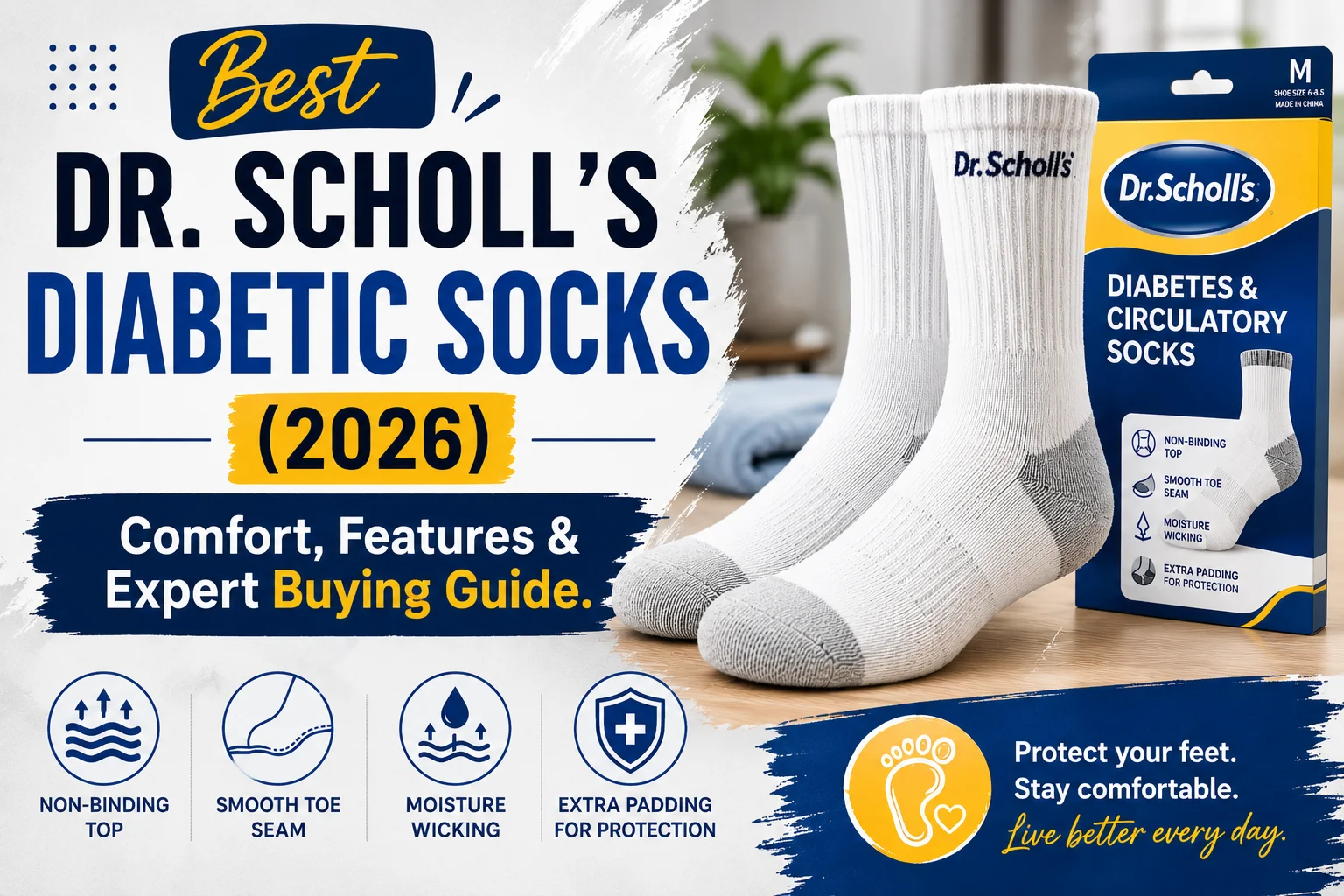
If ordinary socks leave deep cuff marks, rub across the toes, trap sweat, or feel too tight by the end of the day, a diabetic-style sock can be worth considering. Dr. Scholl’s Diabetic Socks are built around that comfort problem: current Diabetes & Circulatory styles use a relaxed non-binding top, cushioned bottom, smooth toe construction, and moisture-management features rather than firm graduated compression.
They are most relevant to people shopping for everyday socks for sensitive feet. They are not a treatment for neuropathy, poor arterial circulation, swelling, or foot ulcers, and they should not be confused with Dr. Scholl’s separate 8–15 mmHg compression sock.
Quick Verdict: Are Dr. Scholl’s Diabetic Socks Good?
For everyday comfort, Dr. Scholl’s Diabetes & Circulatory socks have a sensible feature set: a non-binding stay-up top, smooth toe seam, cushioned sole, polyester/spandex construction, and moisture management. Current Medline listings show men’s M/L crew socks for shoe sizes 7–12, women’s M/L for 4–10, and men’s XL ankle styles for 13–15.
They are worth considering if your priorities are less cuff pressure, smoother toe construction, cushioning, and everyday comfort. Look elsewhere if you need a verified extra-wide calf range, natural-fiber-heavy fabric, or prescribed graduated compression.
Most important: the standard diabetic crew and ankle styles do not list an mmHg compression level. Dr. Scholl’s also sells a separate diabetic/circulatory sock with mild 8–15 mmHg compression, so check the package carefully before buying.
What Makes Dr. Scholl’s Socks “Diabetic”?
The term “diabetic sock” is not about adding medication or a special treatment to the fabric. It usually describes construction choices intended to make socks gentler on feet that may be sensitive to pressure, rubbing, moisture, or heat.
The current Dr. Scholl’s Diabetes & Circulatory line combines several of those design priorities. Medline lists a non-binding stay-up comfort top, cushioned bottom, smooth toe seam, polyester/spandex fabric, TempRite temperature-response technology, and DS Dry moisture management on its crew styles.
These features matter because diabetes can be associated with peripheral neuropathy and reduced sensation. CDC and NIDDK emphasize daily foot inspection because rubbing, blisters, or injuries may go unnoticed. A sock can reduce some friction and pressure, but it cannot make a poorly fitting shoe safe or prevent every ulcer or infection.
Current Dr. Scholl’s Diabetes & Circulatory Styles
Dr. Scholl’s diabetic socks are sold in several lengths and package configurations, and listings can vary by retailer. The most common styles currently found in U.S. retail and medical-supply listings are crew, ankle, and quarter socks.
| Style | Best suited to | Notable current features |
|---|---|---|
| Crew | Everyday shoes, work shoes, cooler weather, more leg coverage | Non-binding top, cushioned bottom, smooth toe, TempRite, DS Dry |
| Ankle | Sneakers, casual shoes, warmer weather | Similar comfort construction with less leg coverage |
| Quarter | Athletic/casual footwear when ankle socks feel too short | Non-binding top, comfort toe seam, TempRite and DS Dry on current listings |
| Mild-compression diabetic/circulatory sock | People specifically seeking light compression after confirming it is appropriate | Separate product listed at 8–15 mmHg |
Black and white are common colors, and pack counts vary by style and seller.
Crew vs Ankle vs Quarter: Which Is Better?
Choose by shoe and climate. Crew socks give more leg coverage, ankle socks reduce warmth and bulk, and quarter socks sit between the two. Length does not make one style more “diabetic”; smooth fit without bunching or a tight band matters more.
Non-Binding Top: Helpful, but Fit Still Matters
The main selling point of Dr. Scholl’s non-binding diabetic socks is the relaxed cuff. Unlike a conventional sock with a tighter elastic band, the top is designed to stretch without gripping the lower leg as aggressively. Medline describes the crew version as a “non-binding, stay-up comfort top” with a relaxed fit.
That does not mean every wearer will get a mark-free fit. Calf shape, ankle circumference, swelling, size choice, and how much the sock stretches during the day all matter. A sock can be marketed as non-binding and still feel tight on a larger ankle or calf.
After wearing a new pair, check your skin. A deep groove, persistent redness, pain, discoloration, or a cuff that rolls into a narrow band are reasons to reassess fit. With reduced sensation, visual inspection matters because discomfort may not provide an early warning.
Smooth Toe Seams, Cushioning and Friction
Dr. Scholl’s diabetic crew and ankle socks use a smooth toe seam and cushioned bottom. These features are practical rather than cosmetic. A bulky seam can press against toes inside a shoe, while cushioning can soften contact under the heel and forefoot.
The American Diabetes Association advises choosing socks that fit well, are not too tight, manage moisture, and avoid bothersome seams; padding can also be useful when additional cushioning is needed.
“Smooth toe” and “seamless” are not always identical. Some listings describe a smooth seam, while specific products use terms such as Invisiseam or seamless toe. Check the exact package. A smooth seam can still irritate a sensitive spot if the shoe’s toe box is crowded.
TempRite, DS Dry, FreeFlow and Odor-Control Features
Feature names can make a simple sock sound more complicated than it is. For buyers, the useful question is what the feature is intended to do.
TempRite is described in current Medline listings as a temperature-responsive comfort feature. It should be viewed as a comfort technology, not a treatment for medically cold feet or impaired circulation.
DS Dry is Dr. Scholl’s moisture-management technology. Current crew and ankle listings describe it as helping wick moisture for day-long wear. Moisture management can be useful because keeping feet dry reduces prolonged dampness inside footwear.
Some retailer listings also reference FreeFlow moisture dispersion, Silvadur antimicrobial technology, or odor-control treatments on certain Dr. Scholl’s diabetic styles. These claims are product-specific, not universal across every package.
An antimicrobial treatment on a sock is primarily there to protect the product or help manage odor; it should not be interpreted as protection against a diabetic foot infection. Medline makes this limitation explicit on its antimicrobial compression-sock listing.
Materials: Polyester, Spandex, Cotton-Free and Latex-Free Claims
The current Medline crew and ankle products are listed as polyester/spandex. That synthetic blend favors stretch, shape retention, and moisture movement over the absorbent feel of a cotton-heavy sock.
Some Dr. Scholl’s diabetic/circulatory styles are marketed by retailers as cotton-free and latex-free, but this should not be assumed for the entire line. One current retailer listing for a men’s ankle style specifically describes cotton-free and latex-free construction along with FreeFlow and Silvadur features.
If you need to avoid latex because of a known allergy, verify the packaging for the exact SKU you are buying. The same rule applies if you strongly prefer cotton-free socks or want a particular fiber percentage.
Remember that cushioning takes up shoe space; a thick sock can increase toe pressure in an already-snug shoe.
Dr. Scholl’s Diabetic Socks Sizing
Sizing is one of the most important parts of this purchase because a “non-binding” design cannot compensate for choosing a sock that is too small.
Current Medline listings show:
- Men’s M/L: shoe sizes 7–12 on standard crew styles.
- Men’s XL: shoe sizes 13–15 on current ankle listings.
- Women’s M/L: shoe sizes 4–10 on current crew listings.
- Mild-compression version: sizing differs; for example, Medline lists size Medium as men’s 3–9 / women’s 4–10 and XL as men’s 13–15.
Do not use the compression-sock size chart to choose the ordinary diabetic crew sock, or vice versa.
What If You Have Wide Feet, Wide Ankles or Large Calves?
Shoe size tells you foot length, not how much room you need around the ankle and calf. If your main problem is a tight cuff, look for a size or style that gives adequate cross-stretch without sagging.
For very large calves, a brand with a published calf-stretch measurement can be easier to evaluate. Sizing up blindly may cause bunching. A good fit lies smoothly, stays up without digging in, and avoids folds under the heel or toes.
Are Dr. Scholl’s Diabetic Socks Good for Neuropathy, Swelling or Circulation?
They may be comfortable for some people with sensitive feet or neuropathy because of the non-binding top, smooth toe area, and cushioning. But they do not treat diabetic neuropathy or restore lost sensation.
Peripheral neuropathy can reduce awareness of injuries, which is why NIDDK recommends daily foot checks and regular professional foot exams.
For swelling, a roomy non-binding sock may accommodate the leg better than a tight ordinary sock, but it is not the same as compression therapy. New, significant, one-sided, painful, or unexplained swelling deserves medical evaluation rather than self-treatment with socks.
For circulation, a loose cuff may avoid unnecessary constriction, but standard diabetic socks are not proven to “increase circulation.” Arterial and venous circulation are different medical issues.
If you have peripheral artery disease, a history of blood clots, substantial edema, wounds, major color or temperature changes, or reduced sensation, ask a qualified clinician what sock or compression approach is appropriate.
Dr. Scholl’s Diabetic Socks vs Compression Socks
This is the most important buying distinction.
Standard Dr. Scholl’s diabetic socks are designed mainly around comfort and reduced constriction. Graduated compression socks intentionally apply measured pressure, usually expressed in mmHg, with a specific pressure profile along the leg.
Dr. Scholl’s does have a separate diabetic/circulatory compression sock listed by Medline at 8–15 mmHg, which is mild compression. That is a different product from the common four-pair crew and ankle diabetic socks.
Diabetes does not automatically mean compression is appropriate. Arterial disease, neuropathy, wounds, and other factors can change that decision. The ADA recommends discussing compression stockings with a provider when issues such as venous insufficiency, swelling, or a DVT history are involved.
Dr. Scholl’s vs Regular Socks, Orthofeet, Viasox and Dr. Segal’s
Compared with basic regular socks, Dr. Scholl’s emphasizes a relaxed cuff, smoother toe construction, cushioning, and moisture management.
Orthofeet may suit buyers who want a more explicitly seam-free design or extra-roomy construction. Its current diabetic sock line describes a non-constrictive fit, seam-free interior, moisture-wicking system, and cushioned design, with some extra-roomy models.
Viasox EasyStretch may be easier to evaluate for very large calves because the brand publishes calf-stretch ranges up to 30 inches depending on size. Its current EasyStretch line also uses a non-binding design, seamless toe, and padded sole.
Dr. Segal’s is another non-binding, seamless-style alternative and may appeal to shoppers who want more colors and patterns rather than the mostly black-and-white medical-basic look associated with many Dr. Scholl’s listings.
None is automatically “best.” The better choice depends on calf room, toe sensitivity, shoe space, fabric preference, desired thickness, and whether you need ordinary non-binding comfort or actual graduated compression.
Who Are Dr. Scholl’s Diabetic Socks Best For?
They make the most sense for adults wanting an everyday sock with a softer top and fewer obvious pressure points, including many people with sensitive feet or seniors who dislike tight cuffs.
For work, walking, and travel, choose the length that stays smooth inside your footwear. For cold feet, a crew style adds coverage, but persistent coldness—especially with color change or numbness—should not be treated as a sock problem alone.
For sleeping, ordinary loose socks can be reasonable for warmth if they do not constrict the leg; NIDDK specifically notes that people with diabetes may wear socks in bed if their feet get cold.
That should not be interpreted as a reason to sleep in compression stockings unless a clinician has specifically recommended doing so.
How to Buy the Right Pair
Before ordering, check five things: the exact style, shoe-size range, cuff stretch, toe construction, and whether the package lists an mmHg level.
If your feet swell during the day, judge fit when they are at their larger size. If you use orthopedic or diabetic footwear, make sure the added cushioning does not crowd the shoe. A sock that is comfortable on its own can still create pressure when combined with a tight toe box.
After several hours, they should not bunch, twist, slide under the heel, or create a deep cuff groove. If sensation is reduced, inspect the skin rather than relying only on feel. Verify the package label because listings change.
Washing and How Long They Last
Current retailer listings describe the socks as machine washable; follow the exact care label because drying instructions can vary.
Replace socks when the cuff becomes uneven, the heel thins, cushioning packs down, the toe area develops roughness, or the fabric no longer lies smoothly.
There is no single reliable lifespan because wear depends on rotation, footwear, walking volume, and laundering.
Pros and Cons
Pros
- Non-binding, relaxed cuff on common diabetic/circulatory styles.
- Smooth toe construction and cushioned bottom.
- DS Dry moisture management and TempRite comfort features on current crew/ankle listings.
- Common men’s and women’s shoe-size ranges.
- Crew, ankle, and quarter-length options.
- Separate mild-compression product exists for shoppers specifically looking for 8–15 mmHg.
Cons
- Standard diabetic styles are not graduated compression socks.
- Calf circumference is not as clearly published as on some extra-wide competitors.
- Materials and feature names vary by SKU and retailer.
- Mostly practical basic styles rather than a large pattern selection.
- A non-binding label does not guarantee a perfect fit for severe swelling or very large calves.
Frequently Asked Questions
Do Dr. Scholl’s Diabetic Socks Improve Circulation?
Standard non-binding diabetic socks are designed to avoid a tight cuff, not to medically improve circulation. Do not treat them as therapy for arterial or venous disease.
Are Dr. Scholl’s Diabetic Socks Compression Socks?
Most standard Diabetes & Circulatory crew and ankle styles are not sold with an mmHg compression rating. A separate Dr. Scholl’s diabetic/circulatory model is listed at 8–15 mmHg mild compression.
Are They Good for Swollen Feet?
A soft, stretchy sock may be more comfortable than a tight regular sock, but persistent or unexplained swelling needs appropriate medical evaluation. For large calves or edema, also check actual circumference capacity rather than shoe size alone.
Are Dr. Scholl’s Diabetic Socks Seamless?
Some styles are described as having smooth toe seams; other specific listings use “seamless” or Invisiseam language. Verify the exact product instead of assuming the entire line is constructed identically.
Can People Without Diabetes Wear Them?
Yes. The design features—relaxed cuffs, cushioning, smoother seams, and moisture management—can appeal to anyone who prefers a gentler everyday sock.
Can Diabetic Socks Prevent Foot Ulcers?
No sock can guarantee ulcer prevention. Socks may help reduce certain sources of friction or pressure, but diabetes-related foot protection also depends on daily inspection, properly fitting shoes, skin care, diabetes management, and professional care when problems appear.
CDC and NIDDK recommend checking the feet every day and seeking care for concerning changes.
Final Verdict: Are Dr. Scholl’s Diabetic Socks Worth It?
Dr. Scholl’s Diabetic Socks are a practical choice for shoppers who want an everyday, non-binding sock with cushioning, a smoother toe area, and moisture-management features. The standard crew and ankle versions are better understood as comfort-oriented diabetic socks, not medical compression hosiery.
Their main strengths are familiar sizing and practical comfort features. Their limitation is less detailed calf-fit information than some extra-wide competitors, while features vary between SKUs.
If you have neuropathy, wounds, significant swelling, peripheral artery disease, major color changes, or other circulation concerns, use sock features as only one part of foot care. The right sock should protect comfort without adding pressure—and it should never replace daily foot inspection or individualized medical advice.
Medical information notice: This article provides general educational and product-selection information. It is not a diagnosis or a substitute for care from a qualified health professional. If you have diabetes with loss of sensation, wounds, significant swelling, suspected circulation problems, or questions about compression, ask a clinician or podiatrist what type of sock is appropriate for you.
Sources & Medical References
- CDC — Your Feet and Diabetes: Guidance on diabetic neuropathy, daily foot inspection, properly fitting shoes and recognizing foot problems.
- National Institute of Diabetes and Digestive and Kidney Diseases — Diabetes & Foot Problems: Guidance on neuropathy, circulation, daily foot care and when professional evaluation is important.
- NIDDK — Peripheral Neuropathy: Information on reduced sensation, blisters, sores and regular foot examinations.
- American Diabetes Association — Foot-Care Guidance: Guidance on well-fitting, moisture-wicking, non-restrictive socks and foot protection.
- Medline — Dr. Scholl’s Diabetes & Circulatory Socks: Current product information for non-binding tops, smooth toe seams, TempRite, DS Dry, materials and sizing.
- Medline — Dr. Scholl’s 8–15 mmHg Diabetic & Circulatory Compression Socks: Current distinction between standard diabetic socks and the separate mild-compression product.
- Orthofeet, Viasox and Dr. Segal’s official product information: Used only to compare current construction, sizing and non-binding sock features.
