

Have you ever unlaced your shoes at the end of a long, brutal workday and felt like your lower legs were weighted down with wet concrete? If you spend eight hours on your feet—or trapped in a cramped economy seat on a cross-country flight—you know that dull, throbbing ache all too well.
That heavy feeling isn’t just everyday fatigue. It’s fluid and blood settling in your lower extremities thanks to constant downward gravity.
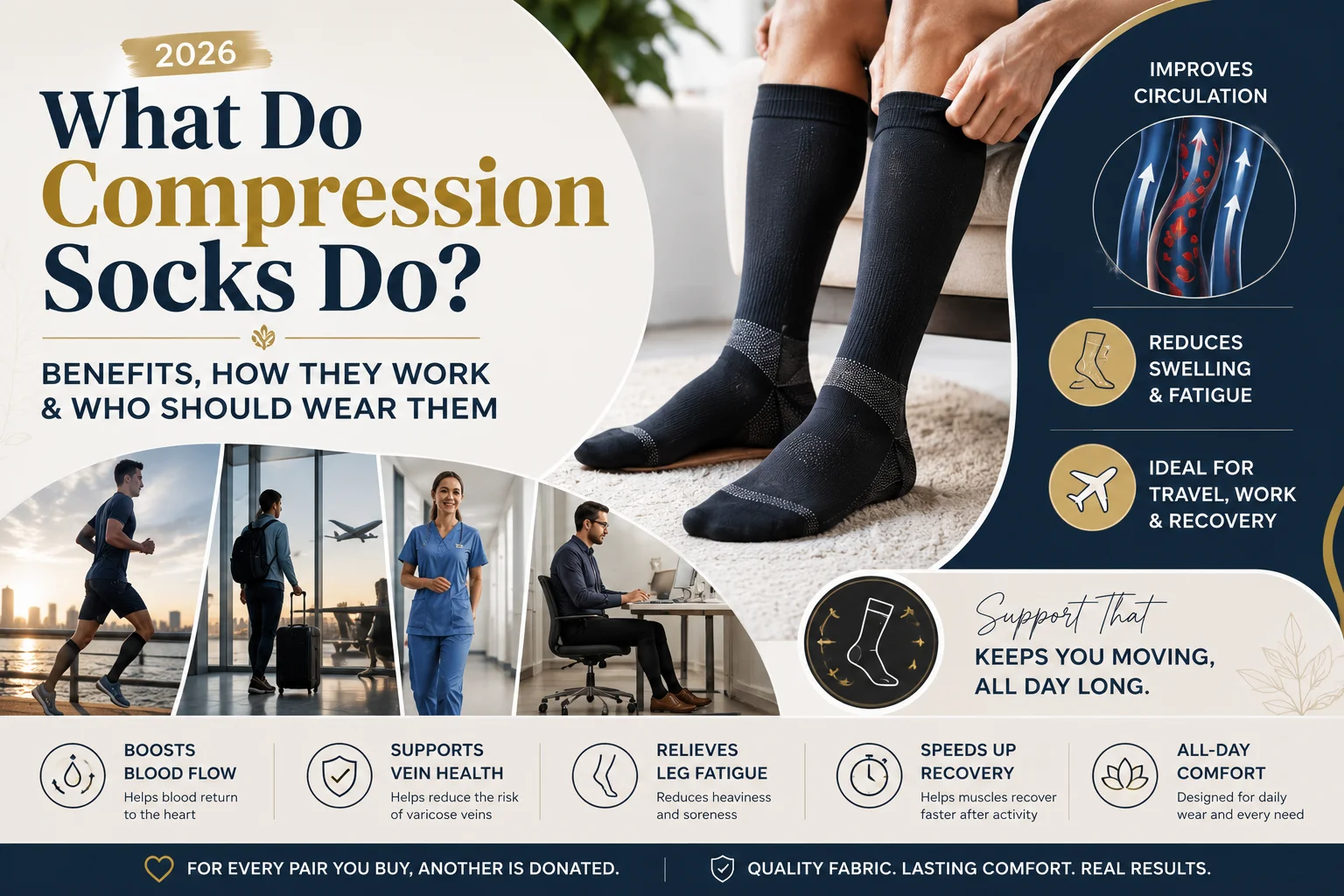
So, what do compression socks do to change that story? At their core, these specialized garments act as an external engine for your circulatory system. By applying targeted pressure to your ankles and calves, they help your body overcome gravity, keeping blood flowing smoothly back up toward your heart instead of pooling around your ankles.
Whether you’re a marathon runner trying to recover faster, a nurse working 12-hour shifts, or someone dealing with stubborn ankle swelling, understanding what do compression socks do can transform how your legs feel every single day. Let’s break down the mechanics, practical everyday benefits, squeeze levels, and real-world tips so you can figure out exactly what your legs need.
The Basic Science: How Compression Socks Work on Your Legs
To really understand what do compression socks do, you need to take a quick peek beneath the surface of your skin. Your circulatory system relies on small one-way valves inside your veins. When your heart pumps, blood travels down to your toes; when your calf muscles contract, they squeeze those veins and push the blood back up toward your heart.
When you sit or stand still for hours, those calf muscles stay relaxed. Gravity takes over, and blood struggles to climb back up. Over time, those tiny vein valves can stretch, causing fluid to leak into surrounding tissue.
How compression socks support healthy blood flow. Source: Masterton Foot Clinic
Compression socks step in by wrapping your legs in a firm, continuous hug. By physically narrowing the diameter of your surface veins, they speed up velocity—much like putting your thumb over the end of a garden hose. The pressure squeezes fluid out of the soft tissues and back into your lymphatic system, giving your body the leverage it needs to maintain steady circulation.
Graduated Compression vs. Uniform Compression
Not all snug socks operate the same way. In fact, understanding this distinction is crucial when asking yourself what do compression socks do for specific health or athletic goals:
- Graduated Compression: The pressure is strongest at the ankle (where gravity works hardest) and gradually decreases as the sock moves up toward your knee or thigh. This upward gradient creates a natural suction effect that drives blood upward.
- Uniform Compression: These socks exert the exact same amount of pressure across the entire leg. They are frequently used in sports performance sleeves, but they don’t offer the same targeted circulatory boost for fluid retention as graduated options.
What Do Compression Socks Do for Everyday Health and Circulation?
For the vast majority of people, keeping legs healthy comes down to daily wear and tear. Here is a breakdown of how these specialized socks support everyday leg health and keep common physical complaints at bay.
+-----------------------------------------------------------------------+
|                    Key Everyday Benefits at a Glance                  |
+--------------------------+--------------------------------------------+
| Daily Issue              | How Compression Helps                      |
+--------------------------+--------------------------------------------+
| Lower Leg Swelling       | Prevents fluid buildup around ankles       |
| Vein Strains & Bulging   | Takes structural pressure off vein walls   |
| "Heavy Leg" Fatigue      | Boosts oxygen delivery to tired muscles    |
| Long-Distance Travel     | Minimizes deep vein thrombosis (DVT) risk  |
+--------------------------+--------------------------------------------+
1. Reducing Swelling (Edema) in Feet and Ankles
Gravity is constantly pulling fluid toward the floor. If you sit at a desk all afternoon, you might notice your socks leaving deep indentations in your skin or your shoes fitting tighter by 5:00 PM. Graduated pressure prevents interstitial fluid from accumulating around your ankle joint, keeping your feet feeling normal all day long.
2. Preventing and Managing Varicose and Spider Veins
Varicose veins occur when internal vein walls weaken and expand under chronic pressure. Once a vein stretches out, its internal valves can no longer close tightly, creating a visible twist or bulge under the skin. Compression garments act as an external wall support. They brace those delicate veins, helping the internal valves meet in the middle and function normally again.
3. Mitigating DVT Risk During Travel
Sitting in a car or airplane for longer than four hours causes blood velocity in the legs to slow down significantly. In severe cases, this stagnant blood can form a Deep Vein Thrombosis (DVT)—a dangerous clot that can travel to the lungs. Gentle pressure keeps blood moving continuously, drastically cutting down the risk of clot formation during long trips.
What Do Compression Socks Do for Athletes and Workouts?

Targeted leg support during high-impact movement. Source: The Manual
| Product | Best For | Compression | Material | Rating | Price |
|---|---|---|---|---|---|
| Physix Gear Compression Socks | Everyday Use & Beginners | 20–30 mmHg | Nylon/Spandex | ⭐⭐⭐⭐⭐ | 👉 Check Price on Amazon |
| CHARMKING Compression Socks | Budget Choice | 15–20 mmHg | Nylon Blend | ⭐⭐⭐⭐⭐ | 👉 Check Price on Amazon |
| Bombas Compression Socks | Premium Comfort | 15–20 mmHg | Cotton Blend | ⭐⭐⭐⭐⭐ | 👉 Check Price on Amazon |
| Sockwell Elevation Compression Socks | Merino Wool Option | 15–20 mmHg | Merino Wool | ⭐⭐⭐⭐⭐ | 👉 Check Price on Amazon |
| SB SOX Compression Socks | Best Overall Value | 20–30 mmHg | Nylon/Spandex | ⭐⭐⭐⭐⭐ | 👉 Check Price on Amazon |
Reduced Muscle Vibration and Oscillation
When your foot hits the asphalt during a run, a shockwave travels directly up your heel, calf, and knee. This rapid vibration causes micro-tears in the muscle tissue, leading to soreness the next morning. Compression socks wrap tightly around the calf muscle mass, dampening those vibrations and reducing structural muscle fatigue during heavy impact.
Faster Post-Workout Recovery
After intense exercise, metabolic waste products build up in your muscle tissue. Wearing graduated compression after a workout maintains high blood flow to the tired calves, helping carry oxygen-rich blood into the area while clearing out metabolic byproducts. Many runners report significantly less delayed-onset muscle soreness (DOMS) when keeping compression gear on for two to three hours post-run.
Decoding Pressure Levels: Finding Your Right Match
Compression is measured in millimeters of mercury (mmHg), the exact same scale used to measure blood pressure. Choosing the correct rating ensures you get real benefits without restricting blood flow.
Caution on Fit: Compression gear should feel firm and supportive, but it should never cause sharp pain, numbness, tingling, or skin discoloration. If your toes turn pale or blue, take the socks off immediately.
| Pressure Level (mmHg) | Type | Common Uses | Who It’s Best For |
|---|---|---|---|
| 8 – 15 mmHg | Mild | Everyday fatigue, light swelling | Beginners, mild desk fatigue |
| 15 – 20 mmHg | Moderate | Travel, athletic recovery, mild varicose veins | Standers, runners, travelers |
| 20 – 30 mmHg | Firm (Medical Grade) | Post-surgery, severe edema, severe varicose veins | Prescribed patients, severe swelling |
| 30 – 40+ mmHg | Extra Firm | Chronic venous insufficiency, lymphedema | Doctor guidance strictly required |
How to Put Them On Without Struggling
Because these garments are designed to be extremely tight around the ankle, getting them on can feel like a mini-workout if you don’t use the right technique:
1
Reach inside and turn the sock inside-out
Prep stage
1.Reach inside and turn the sock inside-out:Prep stage.
Reach all the way down to the heel pocket of the sock, grab the inside heel, and pull the leg portion inside-out. Leave only the toe pocket right-side in.
2
Slide your foot into the toe pocket
Positioning
2.Slide your foot into the toe pocket:Positioning.
Slip your toes and midfoot into the small opening. Work the fabric over your heel until your foot is comfortable and the sock’s heel matches your own.
3
Unroll up the calf
Smooth execution
3.Unroll up the calf:Smooth execution.
Gently gather the gathered cuff fabric and unroll it steadily up your leg toward your knee. Never pull from the top band, as this can overstretch the elastic material.
4
Smooth out folds and wrinkles
Final check
4.Smooth out folds and wrinkles:Final check.
Flatten out any wrinkles across your shin or ankle with your palms. Ensure the top band rests about two finger-widths below your knee bend.
Common Misconceptions About Compression Socks

Because these products cross the boundary between medical gear and everyday athletic apparel, a few persistent myths pop up frequently:
- “They are only for elderly people.” While older adults use them for circulation care, athletes, pregnant women, nurses, pilot crews, and software engineers rely on them daily to stay energized.
- “Tighter is always better.” Applying 30–40 mmHg pressure without a clear medical need can actually reduce surface arterial flow and irritate skin. More squeeze isn’t better—correct squeeze is better.
- “You should sleep in them.” Unless specifically directed by a vascular surgeon after an operation, you should take them off before sleeping. When you lie flat, gravity no longer pulls blood down your legs, making external pressure unnecessary.
Frequently Asked Questions
Can I wear compression socks every single day?
Yes, you can safely wear them every day during waking hours. Just make sure to remove them before sleeping, wash them regularly to restore fabric elasticity, and inspect your skin for any signs of chafing or irritation.
What do compression socks do for pregnant women?
During pregnancy, total blood volume increases by up to 50%, while a growing uterus exerts pressure on pelvic veins. Compression socks help manage the resulting severe ankle swelling and reduce the risk of developing pregnancy-related varicose veins.
How long do compression socks last before losing their squeeze?
With daily wear and proper care (air drying is recommended!), high-quality pairs maintain their rated pressure for roughly 4 to 6 months. Once the fabric feels easy to pull on or starts sliding down your calf, it’s time to replace them.
The Takeaway on Healthy Circulation
Understanding what do compression socks do boils down to a simple principle: giving your veins a helpful push against gravity. Whether you want to step off an 8-hour flight with fresh feet, beat the afternoon desk slump, or protect your leg health for years to come, a comfortable pair of 15–20 mmHg socks can make a remarkable difference in how you move through your day.

1 thought on “What Do Compression Socks Do? (2026): Benefits, How They Work & Who Should Wear Them”