

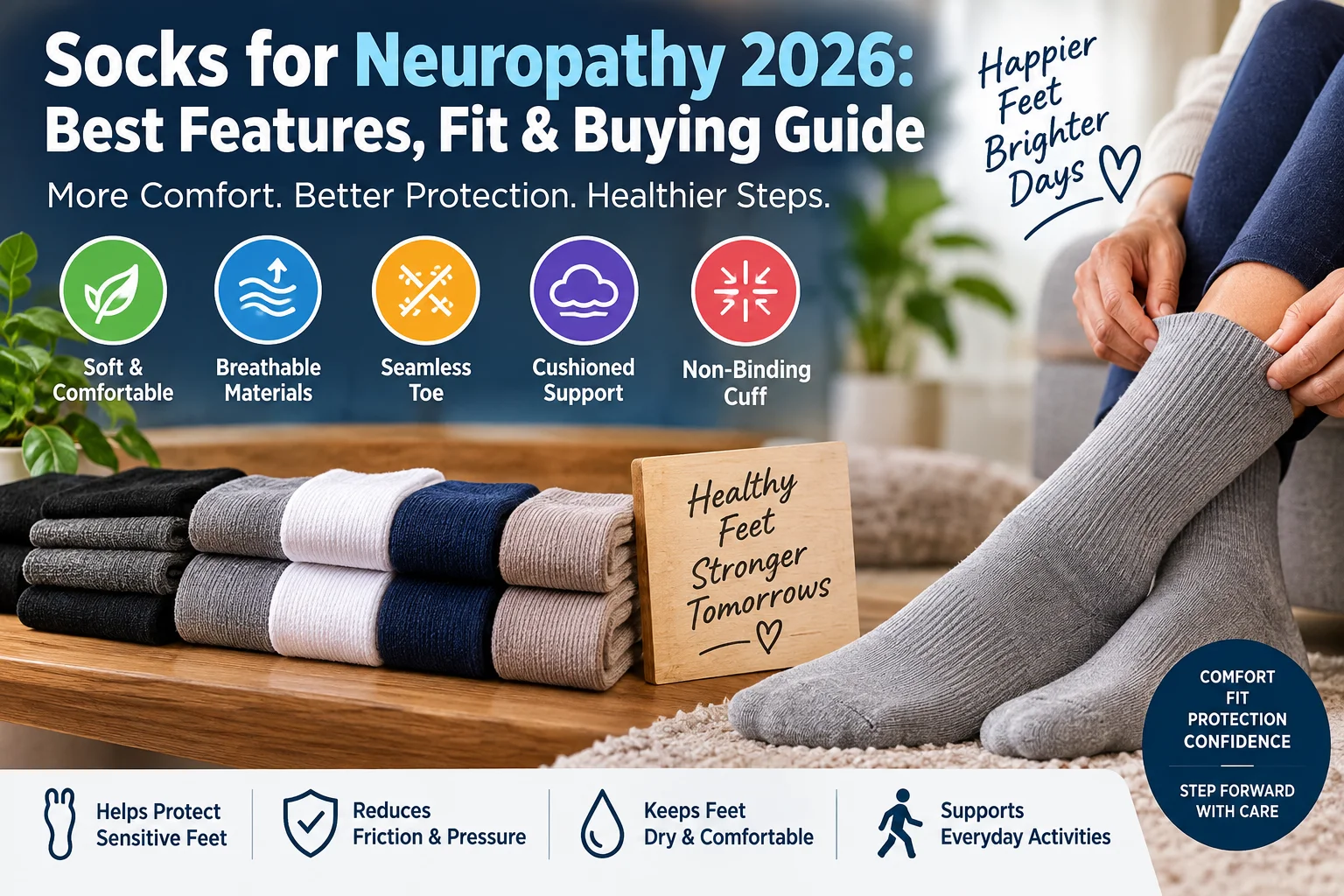
When feet are numb, burning, tingling, or unusually sensitive, an ordinary sock can become a real comfort and protection issue. A rough toe seam may feel unbearable to one person, while another may not feel a wrinkle or pressure point at all. Choosing socks for neuropathy therefore means looking beyond the label and checking the construction, fit, cushioning, moisture control, and compatibility with your shoes.
Peripheral neuropathy can cause numbness, tingling, burning, pain, weakness, and reduced ability to feel pain or temperature. Socks cannot repair damaged nerves or treat the underlying cause, but the right pair can create a smoother, more protective layer between skin and footwear.
This guide explains which features matter, how neuropathy socks compare with diabetic and compression socks, and how to choose for numb feet, swelling, wide feet, walking, work, and different seasons.
Quick Answer: What Are the Best Socks for Neuropathy?
For many people, the best neuropathy socks are properly sized, smooth inside, non-binding at the cuff, lightly cushioned, and able to manage moisture without bunching.
Prioritize:
- A seamless or very flat toe
- A gentle cuff that stays up without digging in
- Enough toe room
- A smooth, low-friction interior
- Light or moderate cushioning
- Breathable, moisture-managing fabric
- Correct heel alignment
- Wide or extra-wide sizing when needed
For people with diabetes and reduced sensation, daily foot inspection and well-fitting shoes remain essential. NIDDK recommends clean, lightly padded socks that fit well and notes that socks without seams are best for diabetes-related foot protection.
Why Socks Matter More With Neuropathy
Peripheral neuropathy affects nerves outside the brain and spinal cord. Depending on which nerves are involved, a person may feel burning, pins and needles, numbness, pain, or extreme sensitivity to light touch. Some people also lose the ability to sense pain or temperature normally.
That creates two different sock problems.
With hypersensitive feet, a thick seam, scratchy yarn, or tight band can become painful. With reduced sensation, a fold, blister, pebble, or pressure point may remain unnoticed for longer.
For diabetic neuropathy, this matters even more because loss of protective sensation can make foot injuries harder to notice. NIDDK advises daily foot checks and appropriate footwear for this reason.
Think of socks as one part of a system: skin, sock, shoe, inspection, and medical care when needed. A good sock cannot compensate for a shoe that is too narrow or for an untreated wound.
Features That Matter Most in Neuropathy Socks
Seamless or Flat Toe Construction
A raised toe seam can rub across sensitive toes or create concentrated pressure inside a snug shoe. “Seamless” may mean truly seamless, hand-linked, or simply very low-profile. The practical test is whether you can feel a ridge when you run your fingers across the inside.
For people with reduced sensation, inspect rather than relying only on comfort. NIDDK specifically recommends seamless socks in its diabetes foot-care guidance.
Non-Binding Cuff
A non-binding or non-restrictive cuff should hold the sock in place without creating a tight band around the ankle or calf. This is useful when ordinary elastic feels painful or leaves deep marks.
Too loose is not ideal either. A sock that slides down can bunch around the heel or arch. The goal is secure without concentrated pressure.
Appropriate Cushioning
Cushioned or padded socks can add a protective layer under the heel and forefoot. More padding, however, is not automatically better.
Thick socks take up shoe space. If cushioning makes the shoe tighter, it can reduce toe room and create new pressure areas. Choose enough padding for comfort while preserving a roomy, stable shoe fit.
Moisture Management and Breathability
Damp fabric can increase discomfort and friction. For walking, work, or warm weather, choose a sock that manages sweat and dries reasonably well.
Do not judge moisture performance by fiber name alone. Fabric weight, knit, ventilation, shoe breathability, and activity level all matter. If socks become wet, change into a dry pair.
Correct Size, Width, and Heel Position
A sock should follow the shape of the foot without stretching excessively or forming folds. The heel pocket belongs on the heel, not under the arch or pulled high toward the Achilles tendon.
People with wide feet, swollen feet, or wide calves should consider products made in wider dimensions. Simply choosing a longer shoe size can leave extra fabric that wrinkles.
Best Socks for Neuropathy by Need

| Need | Prioritize | Watch for |
|---|---|---|
| Numb feet | Smooth interior, flat toe, light cushioning, secure fit | Hidden folds, rough threads, objects inside shoes |
| Burning or sensitive feet | Soft fabric, low-friction interior, breathable construction | Coarse yarn, thick seams, tight footwear |
| Diabetic neuropathy | Non-binding cuff, seamless toe, light padding, moisture control | Wounds, redness, temperature or color changes |
| Swollen feet | Extra stretch, wide cuff, width options | Cuff tightening as swelling increases |
| Wide feet or calves | True wide/extra-wide sizing | Buying extra length instead of extra width |
| Walking or work | Stable heel, moisture control, moderate cushioning | Slippage, bunching, excess thickness |
| Winter | Smooth merino or insulating blend | Boots becoming too tight |
| Summer | Lightweight, breathable, quicker-drying construction | Rough thin fabric or dampness |
| Product | Key Features to Compare | Good Choice For | Style | Amazon |
|---|---|---|---|---|
| Doctor’s Choice Diabetic Full Cushion Socks | Seamless toe, non-binding leg, full cushioning, moisture-wicking construction | Everyday wear, sensitive or reduced-sensation feet | Crew | Check Price on Amazon |
| Dr. Segal’s Diabetic / Neuropathy Socks | Non-binding top, seamless construction, extra cushioning, moisture-management features | Sensitive feet, wider ankles/calves, everyday use | Crew | Check Price on Amazon |
| OrthoSleeve Wellness Care Socks | Seamless, non-binding design, moisture-wicking fabric, padded construction | Lightweight wear, warmer weather and lower-profile footwear | No-show / Crew | Check Price on Amazon |
| Pembrook Knit Diabetic Socks | Wide non-binding design, smooth toe construction, multi-pair packs | Everyday use and people who dislike tight cuffs | Crew | Check Price on Amazon |
| Pembrook Bamboo Viscose Diabetic Socks | Bamboo-derived viscose blend, non-binding construction, soft feel | Readers prioritizing softness and wider fit | Ankle / Crew | Check Price on Amazon |
| Physician’s Choice Diabetic Crew Socks | Non-binding top, smooth toe, moisture-managing blend | General daily wear and multi-pair value | Crew | Check Price on Amazon |
The “best” choice depends on your symptoms, foot shape, shoes, activity, and whether swelling or vascular disease is present.
What Material Is Best for Neuropathy Socks?

No single material wins for every person. Construction and fit usually matter more than the marketing name of the fiber.
Cotton Blends
Cotton feels soft and familiar and may work well for everyday use. Cotton-rich socks can retain moisture longer after heavy sweating, so active users may prefer a blend that improves drying and shape retention.
Bamboo-Derived Viscose or Rayon
Most “bamboo socks” use regenerated fibers such as bamboo-derived viscose or rayon, commonly blended with synthetic fibers. They can feel smooth and soft.
Do not assume “bamboo” automatically means medically superior. Check the cuff, seam, thickness, sizing, and care instructions.
Merino Wool
Fine merino wool or wool blends can be useful for cold weather because they provide insulation without necessarily feeling like coarse traditional wool. The main trade-off is thickness: make sure winter socks do not crowd the shoe or boot.
Synthetic Blends
Polyester, nylon, elastane, and related fibers may improve stretch, durability, shape retention, and drying. They are often practical for walking, work, or warm weather.
Judge the finished sock by how it fits and behaves—not by one fiber percentage.
Neuropathy Socks vs. Diabetic Socks

Neuropathy socks and diabetic socks overlap substantially, but neither term is a strict medical product definition.
Many diabetic socks use features that also suit neuropathic feet: a non-binding cuff, flat or seamless toe, smooth interior, cushioning, moisture management, and extra room. That makes diabetic socks a sensible category to compare for diabetic neuropathy.
Peripheral neuropathy also has many non-diabetic causes. Mayo Clinic lists injuries, infections, metabolic disorders, autoimmune conditions, inherited causes, toxins, and other contributors in addition to diabetes.
So someone with non-diabetic neuropathy does not automatically need a sock labeled “diabetic.” Buy by feature and fit.
Neuropathy Socks vs. Compression Socks
This distinction is important.
A typical non-binding neuropathy sock aims to avoid concentrated pressure. A medical compression sock intentionally applies external pressure, usually graduated from greater pressure near the ankle to less pressure higher on the leg.
Compression may be used for certain venous or swelling problems, but it does not treat nerve damage itself. Do not choose it simply because a product promises “better circulation.”
Reduced sensation can also make excessive local pressure harder to detect. An international consensus statement on medical compression recommends careful sizing and special caution in people with diabetes or neuropathy; it also identifies severe peripheral arterial disease as a contraindication to sustained medical compression stockings.
Therefore, do not assume that 15–20 mmHg or 20–30 mmHg is appropriate just because you have neuropathy, and do not assume stronger compression is better. If you have significant sensory loss, known or suspected peripheral artery disease, wounds, major circulation problems, or unexplained swelling, ask a qualified healthcare professional whether compression is appropriate.
Fit and compression level are separate decisions. Even the right pressure can be unsafe or uncomfortable in the wrong size.
Socks for Neuropathy and Swollen Feet
Swelling can change foot, ankle, and calf dimensions throughout the day. A sock that fits in the morning may become restrictive later.
Look for a broad, flexible cuff and enough stretch through the ankle and foot. Extra-wide neuropathy socks can be useful when standard sizes leave pressure marks, but they should still remain smooth rather than sliding or wrinkling.
If swelling is new, severe, one-sided, painful, or unexplained, do not treat it only as a sock-sizing problem. It can have many causes and may require medical assessment.
Men, Women, Seniors, Wide Feet, and Wide Calves
The essential protective features are similar for men and women; what changes is sizing and foot shape. Petite feet may need a shorter foot section and smaller heel pocket, while larger feet may need extended sizes.
Seniors may value easy-on designs if hand strength, balance, or flexibility makes dressing difficult. Wide-foot and wide-calf users should look for true width accommodation instead of simply sizing up in length.
For anyone who cannot easily see or reach the feet, help with inspection can be useful. The American Diabetes Association recommends daily checks for people with diabetes and reduced sensation and suggests assistance when someone cannot inspect the feet adequately.
How Should Socks for Neuropathy Fit?
Use this six-point check:
- Toes: They lie naturally without curling or compression.
- Toe area: No ridge presses across the toes.
- Heel: The heel pocket aligns with your heel.
- Sole: No wrinkles sit under the forefoot or heel.
- Cuff: It stays up without a painful or deep groove.
- Shoe: The sock does not make footwear noticeably tighter.
Inspect fit after laundering because shrinkage or damaged elastic can change how a sock sits.
With numb feet, visual inspection matters. Check the skin after trying a new sock, especially around the toes, heel, ankle, and cuff line.
Common Buying Mistakes
Buying by the word “neuropathy” alone. Marketing language does not guarantee a smooth seam, proper width, or suitable cuff.
Choosing maximum cushioning. Extra padding may feel protective but can crowd a shoe.
Assuming loose is always safer. An oversized sock can migrate and wrinkle. Non-binding should not mean unstable.
Ignoring the inside. Turn the sock inside out and check for knots, thick seams, rough stitching, or loose threads.
Using compression as a default. Compression strength is not a quality rating. It should have a reason and, when medical issues are present, appropriate professional guidance.
Walking, Work, Everyday Wear, Summer, and Winter
For walking, prioritize stable heel fit, moisture management, and enough cushioning to reduce rubbing without crowding the shoe.
For work, evaluate the footwear first. Structured or safety shoes may have limited interior space, so thick padding can become counterproductive.
For everyday wear, a lightweight or mid-weight ankle or crew sock with a flat toe and gentle cuff is often practical.
For winter, fine merino or another insulating blend can help with warmth. If sensation is reduced, avoid using direct heat as a substitute for proper clothing. NIDDK advises people with diabetes-related nerve damage not to use heating pads or hot-water bottles on the feet because burns may go unnoticed.
For summer, choose lighter, breathable construction and change socks when they become damp.
Can Neuropathy Socks Help Numbness, Tingling, Burning, or Nerve Pain?
They may improve comfort and protection, but they are not a treatment for neuropathy.
A smooth sock may reduce irritating contact for hypersensitive feet, and a well-fitted sock can remove avoidable friction or pressure. It cannot repair peripheral nerves or reliably stop numbness, tingling, burning, or nerve pain.
If these symptoms are new, persistent, or worsening, medical evaluation matters because neuropathy has many possible causes. Mayo Clinic advises an office evaluation for persistent burning, numbness, or tingling involving much or all of the bottom of the foot.
Foot-Care Habits That Matter as Much as the Sock
For diabetes or significant loss of protective sensation, good socks work best alongside routine foot care. NIDDK and the American Diabetes Association recommend regular foot inspection, appropriate socks, and well-fitting footwear for diabetes-related foot protection.
Useful habits include:
- Wear clean, dry socks.
- Smooth out wrinkles before putting on shoes.
- Check shoes for pebbles, rough lining, or other objects.
- Avoid walking barefoot when sensation is significantly reduced.
- Inspect the feet after trying new socks or footwear.
- Replace socks with holes, rough areas, damaged elastic, or permanent folds.
Seek prompt medical care for a wound that is not healing, signs of infection, marked color or temperature changes, or other concerning foot changes—particularly with diabetes or reduced sensation.
7-Point Neuropathy Sock Buying Checklist
Before buying, ask:
- Is the inside smooth? Check the toe, heel, and decorative stitching.
- Is the cuff gentle? A wide or non-binding top may help when regular elastic digs in.
- Is the size right for length and width? Do not size up blindly.
- Does the cushioning fit the shoe? More padding needs more shoe space.
- Does the fabric suit the activity and climate? Think about warmth, sweat, drying, and breathability.
- Does swelling change fit later in the day? Check when swelling is greatest.
- Is compression being considered for a medical reason? Make that decision separately from ordinary sock comfort.
The best pair should stay smooth, secure, and unobtrusive rather than requiring constant adjustment.
Frequently Asked Questions
What Are Neuropathy Socks?
They are socks designed or marketed for numb, tingling, burning, or sensitive feet. Common features include a flat toe, non-binding cuff, cushioning, and moisture control. The construction matters more than the label.
Do Socks Help Neuropathy?
They can improve comfort and reduce avoidable friction or pressure, but they do not cure neuropathy or repair nerve damage.
Are Seamless Socks Good for Neuropathy?
They can be useful because a flat toe removes a common rubbing point. This matters particularly when toes are sensitive or sensation is reduced.
Are Non-Binding Socks Good for Neuropathy?
Often, provided they still fit securely. A sock that is too loose may slide and bunch.
What Socks Are Best for Numb Feet?
Look for a smooth interior, flat toe, light cushioning, correct sizing, and a non-restrictive cuff. Because numbness can hide irritation, inspect the feet rather than relying only on sensation.
Are Diabetic Socks Good for Neuropathy?
Many are, because diabetic socks often include features useful for neuropathy. But not all neuropathy is caused by diabetes, and the “diabetic” label does not guarantee correct fit.
Can I Wear Compression Socks With Neuropathy?
Sometimes, depending on why compression is needed and on circulation, sensation, pressure level, and fit. Significant neuropathy or possible arterial disease warrants individualized guidance before medical compression.
Can Compression Socks Make Neuropathy Worse?
An ill-fitting or excessively compressive garment can create pressure and discomfort, and reduced sensation may make problems harder to notice. Correct assessment, sizing, and use matter.
Can I Wear Neuropathy Socks All Day?
A comfortable, properly fitted non-compression sock can generally be used for normal daily wear. Change it if it becomes damp, wrinkled, or irritating, and follow clinical instructions if wounds or medical compression are involved.
Can I Sleep in Neuropathy Socks?
A loose, non-compression sock may be used for warmth. NIDDK notes that people with diabetes can wear socks in bed if their feet get cold. Medical compression is different and should follow professional guidance.
How Often Should Neuropathy Socks Be Changed?
Use a fresh pair regularly and change sooner if socks become wet, dirty, stretched, or uncomfortable. Replace pairs that develop holes, rough areas, permanent creases, or damaged cuffs.
How Should Neuropathy Socks Be Washed?
Follow the product care label. Avoid methods that cause excessive shrinkage or damage elasticity, and recheck fit after laundering.
Final Takeaway
The best socks for neuropathy are not defined by a brand or a therapeutic-sounding label. They are the pairs that fit correctly, remain smooth inside the shoe, avoid concentrated cuff pressure, handle moisture, provide appropriate cushioning, and match the wearer’s activity and footwear.
For numb or sensitive feet, pay close attention to seams, wrinkles, toe room, and changing fit during the day. For diabetic neuropathy, pair appropriate socks with daily foot inspection and well-fitting shoes. If you are considering compression, treat that as a separate decision—particularly when reduced sensation, peripheral artery disease, wounds, or significant swelling are involved.
Medical Information Notice: This article provides general educational and product-selection information and is not a diagnosis or substitute for individualized medical care. Seek professional advice for new or worsening numbness, significant sensory loss, wounds, signs of infection, unexplained swelling, major skin color or temperature changes, or a known circulation condition.
Sources & Medical References
- National Institute of Diabetes and Digestive and Kidney Diseases (NIDDK), Peripheral Neuropathy.
- National Institute of Diabetes and Digestive and Kidney Diseases (NIDDK), Diabetes & Foot Problems.
- Mayo Clinic, Peripheral Neuropathy: Symptoms and Causes.
- Mayo Clinic, Foot Pain: When to See a Doctor.

1 thought on “Socks for Neuropathy 2026: Best Features, Fit & Buying Guide”