

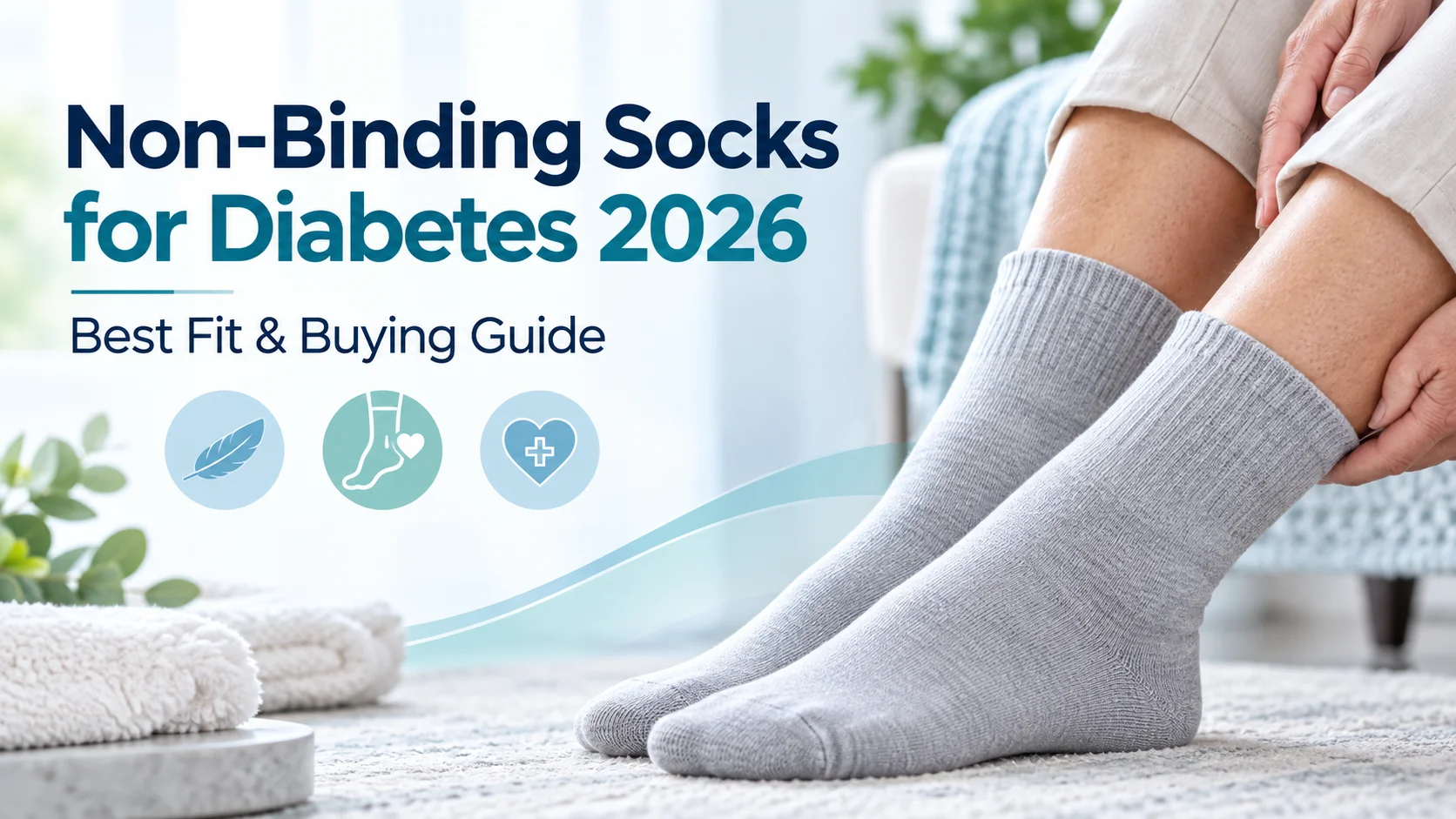
A sock can look roomy and still leave a deep ring around the ankle after a few hours. For someone with diabetes—especially with neuropathy, swelling, sensitive skin, or changes in foot shape—that pressure deserves attention.
Non-binding socks for diabetes are designed to stay up with less concentrated cuff pressure than many ordinary socks. The best pair is not simply “loose”: it should stay smooth, give the toes room, manage moisture, and fit comfortably inside normal footwear.
This guide covers fit, materials, sock marks, swelling, neuropathy, sizing, and the important difference between non-binding and compression socks.
Quick Answer: What Are Non-Binding Socks for Diabetes?
Non-binding diabetic socks use a soft, wide, stretchable top intended to hold the sock in place without creating a tight pressure band around the ankle or calf. Many also use a flat or seamless toe, a smooth interior, moisture-managing fibers, and light cushioning.
They may be useful for people who find ordinary sock cuffs uncomfortable or who have sensitive feet, wide ankles, mild swelling, or reduced sensation. They do not treat diabetes, neuropathy, edema, or peripheral artery disease, and “non-binding” does not mean a sock should hang loosely or slide inside the shoe.
Sock choice is only one part of diabetes foot care. The ADA recommends at least an annual comprehensive foot evaluation and closer surveillance for higher-risk feet; daily self-inspection is also important.
What Does “Non-Binding” Actually Mean?
A standard sock often relies on a relatively narrow elastic band to keep the leg portion from slipping. A non-binding sock spreads that holding force over a wider area or uses a softer stretch construction so there is less localized cuff pressure.
Terms such as soft top, loose top, wide top, gentle top, stretch top, non-restrictive, and non-constricting often describe similar ideas. Because labeling varies by brand, judge the actual fit: the cuff should stay up without painful pressure, deep grooves, or rolling.
“Elastic-free” can also be misleading. Some non-binding socks contain spandex or elastane for shape control. A little stretch is not automatically a problem; concentrated pressure and poor fit matter more.
Why Non-Binding Construction Can Matter for Diabetic Feet

Diabetes affects feet differently. Some people retain normal sensation and circulation; others develop neuropathy, loss of protective sensation, PAD, deformity, swelling, or previous ulceration.
Neuropathy matters because reduced sensation can make rubbing, pressure, heat, or minor injury harder to notice. ADA guidance identifies neuropathy, PAD, deformity, callus, prior ulceration, and prior amputation among important risk factors for diabetic foot complications. NIDDK advises daily foot checks because problems may occur without much pain.
A non-binding cuff removes one avoidable pressure source, but it cannot compensate for a sock that is too small, wrinkled, damp, or crowded inside a tight shoe.
Do Non-Binding Socks Improve Circulation?
They should not be sold as a blood-flow treatment. Their purpose is to avoid unnecessary cuff constriction, not to prove increased arterial blood flow or medically treat “poor circulation.”
If a person has cold feet, color changes, leg pain with walking, slow-healing wounds, or known PAD, changing socks is not a substitute for vascular assessment. ADA foot-care recommendations include vascular evaluation as part of identifying an at-risk foot.
How Should Non-Binding Diabetic Socks Fit?
The ideal fit is gentle but secure. “Loose” should mean low pressure at the cuff—not extra fabric moving around the foot.
Use this fit check:
- Cuff: It stays up without digging in, rolling, or creating a painful groove.
- Heel: The heel pocket sits at the heel rather than halfway up the ankle or under the arch.
- Toes: There is room to move the toes without excess fabric folding at the front.
- Sole: The fabric lies flat with no wrinkles or bunching under the heel, forefoot, or toes.
- Shoe fit: The sock does not make a normally well-fitting shoe suddenly feel tight.
- After removal: Look for persistent redness, blistering, broken skin, pressure lines, or areas that feel sore.
For crew or knee-high socks, calf circumference may matter as much as shoe size. Someone with a wide calf can buy the correct foot length and still end up with a cuff that is too tight. If a brand provides ankle and calf measurements, use them rather than simply sizing up.
Sizing up can solve one problem and create another: a sock that is too long may wrinkle, slide, or bunch inside the shoe.
Are Sock Marks Normal?
A faint, temporary impression can occur with many socks. A mark by itself does not diagnose poor circulation.
What deserves more attention is a deep indentation, pain, persistent redness, skin injury, new swelling, or a mark that appears because the cuff is clearly too tight. In someone with reduced sensation, visual checks matter because discomfort may not provide a reliable warning.
Unexplained swelling, a new warm or red foot, an open wound, drainage, or significant skin-color change should not be managed by simply switching to looser socks. ADA 2026 guidance recommends prompt specialist assessment for an open ulcer or unexplained swelling, redness, or increased skin temperature in a person with diabetes.
Features That Matter Most

1. A Genuinely Gentle Cuff
The cuff is the defining feature. Look for a wide, soft band with enough stretch to accommodate normal ankle or calf movement without folding over.
Extra-wide non-binding diabetic socks can be useful when standard cuffs are consistently tight, but “extra wide” should refer to real sizing capacity—not just marketing language. Check the size chart when available.
2. A Smooth or Seamless Toe
A bulky toe ridge can rub against sensitive skin, especially in a shoe with limited toe-box space. A true seamless toe, linked toe, or very flat seam reduces one common friction point.
IWGDF prevention guidance for people at moderate or high risk of diabetes-related foot ulceration recommends appropriate footwear and includes seamless socks among practical foot-protection considerations. It also emphasizes footwear with adequate length, width, and depth.
3. Moisture Management and Breathability
The goal is not to make the foot “sterile”; it is to reduce prolonged dampness and discomfort. Moisture-wicking synthetic fibers, wool blends, and some blended fabrics can help keep the inside of the shoe more comfortable than a sock that remains heavily saturated.
For sweaty feet or long workdays, moisture handling may matter more than whether the label says cotton, bamboo, or polyester.
4. Cushioning Without Crowding the Shoe
Light cushioning under the heel and forefoot can improve comfort and reduce the harsh feel of footwear. More padding is not always better.
A thick sock takes up shoe space. If it makes the toe box, sides, or top of the shoe noticeably tighter, the additional cushioning may create a new fit problem.
If you choose cushioned non-binding diabetic socks, test them with the shoes you actually wear.
5. A Smooth Interior
Raised logos, rough seams, bulky stitching, or loose threads can become rubbing or pressure points. Turn the sock inside out before buying, when possible, and inspect the areas around the toes, heel, and cuff.
Best Non-Binding Socks for Diabetes by Need
There is no single best sock for everyone. Fit, sensation, swelling, footwear, climate, and daily activity change the choice.
| Product | Key Features | Good Choice For | Style | Amazon |
|---|---|---|---|---|
| Doctor’s Choice Diabetic Crew Socks | Non-binding leg, seamless toe, full cushioning, moisture-wicking synthetic blend | Everyday wear, walking, longer daily use | Crew | Check Price on Amazon |
| Dr. Scholl’s Diabetes & Circulator Socks | Non-binding top, moisture-management design, widely available sizing | General everyday wear | Crew / Ankle | Check Price on Amazon |
| Pembrook Bamboo Viscose Diabetic Socks | Bamboo-viscose blend, non-binding stretch, smooth toe construction | Soft feel, wider feet/calves, everyday comfort | Crew | Check Price on Amazon |
| Orthofeet BioSoft Padded Sole Diabetic Socks | Non-constrictive loose knit, seam-free design, moisture management, soft cushioning | People wanting extra room and cushioning | Crew | Check Price on Amazon |
| Debra Weitzner Non-Binding Diabetic Socks | Stretchable non-binding cuff, cotton-blend styles, roomy construction | Everyday wear and people who dislike tight sock tops | Crew | Check Price on Amazon |
| Hugh Ugoli Bamboo Diabetic Socks | Bamboo-derived rayon blend, wide/non-binding top, smooth toe design | Soft everyday socks and wide-calf comfort | Crew | Check Price on Amazon |
| Need | Prioritize | Watch for |
|---|---|---|
| Sensitive feet or neuropathy | Smooth interior, flat or seamless toe, gentle cuff | Hidden seams, wrinkles, rough yarns |
| Swollen ankles or feet | Wide stretch range, roomy foot, non-binding top | Cuff rolling, tight shoes, worsening swelling |
| Wide feet or calves | Width-specific sizing, ankle/calf measurements | Sizing up only by shoe size |
| Everyday walking | Moisture management, secure heel, light cushioning | Slippage or excess thickness |
| Work or long standing | Breathability, durability, stay-up cuff | Dampness, pressure marks later in the day |
| Dress shoes | Thin smooth fabric, flat toe, gentle cuff | Excess padding in low-volume shoes |
| Cold weather | Warm, moisture-managing wool or blend | Thick socks crowding footwear |
| Seniors with limited dexterity | Easy-stretch cuff, simple sizing, soft fabric | Socks that are so loose they twist or fall |
Non-Binding Socks for Neuropathy or Numb Feet
Non-binding socks can reduce a source of cuff pressure, but they do not treat diabetic neuropathy.
People with loss of protective sensation may not reliably feel a wrinkle, pressure spot, blister, or other minor injury. This makes visual inspection and appropriate footwear especially important.
NIDDK recommends daily foot checks and at least yearly foot examinations for people with diabetes, with more frequent evaluation when foot problems are present.
Non-Binding Socks for Swollen Feet, Ankles, or Edema
A stretchy, extra-wide non-binding sock may feel more comfortable when swelling makes an ordinary cuff dig into the ankle or lower leg.
But non-binding socks do not treat edema.
New, severe, painful, one-sided, or unexplained swelling warrants medical evaluation. For recurring medically significant swelling, ask whether non-binding socks or a specific compression strategy is appropriate.
That distinction matters because swelling can have many causes, and a loose-top comfort sock performs a very different job from medical compression.
Cotton, Bamboo, Merino Wool, or Synthetic?

Material matters, but construction and fit often matter more than the fiber name.
Cotton Blends
Cotton feels soft and familiar, but high-cotton socks can hold moisture. Blends may improve stretch, shape retention, and drying.
Someone who strongly prefers cotton can still look for a predominantly cotton diabetic sock with a smooth toe, gentle cuff, and enough synthetic fiber to maintain shape.
Bamboo-Derived Viscose or Rayon
Most “bamboo socks” use regenerated cellulose such as bamboo viscose or rayon. They can feel smooth and soft, but bamboo is not automatically medically superior.
Do not assume the word “bamboo” proves that a sock is antimicrobial, therapeutic, or better for every diabetic foot. Check the full blend, cuff, seams, thickness, and care instructions.
Merino Wool
Fine merino can provide warmth while managing moisture well. Some pairs cost more, need gentler care, or are too thick for snug footwear.
A lighter merino blend may make more sense than a heavy hiking sock when shoe space is limited.
Polyester, Nylon, Spandex, and Elastane
Synthetics can add moisture management, stretch, durability, and shape retention.
Spandex or elastane can still be part of a non-binding design; pressure distribution and fit matter more than the fiber name.
Non-Binding Socks vs. Compression Socks

This is one of the most important distinctions to understand.
| Non-Binding Diabetic Sock | Medical Compression Sock |
|---|---|
| Designed to minimize restrictive cuff pressure | Designed to apply intentional external pressure |
| Usually not sold by medical compression level | Commonly labeled in mmHg |
| Focuses on comfort, seams, moisture and fit | Often uses graduated compression |
| May suit people bothered by tight ordinary cuffs | May be used for specific venous, lymphatic or other clinical indications |
| Does not medically treat edema or venous disease | May form part of treatment when appropriately selected |
A 15–20 mmHg or 20–30 mmHg compression sock is not simply a tighter diabetic sock. It belongs to a different product category with a different purpose.
Medical compression can be useful for selected conditions, but it requires attention to arterial circulation, neuropathy, fit, and the reason it is being used.
An international consensus statement on medical compression recommends screening for conditions that increase compression-related risk. It identifies severe peripheral arterial disease as a contraindication to sustained medical compression stockings and calls for particular caution in certain people with severe diabetic neuropathy and sensory loss.
People with diabetes should therefore not assume that compression is automatically needed—or automatically unsafe. The answer depends on vascular status, sensation, the cause of swelling, skin condition, and the clinical reason compression is being considered.
How to Choose Non-Binding Diabetic Socks
Use a simple decision process rather than buying solely because the package says “diabetic.”
Step 1: Identify the Problem You Want to Solve
Is your main problem a tight cuff, toe-seam rubbing, wide calves, sweating, shoe crowding, sensitive skin, or swelling?
Different problems require different features.
Step 2: Measure More Than Shoe Size When Needed
For ankle, crew, and knee-high styles, compare your shoe size with the brand’s size chart.
For taller socks, measure the widest part of the calf if the manufacturer provides calf ranges. An accurate foot size does not guarantee a comfortable calf fit.
Step 3: Match Sock Thickness to Your Footwear
A plush sock may work well in walking shoes but feel cramped in dress shoes.
If the shoe becomes tight after you change socks, the extra cushioning may defeat the purpose of selecting a low-pressure design.
Step 4: Inspect the Inside
Check the toe seam, heel stitching, loose threads, labels, and raised areas.
“Seamless” claims can describe different constructions, so inspect the actual sock when possible rather than relying solely on the front of the package.
Step 5: Re-Check Fit Later in the Day
Feet and ankles may be larger later in the day. A cuff that feels comfortable in the morning may feel more restrictive after hours of standing or sitting.
Check both the skin and the sock’s position.
Step 6: Replace Socks That No Longer Fit Correctly
Repeated washing and wear can change elasticity and shape.
Replace socks that sag, twist, develop holes, bunch under the foot, become rough inside, or start creating pressure they did not create previously.
Ankle, Crew, Knee-High, Dress, and Work Styles
Choose length around footwear and activity, not medical claims.
Ankle socks can work with low-cut shoes, while crew socks are versatile for daily wear. Knee-high non-binding socks provide more coverage but are not automatically compression socks. For knee-high pairs, calf circumference becomes especially important.
Dress socks should stay thin enough for lower-volume shoes. Work and walking socks may benefit from moisture management and light cushioning, provided the extra thickness does not crowd the shoe.
Men’s and women’s versions mainly differ in sizing and proportions. The same fundamentals remain important: adequate toe room, heel alignment, smooth construction, and a cuff that does not create problematic pressure.
Common Buying Mistakes
Do not solve a tight cuff by automatically sizing up; extra fabric can wrinkle and rub.
Do not assume non-binding means “no elastic.” Controlled stretch can help the sock stay smooth and prevent slippage.
Avoid very thick cushioning if it makes footwear tight.
Most importantly, do not treat persistent swelling or circulation symptoms as a sock problem. Compare actual cuff design, seam profile, sizing, fiber blend, cushioning, and care requirements rather than relying on a “medical” label alone.
Wearing and Caring for Non-Binding Diabetic Socks
Start with a clean, dry pair and smooth out every fold.
When removing the socks, inspect the feet for redness, blisters, cuts, swelling, drainage, or unusual pressure areas. NIDDK recommends daily foot inspection for people with diabetes.
Follow the manufacturer’s care label and replace socks that become rough, holey, distorted, or unable to stay smooth.
Sleeping in non-binding socks is not automatically necessary. People with significant neuropathy, circulation problems, wounds, or medically important swelling should follow individualized foot-care advice rather than assuming overnight sock wear is beneficial.
When to Ask a Podiatrist or Other Healthcare Professional
Seek professional guidance if you have diabetes plus an open sore, blister that is not healing, new redness or warmth, drainage, significant color change, loss of sensation, worsening swelling, or known peripheral artery disease.
You should also ask before self-selecting medical compression when you have a diagnosed circulation disorder, substantial neuropathy, a history of diabetic foot ulcer, or unexplained leg swelling.
The goal is to separate ordinary comfort choices from situations where circulation, nerve function, skin integrity, or swelling needs clinical evaluation.
FAQs About Non-Binding Socks for Diabetes
Are Non-Binding Socks Good for Diabetics?
They can be a comfortable option for people who are bothered by tight cuffs, rubbing, or pressure marks.
Their value comes from fit and construction, not from treating diabetes. People with higher-risk feet still need appropriate medical foot care and regular inspection.
Should Diabetic Socks Be Tight or Loose?
Neither.
A good diabetic sock should be secure enough not to slide or bunch, but gentle enough that the cuff does not dig into the ankle or calf.
“Non-binding” should mean low, distributed cuff pressure rather than a baggy fit.
What Socks Don’t Leave Ankle Marks?
Look for a wide, stretchable cuff properly sized for your ankle or calf instead of a narrow elastic band.
A very faint temporary imprint can still occur. Painful, persistent, or deep grooves suggest that the sizing or cuff design should be reassessed.
Are Seamless Non-Binding Socks Better for Neuropathy?
A smooth or seamless toe can remove a potential rubbing point, which can be useful when sensation is reduced.
It does not treat neuropathy. Daily inspection, appropriate footwear, and professional foot assessment remain important.
Do Non-Binding Socks Help Swollen Feet?
They may accommodate swelling more comfortably than tight ordinary socks, but they do not treat edema.
New, significant, painful, one-sided, or unexplained swelling should be evaluated rather than managed only by changing socks.
Are Non-Binding Socks Compression Socks?
No.
Non-binding socks aim to minimize unwanted constriction. Compression socks intentionally apply external pressure and are commonly labeled by compression level in mmHg.
The two should not be treated as interchangeable products.
Can Diabetics Wear Compression Socks?
Some people with diabetes can wear compression socks when compression is appropriate for their condition.
Diabetes alone does not determine the answer. PAD, neuropathy, skin condition, swelling cause, vascular status, and the intended compression level can all change the decision.
Which Material Is Best for Non-Binding Diabetic Socks?
There is no universal winner.
Choose based on moisture handling, temperature, shoe space, skin comfort, durability, and care needs. Construction, seam smoothness, cuff pressure, and correct sizing often matter more than whether the fiber is cotton, bamboo-derived viscose, merino wool, or synthetic.
Can I Wear Non-Binding Socks All Day?
A properly fitting pair can be suitable for normal daytime wear.
Re-check the skin and fit, especially with reduced sensation or swelling. Change socks if they become damp, wrinkled, bunched, or uncomfortable.
Are Non-Binding Diabetic Socks Worth It?
They can be worthwhile if ordinary cuffs create uncomfortable pressure, you want a smoother toe construction, or wide sizing produces a better fit.
A higher price does not automatically mean a better diabetic sock. Judge the product by fit, cuff construction, seams, moisture handling, durability, and compatibility with your footwear.
Final Takeaway
The best non-binding socks for diabetes are not simply the loosest pair. They stay smooth and secure while avoiding concentrated cuff pressure, bulky seams, excess moisture, and shoe crowding.
Prioritize a gentle wide cuff, correct sizing, a smooth toe, moisture management, and shoe-compatible cushioning. With neuropathy, significant swelling, PAD, wounds, or uncertain compression needs, socks should support—not replace—appropriate medical foot care.
Medical information notice: This article provides general educational information and is not a substitute for individualized medical advice. If you have loss of sensation, a wound, significant or unexplained swelling, known circulation disease, or questions about medical compression, ask a qualified healthcare professional what is appropriate for you.
Sources & Medical References
- American Diabetes Association Professional Practice Committee for Diabetes. Retinopathy, Neuropathy, and Foot Care: Standards of Care in Diabetes—2026. ADA Standards of Care 2026 – Foot Care
- National Institute of Diabetes and Digestive and Kidney Diseases. Diabetes & Foot Problems. NIDDK Diabetes & Foot Problems
- National Institute of Diabetes and Digestive and Kidney Diseases. Peripheral Neuropathy. NIDDK Peripheral Neuropathy
- International Working Group on the Diabetic Foot. IWGDF Guidelines on the Prevention of Foot Ulcers in Persons with Diabetes, 2023 update.
- Rabe E, Partsch H, Morrison N, et al. Risks and contraindications of medical compression treatment—A critical reappraisal: An international consensus statement. PubMed record

2 thoughts on “Non-Binding Socks for Diabetes 2026: Best Fit & Buying Guide”