

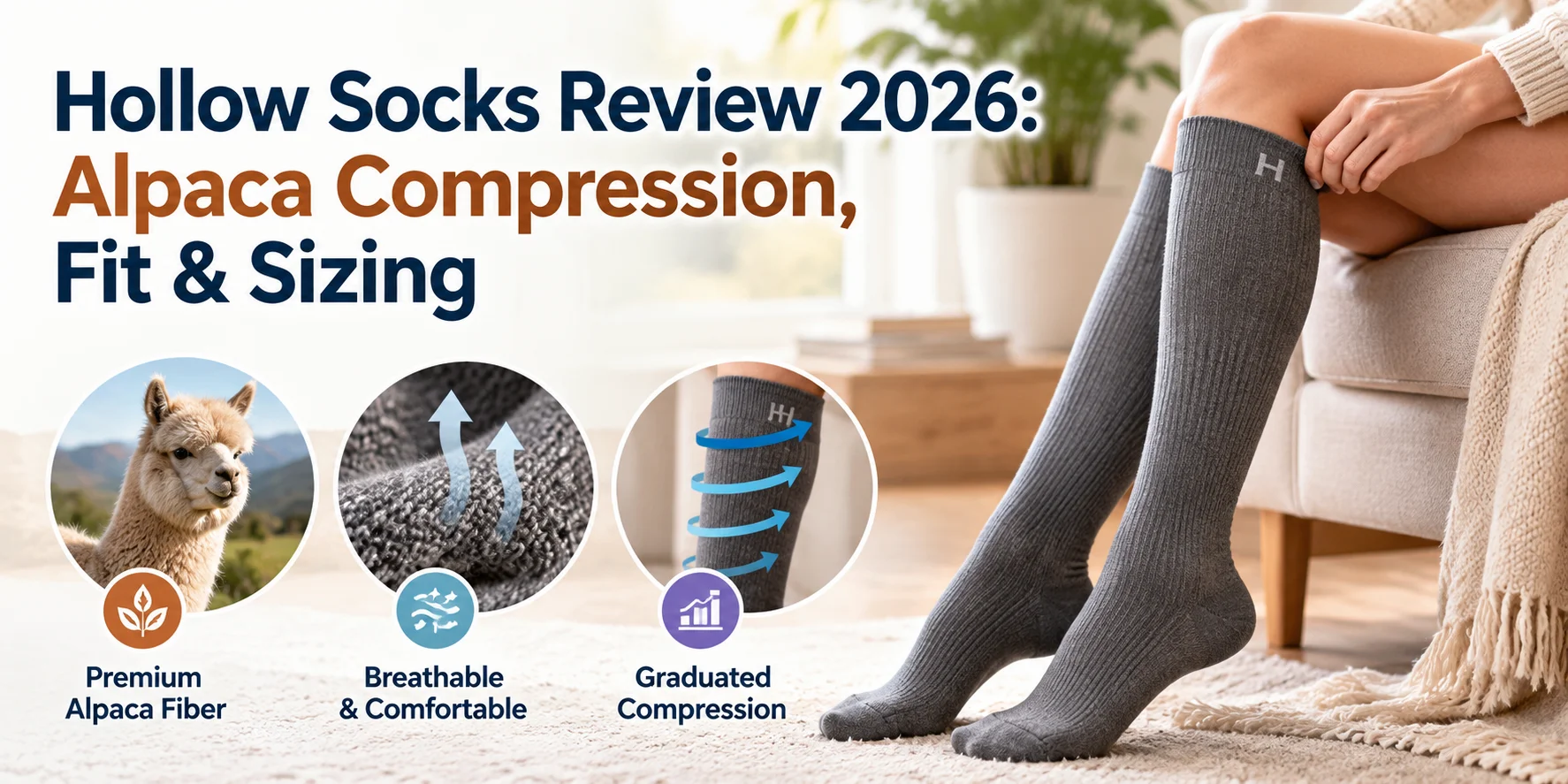
If you like compression socks but dislike the hot, synthetic feel of many traditional pairs, Hollow Socks are an unusual option: knee-high graduated compression made with a substantial amount of Peruvian alpaca fiber. The real buying question is whether Hollow’s 15–20 mmHg compression, calf sizing, fabric blend, and care requirements match how you plan to use them.
This Hollow Socks review focuses on the current Hollow Alpaca Compression Socks rather than the brand’s non-compression styles. It covers verified specifications, standard and wide-calf sizing, work and travel use, fit problems, safety limits, and alternatives.
Quick Answer: Are Hollow Compression Socks Good?
Hollow Compression Socks are a reasonable option for adults seeking everyday graduated compression with an alpaca-blend fabric and broad calf sizing. Hollow currently lists them at 15–20 mmHg, with pressure intended to be strongest near the ankle and decrease up the calf. Standard and wide widths are available, and the published wide-calf chart reaches a 24-inch maximum stretch in XL.
Their biggest differentiator is material, not stronger compression. The standard version is listed as 48% imported Peruvian alpaca fiber, 47% stretch nylon, and 5% spandex; the wide version is 52% alpaca, 44% stretch nylon, and 4% spandex. Hollow says the socks are made in the United States with imported yarn and recommends cold washing and hang drying.
They are not automatically appropriate for unexplained swelling, significant vascular disease, neuropathy, wounds, or anyone prescribed a specific compression level. Those situations call for medical guidance rather than brand claims.
Hollow Compression Socks at a Glance
| Feature | Current Hollow specification |
|---|---|
| Compression | 15–20 mmHg graduated compression |
| Length | Knee-high |
| Standard material | 48% Peruvian alpaca, 47% stretch nylon, 5% spandex |
| Wide material | 52% Peruvian alpaca, 44% stretch nylon, 4% spandex |
| Widths | Standard and wide |
| Shoe sizes | Women’s 4–13; men’s 6–15 across listed sizes |
| Standard calf max stretch | 14–20 inches, depending on size |
| Wide calf max stretch | 18–24 inches, depending on size |
| Manufacturing | Made in USA with imported yarn |
| Care | Wash cold; hang dry recommended |
| Guarantee | 99-day money-back guarantee |
These are manufacturer specifications, not independent clinical findings. Hollow also markets benefits such as swelling relief, temperature control, staying up, and easier donning. General compression effects can be supported by medical evidence; product-specific comfort outcomes still depend on fit and the individual.
How Hollow’s 15–20 mmHg Graduated Compression Works
Graduated compression applies more external pressure around the lower leg, especially near the ankle, and less pressure higher up. Properly fitted compression can help limit blood pooling and fluid accumulation and support venous return.
MedlinePlus describes compression stockings as gently squeezing the legs to move blood upward, while Cleveland Clinic notes that compression can help prevent blood and fluid from pooling in the feet, ankles, and legs.
Hollow’s 15–20 mmHg range is lighter than 20–30 mmHg and higher-pressure options. Cleveland Clinic broadly categorizes less than 20 mmHg as low compression while noting there is no single universal rating scale across all products.
That positions Hollow mainly as everyday compression, not a substitute for clinician-selected medical hosiery. Stronger is not automatically better; appropriate pressure depends on the reason for compression, arterial circulation, symptoms, fit, and medical history.
Can 15–20 mmHg Help Swelling or Tired, Heavy Legs?
It may help some people, particularly when symptoms are associated with prolonged sitting, standing, or venous pooling. But the cause of swelling matters. New, one-sided, painful, severe, or unexplained swelling should not be treated as a simple sock-selection problem.
Evidence also varies by diagnosis. A Cochrane review of compression stockings as initial treatment for uncomplicated varicose veins found low-to-very-low-certainty evidence and could not determine an optimal pressure or stocking length. That is a useful reason to avoid promising the same outcome for every condition.
Alpaca Compression Socks: What the Material Changes

Hollow’s defining feature is alpaca fiber. Alpaca fibers can be medullated, meaning some contain a central medulla; textile research confirms medullation is a characteristic feature of alpaca fiber, although it varies with fiber diameter and type.
Hollow is not a pure alpaca sock. Nylon adds structure and durability, while spandex supports elasticity and compression. The alpaca component mainly changes feel and thermal/moisture characteristics.
Hollow markets the blend as temperature regulating, breathable, moisture wicking, soft, and odor resistant. Treat those as product attributes rather than guarantees that feet will never sweat, smell, or feel hot. Comfort depends on the whole knit, sock thickness, shoe ventilation, activity, weather, and the wearer.
Alpaca vs Merino Wool
Neither alpaca nor merino is universally better. Alpaca can feel soft and lightweight; merino is also widely used in performance footwear.
Buyers who dislike heavily synthetic compression may appreciate Hollow’s high alpaca content. Those who already prefer merino can find 15–20 mmHg options from brands such as Bombas and Sockwell.
Hollow Socks Sizing: Calf Circumference Matters

For knee-high compression, shoe size alone is not enough. A sock may fit the foot but still be too tight around the calf, too long behind the knee, or too loose to maintain its intended pressure.
Hollow’s current chart lists:
| Size | Men’s shoe | Women’s shoe | Standard calf max | Wide calf max |
|---|---|---|---|---|
| Small | — | 4–6.5 | 14 in | 18 in |
| Medium | 6–9 | 7–9.5 | 16 in | 20 in |
| Large | 9.5–12 | 10–13 | 18 in | 22 in |
| XL | 12.5–15 | — | 20 in | 24 in |
The calf figure is a maximum stretch, not an ideal-calf target. Start with shoe size, then make sure your calf fits that size and width. If your foot points to Large but your calf exceeds the standard Large limit, compare the wide Large rather than simply sizing up to XL.
For 18-, 20-, 22-, or 24-inch calves, use both measurements. A 20-inch calf, for example, reaches the published standard XL maximum and wide Medium maximum, but neither option is appropriate unless the foot size also matches. A number at the chart’s limit does not guarantee comfort.
Measure the widest part of the calf while standing naturally. If swelling is persistent or medically significant, professional fitting may be more appropriate than relying on off-the-shelf maximum stretch.
How Hollow Compression Socks Should Fit

A good fit should feel snug and supportive without focal pain. The fabric should lie smooth from ankle to knee. Wrinkles, bunching, or folding the cuff can concentrate pressure.
Useful fit clues:
- Rolling at the top: may mean the cuff sits on a wider part of the leg, the sock is too short or tight, or the top has been folded.
- Painful deep marks: persistent grooves, discoloration, numbness, or tingling are not a desirable compression effect.
- Bunching behind the knee: the sock may be too long or pulled too high.
- Sliding down: the width may be too generous, the garment may be worn out, or it may not be distributed evenly.
- Toe or foot pressure: check that the sock and shoe together are not crowding the foot.
Cleveland Clinic advises keeping compression stockings free of wrinkles and bunching and not folding the top over.
Who May Benefit Most From Hollow Socks?
Standing Jobs: Nurses, Teachers, and Healthcare Workers
People who stand through long shifts are a natural audience for everyday compression. Hollow’s 15–20 mmHg level may suit those looking for lighter support, while the alpaca blend may appeal to workers bothered by heat or moisture inside shoes.
Compression cannot correct poor footwear or an underlying vascular problem, but it can be part of a broader comfort strategy.
Sitting and Office Work
Long periods of sitting reduce calf-muscle activity and can encourage lower-leg pooling. Compression may provide external support, but movement still matters.
Short walks, ankle movement, and position changes remain useful habits rather than something compression socks replace.
Travel and Flying
The CDC advises frequent leg movement on long trips and says some travelers at increased risk for blood clots may benefit from graduated compression stockings after discussing prevention with a doctor.
A systematic review of air-travel trials found high-quality evidence for reducing travel-related leg edema and moderate-quality evidence for reducing venous thromboembolism with graduated compression stockings. That evidence concerns the product category, not a clinical trial proving Hollow specifically prevents DVT.
Walking, Exercise, and Recovery
Hollow can be worn for walking or ordinary activity if it fits comfortably.
If your main goal is running performance or post-exercise recovery, compare sport-specific socks with targeted cushioning, lighter knits, or different compression levels rather than assuming an everyday pair is ideal.
Hot Weather, Winter, and Sweaty Feet
Hollow is marketed for year-round comfort, and alpaca is likely to attract people who find synthetic compression hot. The blend may help with moisture and temperature comfort, but shoe ventilation and activity still strongly influence how dry or warm your feet feel.
In winter, insulation may be welcome. In summer, focus on the complete sock-and-shoe system rather than assuming any fiber is automatically cool.
For sweaty feet, moisture handling can improve comfort, but recurrent fungal problems or excessive sweating are separate concerns a sock should not be claimed to cure.
Hollow Socks vs Wellow, Bombas, Comrad, and Sockwell
| Brand | Current compression options | Material emphasis | Main reason to compare |
|---|---|---|---|
| Hollow | 15–20 mmHg | Alpaca/nylon/spandex | High alpaca content; wide-calf chart to 24-inch max |
| Wellow | 18–25 mmHg Signature | Bamboo-derived viscose blend | Soft everyday feel with somewhat stronger moderate compression |
| Bombas | 15–20 and 20–30 mmHg lines | Cotton, merino, or synthetic by model | More material and pressure choices |
| Comrad | 15–20 and 20–30 mmHg knee-highs | Many nylon-based styles | Broad sizing and multiple pressure levels |
| Sockwell | 15–20 and 20–30 mmHg lifestyle styles | Merino/bamboo-rayon blends | Merino-focused compression and many styles |
Wellow currently lists its Signature socks at 18–25 mmHg with 63% viscose made from bamboo. Comrad lists 15–20 and 20–30 mmHg knee-highs. Sockwell’s lifestyle line and Bombas both offer 15–20 and 20–30 mmHg choices.
Hollow makes the strongest case when alpaca feel and wide-calf capacity are priorities. Another brand may suit you better if you want firmer compression, a different fiber, or sport-specific construction.
Hollow Socks Pros and Cons
Pros
- 15–20 mmHg graduated compression.
- High alpaca content compared with many mainstream compression socks.
- Standard and wide widths.
- Wide-calf maximum stretch up to 24 inches.
- Made in the USA with imported Peruvian alpaca yarn.
- 99-day money-back guarantee.
Cons
- One main compression range may not suit people needing firmer support.
- Alpaca-blend pricing can be higher than basic synthetic socks.
- Maximum-stretch sizing does not guarantee ideal fit at the limit.
- “Easy on/off,” “no marks,” and “stays up” are individual outcomes.
- Not a substitute for prescription compression or evaluation of unexplained swelling.
Safety: Who Should Ask Before Using Compression?
Compression is not appropriate to self-select for every leg problem. An international consensus statement warns that severe peripheral arterial occlusive disease can make sustained medical compression unsafe and recommends arterial assessment when poor circulation is suspected. It also notes additional risks in some people with neuropathy, fragile skin, or other local conditions.
Ask a healthcare professional before using compression if you have diagnosed peripheral artery disease, significant loss of sensation, active wounds or infection, severe or rapidly worsening swelling, heart failure with swelling, a recent or suspected blood clot, or another significant vascular condition.
For diabetes, do not assume compression socks and diabetic socks are interchangeable. Neuropathy, skin integrity, arterial circulation, edema, and treatment goals can change what is appropriate.
Seek prompt medical care for new one-sided swelling with pain, warmth, or redness, and urgent care for chest pain, unexplained shortness of breath, coughing blood, or fainting because these can be signs of a blood clot complication.
Wearing and Washing Hollow Socks
Put compression socks on when your legs are relatively less swollen, often earlier in the day. Position the heel correctly, then smooth the fabric upward rather than pulling hard on the cuff. Do not fold the top.
For general daytime compression, stockings are commonly worn while awake and removed for sleep unless a healthcare professional gives different instructions.
Hollow recommends cold washing and hang drying. The company says machine washing and drying tests showed no damage, but air drying remains its stated recommendation and is the conservative choice for preserving elasticity.
Replace compression socks when they become permanently loose, damaged, stretched out, or no longer stay positioned as intended.
Buying Guide: Are Hollow Socks Worth It for You?
Hollow is easiest to justify when four things line up: you want 15–20 mmHg compression, prefer an alpaca-based fabric, fit within the shoe-and-calf chart, and want an everyday knee-high rather than sport-specific or stronger medical compression.
Before buying, check:
- Purpose: daily comfort, work, travel, or clinician-directed use?
- Compression: is 15–20 mmHg appropriate for that purpose?
- Calf: does standard or wide match your measurement?
- Foot: does the same size also match your shoe size?
- Length: will the knee-high sit below the knee without bunching?
- Material: do you prefer alpaca over merino, bamboo-derived viscose, cotton, or synthetics?
- Care: are you willing to cold wash and preferably air dry?
- Medical context: is there a reason to ask a clinician before starting compression?
Those questions are more useful than review stars alone.
Frequently Asked Questions
What Compression Level Are Hollow Compression Socks?
The current model is listed at 15–20 mmHg graduated compression.
Are Hollow Socks Really Alpaca?
Yes. The compression sock uses imported Peruvian alpaca blended with stretch yarns. Hollow lists 48% alpaca in standard width and 52% in wide.
Are Hollow Socks Made in the USA?
Hollow says its compression socks are made in the United States with imported yarn, including Peruvian alpaca fiber.
Do Hollow Socks Fit Wide Calves?
Yes. The published wide-calf chart ranges from an 18-inch maximum stretch in Small to 24 inches in XL. Match calf and shoe size together.
Do Hollow Compression Socks Leave Marks or Roll Down?
Hollow markets a non-binding, stay-up design, but zero marks or rolling cannot be guaranteed. Painful indentations, numbness, persistent discoloration, or repeated bunching suggest a fit problem.
Are Hollow Compression Socks Easy to Put On?
They may be easier for some people than firmer stockings, but hand strength, mobility, swelling, size, and compression level all affect donning difficulty.
Can You Wear Hollow Socks All Day?
Many people wear lower-pressure compression during daytime hours, but wear time should match your reason for using it and your health status.
Stop and seek advice if you develop pain, numbness, concerning color changes, or worsening symptoms.
Can You Sleep in Hollow Compression Socks?
Do not assume daytime compression should continue overnight. General guidance commonly recommends wearing compression stockings while awake unless a healthcare professional gives different instructions.
How Should You Wash Hollow Socks?
Hollow recommends cold washing and hang drying.
Where Can You Buy Hollow Compression Socks?
The official Hollow website is the most direct source for the current size chart, widths, care instructions, and guarantee. On marketplaces, verify the seller and confirm that specifications match the current model.
Final Takeaway
Hollow Socks stand out by combining 15–20 mmHg graduated compression with a high-percentage alpaca blend and a broad published wide-calf range. They are most interesting for everyday work, travel, prolonged sitting or standing, and buyers who dislike predominantly synthetic compression socks.
Their limitation is just as clear: Hollow is an everyday 15–20 mmHg product, not a universal answer for edema, vascular disease, neuropathy, DVT, or medically prescribed compression. Fit matters more than branding, and calf circumference should be checked alongside shoe size.
If the pressure is appropriate for your needs and the chart matches your measurements, Hollow offers a distinctive material choice. If you need firmer compression, another fiber, sport-specific construction, or clinician-fitted hosiery, compare alternatives rather than forcing one sock to do every job.
Medical information notice: This article provides general educational information and is not a substitute for individualized medical advice. If you have diagnosed vascular disease, significant or unexplained swelling, loss of sensation, wounds, or another medical concern, ask a qualified healthcare professional what type of compression, if any, is appropriate for you.
Sources & Medical References
- Hollow Socks — official Alpaca Compression Socks product information: current compression level, materials, standard/wide sizing, manufacturing, care instructions, and guarantee.
- MedlinePlus — Compression Stockings: general explanation of graduated compression, blood flow, swelling, and proper use.
- Cleveland Clinic — Compression Therapy: compression mechanisms, pressure ranges, fit, daytime use, risks, and common clinical applications.
- CDC — Blood Clots and Travel: travel-related DVT risk, movement recommendations, warning symptoms, and graduated compression guidance for people at increased risk.
- International consensus statement on medical compression: risks, contraindications, peripheral arterial disease, neuropathy, and safe compression use.
- Systematic review of graduated compression during air travel: evidence regarding travel-related edema and venous thromboembolism.
- Cochrane review of compression stockings for varicose veins: evidence quality, symptom outcomes, and uncertainty around optimal compression pressure and length.
- Alpaca-fiber research: evidence concerning fiber medullation and structural characteristics.

1 thought on “Hollow Socks Review 2026: Alpaca Compression, Fit & Sizing”